





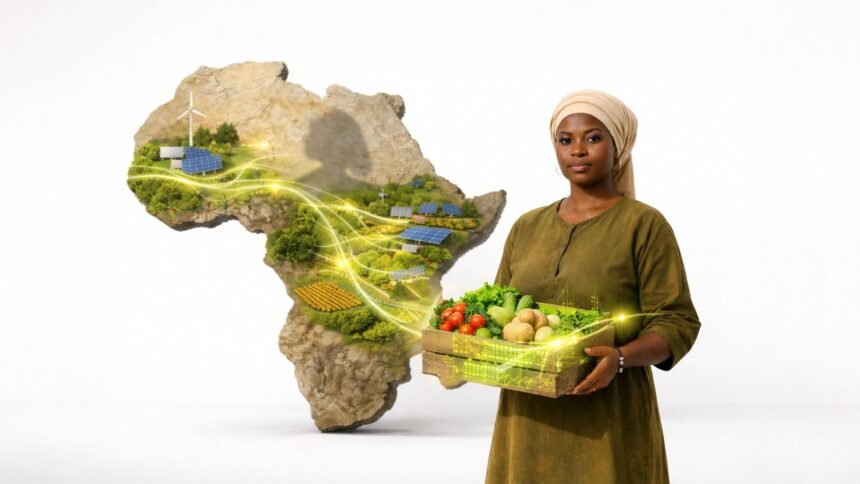
Abuja International Conference Center has hosted summits on trade, peace, and continental integration. In late April, it will host something rarer: a room where the architects of Africa’s green economy are mostly women.
From April 29 to May 1, thousands of founders, policymakers, and investors will gather for the Global African Women’s Sustainability Conference 2.0, co-convened by the African Union and the non-profit ImpactHER, a fully sponsored platform designed to move women from the margins of climate finance to its center.
The gathering, fully sponsored to lower financial barriers, is framed as an “engine room” rather than a talking shop: a place where women of African descent, from Abuja and Accra to London, Toronto, and Dubai, can secure advisory support, export‑readiness training, and grants of up to 5,000–10,000 dollars to scale sustainability‑driven enterprises.
It sits at the intersection of two powerful trends that are often treated separately: the rise of African women entrepreneurs in climate and green sectors, and the growing role of African women in the diaspora as investors, knowledge brokers, and policy advocates shaping the continent’s transition.
This story matters now because African women are stepping into a decisive leadership gap in sustainability and climate action amid a broader continental push to align green growth, climate finance, and industrial policy on African terms.
From Policy Language to Real Power
For more than a decade, African leaders and institutions have presented the green transition as both an existential challenge and a rare opportunity to rewire economies.
Yet in climate negotiations, energy transition task forces, and carbon market deals, the most visible power brokers remain overwhelmingly male, even as women shoulder much of the daily burden of climate impacts in agriculture, water, and informal urban economies.
National climate strategies increasingly reference gender, but the leap from policy language to who designs, finances, and leads real projects is far from complete.
The Global African Women’s Sustainability Conference 2.0 is designed to close part of that gap. Hosted by ImpactHER, an AU‑recognized SME support organization that has trained nearly 200,000 female entrepreneurs across all 54 African countries, the conference builds on earlier “green conference” editions while raising the stakes and the scale.
Under the 2026 theme “Rethink, Reinvent, Regenerate: Women Entrepreneurs as Architects of Global Africa’s Sustainable Future,” organizers are explicit: this is not about adding a gender paragraph to climate plans; it is about positioning women as architects of green industrialization itself.
The stakes are high. If women‑led enterprises can leverage this platform to access capital, shape regulation, and embed themselves in regional value chains, from solar cold storage to circular waste systems and climate‑smart agriculture, Africa’s sustainability model could tilt toward solutions grounded in daily realities rather than in distant baselines.
If they cannot, the continent risks repeating a familiar pattern: impressive declarations in Addis Ababa or Dubai while those closest to climate impacts remain implementers without real power.
Similar experiments are emerging elsewhere. In Kenya, regionally backed leadership programs are elevating women at the frontlines of adaptation, especially in agrifood systems.
In West and Central Africa, funds associated with regional initiatives have provided nearly 4 million dollars to almost 800 women‑led businesses, many in green and resilience sectors, testing whether modest grants and mentorship can spark broader ecosystem change.
Abuja’s conference is not a one‑off event; it is becoming a key node in an emerging, women‑led infrastructure of sustainability across the continent.
Ground-Level Realities
On the ground, the agenda can sound abstract, eco‑financing, green industrialization, but the realities are concrete. A Nigerian founder preparing to attend GAWSC 2.0 runs a solar‑powered cold storage service for vegetable markets on Abuja’s outskirts.
Like many of her peers, she has grown the business through a patchwork of small grants, family remittances, and a diaspora angel investor in Toronto, while formal banks remain wary of her lack of collateral and unconventional business model.
For her, sustainability is not a branding exercise; it is the difference between losing a harvest in a heatwave and preserving income for dozens of smallholder suppliers.
In Accra’s Madina, Nairobi’s Kibera, and Dakar’s Pikine, women’s cooperatives are experimenting with climate‑smart agriculture, urban gardening, and waste‑to‑compost schemes that rarely appear on official climate-project lists.
Their methods, locally improvised drip systems, community‑run recycling hubs, and solar kiosks providing cold storage and phone charging, do not always fit donors’ templates. Still, they respond directly to erratic rains, flooding, and heat.
A quietly revelatory pattern emerges: in many African neighborhoods, the frontline of climate policy is not a ministry building, but a women’s savings group that has turned its pooled capital into small‑scale infrastructure.
The design of GAWSC 2.0 acknowledges this reality. The Abuja event will combine high‑level panels on green economy financing with advisory clinics, sector‑specific masterclasses, and export‑readiness labs where participants refine business models and documentation to meet regulatory and market requirements.
Selected entrepreneurs will compete for sustainability grants of up to 5,000 dollars from ImpactHER and partner schemes. In comparison, other calls promote opportunities of up to 10,000 dollars, particularly for businesses with strong climate or social impact.
The expectation is not that every attendee walks away with funding, but that a significant cohort of women‑led firms will leave with clear next steps: investor leads, refined pitch decks, export contacts, and a realistic roadmap to scale.
Diaspora women are central to this plan. The conference explicitly targets entrepreneurs operating within or outside Africa, as well as women of African descent with active or emerging businesses.
In practice, that means founders based in London or Dubai building African‑linked sustainable brands, diaspora professionals in climate finance scouting for investable projects, and policy experts who can help translate local innovations into regulatory language.
In Abuja, they will sit not only on stages but also at deal tables, negotiating manufacturing partnerships, export arrangements, and co‑investment vehicles that bridge African cities and diaspora markets.
The solutions on offer are therefore layered. At one level, GAWSC 2.0 promises immediate benefits: sponsored travel and accommodation to reduce cost barriers, direct mentorship, and the possibility of catalytic grants.
At another level, it aims to build a durable network of women who can support each other beyond the three days—sharing term sheets, supplier contacts, and cautionary tales about predatory contracts or unsuitable investors.
The underlying bet is that women already running climate‑relevant businesses need less “empowerment” than a more level playing field.
Rules Written for the Wrong Room
Behind the optimism, the policy terrain remains uneven. Across Africa, climate and energy strategies increasingly reference gender equality, yet budget allocations, procurement criteria, and lending rules still privilege large, often male‑dominated incumbents.
Ministries of finance and central banks may endorse women‑focused SME programs, but collateral requirements and credit scoring systems rarely recognize informal savings groups, communal land tenure, or hybrid revenue models that sustain many women‑led ventures.
The result is a structural contradiction: policy documents imagine inclusive green growth, while the financial system’s operating rules keep that inclusion aspirational.
African institutions are beginning to push against this. Development finance institutions and regional programs are rolling out dedicated gender and green windows, offering guarantees and blended finance to de‑risk lending to women‑led SMEs.
ImpactHER’s own record, supporting around and unlocking or influencing an estimated 800 million dollars in potential funding, shows how targeted technical support can move women closer to bankability, even before rules change.
The AU’s decision to co‑host GAWSC 2.0 and publicly back a fully sponsored model indicates that continental bodies now see women‑led sustainability as core to economic transformation, not an add‑on to social policy.
The diaspora complicates these fault lines in useful ways. Women of African descent working inside multilateral banks, climate funds, and corporate sustainability offices are increasingly using their positions to advocate for risk metrics and reporting standards that better reflect African realities—recognizing, for example, community ownership, informal resilience strategies, and blended revenue streams as indicators of strength rather than risk.
At the same time, they must navigate pressure to apply global ESG templates that can overwhelm smaller firms with compliance requirements or undervalue locally appropriate technologies. The conversation in Abuja is therefore not just North versus South, but a negotiation between different visions of what counts as credible, scalable sustainability.
In this context, the most significant outcomes of GAWSC 2.0 may be political as much as financial. If the coalition that assembles in Abuja can translate its momentum into concrete proposals for national climate plans, procurement reforms, and regional green industrial strategies—such as earmarking portions of public tenders and concessional finance for women‑led, climate‑relevant SMEs—it could hard‑wire women’s leadership into the rules of Africa’s transition.
Conversely, if the energy dissipates after May 1 into a handful of success stories and social‑media highlights, the structures that keep women’s solutions at the margins of climate finance will remain largely untouched.
As Abuja prepares to host founders from Lagos, Kigali, Nairobi, Accra, Johannesburg, and diaspora hubs from Berlin to Dubai, one strategic question hangs over the banners and speaker announcements:
will African governments and their global partners move fast enough to redesign climate finance and industrial policy so that the women already reinventing sustainability on the ground, at home and across the diaspora, are treated not as inspirational side stories, but as central planners of Africa’s green future?