



The Pan-African Paradigm of Indigenous Displacement and Structural Neglect
“We are simply asking for peace so that we, the first inhabitants, can return to our forests,” John Mangese’s plea, offered from a makeshift camp in Boikene where he now sleeps on bare ground, distills a crisis that indigenous communities across the continent have voiced for generations: displacement does not merely relocate a people; it severs them from the ecological and economic systems their identity is built upon. Since May 2026, families from the Indigenous Pygmy community of eastern Democratic Republic of Congo have lived in Boikene, in the northern part of Beni, after fleeing attacks attributed to the Allied Democratic Forces in the Ndandi area. Their displacement compounds the marginalization these communities already faced before the latest violence, and it lands them in a region simultaneously battling an active Ebola outbreak, a convergence of crises that leaves an already vulnerable population doubly exposed. Their situation demands the continent confront what genuine protection for indigenous peoples requires when conflict, disease and institutional neglect arrive together, and whether the language of humanitarian response can translate into structural change rather than temporary charity.
Fleeing the Ndandi Attacks
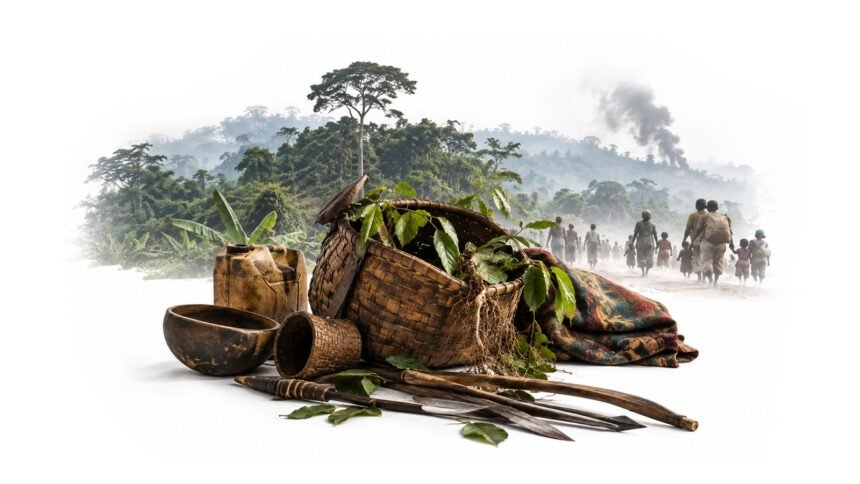
The families now sheltering in Boikene left their homes in the Ndandi area following assaults they attribute to ADF rebels, a group whose activity has destabilized parts of eastern Congo for years. Paul Nguka, among the displaced, described the urgency starkly: “The attackers killed some people and took others into the forest. We could no longer stay there.” Some residents left without their belongings, fleeing amid killings and abductions they witnessed directly. Apolline Apusome, another displaced resident, described the resulting conditions in Boikene bluntly: “We have no roof, we sleep on the ground, without blankets or any protection.” The forced departure was not merely a loss of physical shelter but a rupture from the forest itself, which for this community functioned as the foundation of subsistence through hunting, gathering, and generations of accumulated ecological knowledge.
Life Severed From Its Economic Base
For communities whose livelihoods were built around forest resources, displacement to an unfamiliar urban-adjacent environment represents more than logistical hardship; it is the loss of an entire economic system. Families in Boikene now depend almost entirely on outside assistance for food, clothing, water and healthcare, having lost the hunting and gathering economy that sustained them for generations. Site officials report at least five deaths already recorded among the displaced population since arrival, attributable to the lack of resources and the precariousness of makeshift shelter. Jereve Maneno, an activist with the rights group LUCHA, described the conditions plainly as “inhumane” and called on the international community to act. The lack of durable housing, sanitation, or reliable food distribution in Boikene shows how humanitarian response mechanisms, when underfunded or slow to mobilize, leave displaced indigenous populations disproportionately exposed compared with other displaced groups with stronger institutional advocacy.
An Outbreak Compounding an Emergency
The Beni region’s ongoing Ebola outbreak adds a further, acute layer of risk to a population already living without adequate shelter or sanitation. Displaced families in Boikene face constrained access to healthcare and essential services precisely as the virus continues circulating in the surrounding area, a convergence that public health responders have flagged as particularly dangerous for population groups living in close, unsanitary conditions. The overlapping crises, armed displacement and epidemic disease, illustrate how conflict-driven displacement rarely arrives as a single, contained emergency; it tends to compound whatever structural vulnerabilities already existed, with communities lacking political leverage bearing the heaviest cumulative burden.
Marginalization Predating the Latest Crisis
The Pygmy community’s current suffering did not begin with the Ndandi attacks; it built upon decades of marginalization that has left indigenous forest communities across the DRC and the wider Congo Basin with limited land rights, minimal representation in local governance, and chronic underinvestment in the social services other Congolese communities can access more readily. This pattern echoes similar dynamics affecting indigenous groups elsewhere on the continent, from Cameroon’s forest communities to Southern Africa’s San peoples, where structural exclusion from formal land tenure and political recognition leaves these populations acutely exposed whenever conflict or environmental shock strikes. Human rights defenders monitoring the Boikene camp have called for a stronger humanitarian response specifically calibrated to this community’s particular vulnerabilities, rather than generic displacement programming that overlooks their distinct relationship to forest-based subsistence.
Toward a Sovereignty That Includes the Displaced
The Boikene camp stands as a stark test of whether the continent’s evolving human rights architecture genuinely extends to its most marginalized and least politically visible populations. A durable response would mean not just emergency shelter and food. It would also mean a pathway back to the forest lands these families depended upon, alongside recognition of indigenous land rights that predate the current conflict. Until then, families like Mangese’s remain suspended between a violent present and an uncertain return, their hope for reclaiming their forest homeland a measure of how far institutional accountability for indigenous displacement still has to travel across the continent.