




The Pan-African Paradigm of Infrastructure Autonomy and Digital Non-Alignment
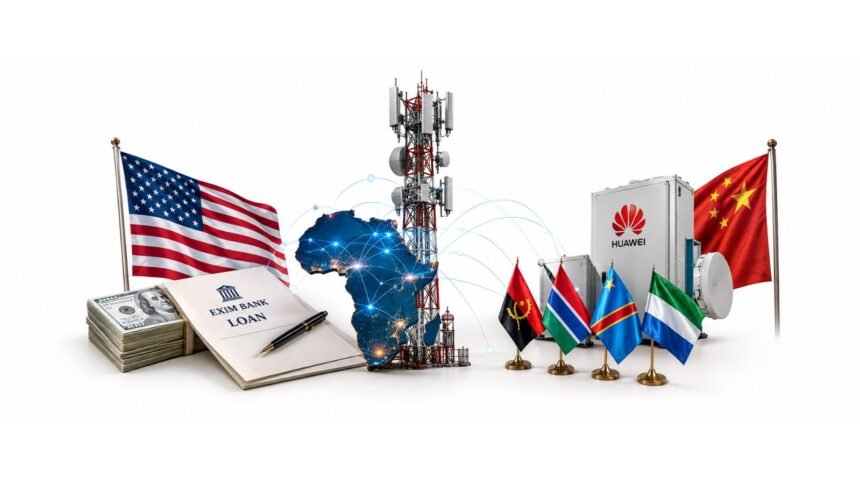
Nearly $100 million, routed through an American export-credit bank to a single telecoms operator serving four African markets, is a modest sum by the standards of continental infrastructure financing. Yet, it arrives freighted with a much larger argument about who African states should trust to carry their data. The loan the US Export-Import Bank extended to Africell this week is not merely a commercial transaction; it is the latest data point in a structural contest over digital sovereignty, waged largely without African governments at the table, between Washington and Beijing. For Angola, The Gambia, the Democratic Republic of Congo and Sierra Leone, the four markets where Africell’s fifteen million subscribers make their calls, move their money and reach the internet, the outcome of that contest will shape the underlying architecture of connectivity for a generation. The Pan-African question is not simply whether Huawei’s equipment is more affordable, which it typically is, but whether the continent can build genuine institutional capacity to weigh these offers on its own terms, rather than serving as a proxy battlefield in a rivalry it did not choose. Reclaiming that agency begins with treating infrastructure financing as a matter of strategic self-determination, not a footnote in someone else’s geopolitical ledger.
A Bank, Not a Gift: The Mechanics of the EXIM Loan
The mechanics of the deal are straightforward even if its politics are not. The US Export-Import Bank will lend Africell close to $100 million so the operator can, in the words of the release announcing it, invest in the latest mobile network technology from American and allied suppliers. Africell Holding’s chief executive, Ziad Dalloul, framed the arrangement as a partnership rather than a bailout, saying the company was pleased to work with EXIM to introduce more trusted and secure communications infrastructure across its operating markets. That language of trust and security is doing quiet structural work: it recasts a financing instrument as a values statement, positioning Africell, Africa’s only American-owned telecoms firm, as a demonstration case for what a non-Huawei network buildout can look like on the continent, and for whom the financing architecture is ultimately designed to benefit.
Huawei’s Shadow: Fifty-Two Percent and the Weight of Incumbency
Any American financing pitch on African telecoms infrastructure has to be read against the scale of the incumbent it is trying to displace. Huawei holds roughly 52% market share of 5G infrastructure across the continent, according to Counterpoint Research, a dominance built over more than a decade of aggressive pricing, financing and after-sales support that Western competitors have struggled to match. The Trump administration’s loan follows through on a 2025 executive order directing US agencies to promote American technology abroad across artificial intelligence, cloud services, data storage and networking. It continues a “clean network” campaign first launched in Trump’s initial term to purge Chinese telecoms equipment from allied infrastructure. Washington has paired that campaign with heavy sanctions on Huawei over allegations that its equipment could be used for surveillance, allegations the company has consistently denied, and which it did not respond to requests to address directly in relation to this loan.
Beijing’s Rebuttal: Growth, Welcome, and the Accusation of Undermining
China’s embassy in Washington did not let the announcement pass without a rejoinder, arguing that Chinese investment across Africa has driven growth and been welcomed by the residents who benefit from it, and urging the United States to do more to support other countries’ development rather than what it characterized as pursuing an Africa agenda aimed at undermining China-Africa cooperation. The framing echoes a warning delivered years earlier by Wendy Sherman, then US deputy secretary of state under Joe Biden, who told Africell’s Angola office in 2022 that countries choosing Huawei were potentially surrendering their sovereignty by handing their data to another country. Both governments, in other words, are making a sovereignty argument against the other—a rhetorical symmetry that leaves the African institutions meant to adjudicate the trade-off largely absent from the conversation, reduced to hosts of a contest scripted elsewhere.
Fifteen Million Subscribers, Four Markets, One Recurring Bet
This is not Washington’s first wager on Africell. Founded in 2001 and built on technology from HP, Nokia, Dell and Oracle among others, the operator received a $100 million loan in 2018 from the Overseas Private Investment Corporation, the precursor to today’s International Development Finance Corporation, to expand its communications infrastructure, and has since built a data center in Angola to anchor its regional operations. The recurrence of American state financing for the same private operator, nearly a decade apart, suggests less a single transaction than an emerging pattern: Washington identifying a small number of trusted continental partners and channeling repeated rounds of concessional capital through them, rather than building broader, more diffuse financing relationships with African-owned carriers or regional development institutions that might carry the sovereignty argument further.
Structural Sovereignty in the Age of Great-Power Telecom Competition
What Africell’s borrowers and subscribers ultimately inherit from this contest is neither purely American nor purely Chinese network architecture, but the terms of a rivalry conducted mostly over their heads. The path toward genuine structural sovereignty runs through continental institutions, regional regulators, the African Union’s digital strategy bodies, or bodies like Smart Africa, building independent technical capacity to evaluate network equipment, financing terms, and data-governance implications on criteria African governments set themselves, rather than inheriting the binary of Washington versus Beijing as the only available choice. Until that capacity matures, loans like this one will keep arriving dressed as partnership while functioning as leverage, and the paradigm of digital non-alignment will remain more aspiration than institutional reality. Reclaiming it is a slower project than any single loan, but it is the only one that ends with African states, rather than their financiers, deciding who builds their networks.