




The Pan-African Paradigm of Digital Self-Determination and Democratic Integrity
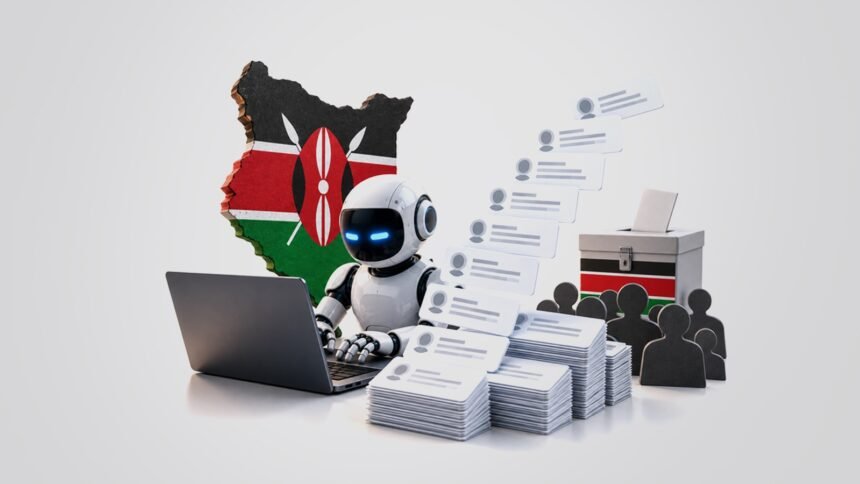
What does it take to make a coordinated political campaign look like the spontaneous opinion of ordinary citizens? Increasingly, it takes little more than a chatbot and an operator willing to instruct it carefully. Anthropic’s disclosure that a single Kenyan actor used its Claude system to mass-produce social media posts ahead of the 2027 general election, content designed explicitly to mimic grassroots commentary rather than reveal itself as coordinated messaging, lands as an early warning shot for a continent whose democratic institutions are already contending with disinformation, ethnic mobilization and weak platform accountability. The Pan-African stakes here extend well beyond Kenya’s borders: as generative AI tools become cheaper and more capable, the barrier between a well-resourced political machine and a lone operator with a laptop collapses, and the information environments that African publics rely on to form political judgment become correspondingly easier to counterfeit. Reclaiming sovereignty over that information space, deciding, as a continent, what standards govern AI-assisted political speech, is no longer a hypothetical governance question but an urgent and immediate one.
Fifty at a Time: Inside the Mechanics of a Manufactured Campaign
Anthropic’s investigators traced the operation to a single actor generating Kenyan political content in disciplined batches of exactly fifty tweets, a cadence that itself betrayed the automation underneath the seemingly organic posts. The content followed a recognizable political architecture: many posts praised Energy Cabinet Secretary Opiyo Wandayi over a contentious Kenya Power tariff dispute, deploying hashtags such as #PowerReliefKE and #PoweringTheNewKenya to simulate a groundswell of public gratitude. Other batches pushed narratives that the United Opposition coalition was fracturing ahead of 2027, while specifically targeting former deputy president Rigathi Gachagua and former president Uhuru Kenyatta with critical messaging. The operator’s explicit instruction to Claude to make the output appear spontaneous rather than coordinated most clearly exposes the intent: this was not persuasion through argument but persuasion through counterfeit consensus.
A Playbook Without a Signature: What Anthropic Could and Could Not Prove
Anthropic carefully drew a line between what its evidence supports and what it merely suggests. The company said explicitly that it found no evidence of government involvement, describing the operation instead as consistent with what it called “an entirely domestic Kenyan operation.” At the same time, it noted that the network’s pro-administration tone and specific hashtag choices suggested a plausible alignment with the ruling coalition, without being able to identify the organization or individuals actually responsible. That gap between behavioral pattern and attributable responsibility is likely to become a recurring feature of AI-era political forensics across the continent: platforms and AI providers can increasingly detect that a coordinated operation exists, and can describe its apparent sympathies, while struggling to name who paid for it or directed it, leaving accountability structurally diffuse even as the technical evidence accumulates.
From Retail Ads to Political Talking Points: One Operator, Two Personas
Perhaps the most revealing structural detail in Anthropic’s report is that the same actor ran an almost identical workflow to market Kenyan retail brands under an entirely separate commercial persona, treating political messaging and product promotion as functionally the same production problem. The operator supplied the topics, talking points, and hashtags; Claude turned raw instructions into large volumes of platform-ready posts. As Anthropic put it, “the core ideological messages were completely decided by the actors before Claude was used,” a formulation that assigns responsibility for content squarely to the human operator while acknowledging that the AI tool supplied the scale that made mass production of political messaging economically trivial for a single individual.
Category One on the Breakout Scale, and a Continental Pattern Emerging
Anthropic classified the Kenyan network as Category One on its internal Breakout Scale, meaning the activity stayed contained within its own cluster of fake accounts and local influencers on a single platform, with no evidence that it reached or influenced real people. That containment is reassuring only in the narrowest sense, since Kenya is not an isolated case: OpenAI disrupted a comparable election-related AI operation in Ghana in January 2025, and Anthropic’s own report separately identifies an influence campaign targeting audiences in the Democratic Republic of Congo. Taken together, the three disclosures sketch a continental pattern rather than a series of unrelated incidents, in which AI-assisted political manufacturing is becoming a standard feature of electoral cycles from West to Central to East Africa well before most national regulatory frameworks have caught up with the technology.
Toward an African Standard for AI and Electoral Integrity
The structural lesson of Kenya’s case is not that AI companies are failing to police misuse; Anthropic’s own detection and disclosure argue against that reading, but that African electoral bodies, media regulators and civil society organizations largely lack independent capacity to detect these operations themselves, remaining dependent on voluntary disclosures from the same Silicon Valley firms building the underlying technology. A genuinely self-determined response would see the African Union, national electoral commissions and regional press-freedom bodies developing their own monitoring frameworks and disclosure requirements ahead of the 2027 cycle, rather than waiting for the next corporate transparency report to reveal what already happened. Sovereignty over the information space that shapes African democratic choices cannot be outsourced indefinitely to the goodwill of the companies whose tools make manufactured consent possible in the first place.