


From AMISOM to Aussom, Two Decades in Mogadishu
In 2007, Ugandan soldiers became the first African troops to land in Somalia under the new African Union Mission in Somalia, known as AMISOM. Their task was to protect a transitional government that controlled little beyond a few streets of Mogadishu against Islamist militants. Nearly twenty years later, Uganda has begun bringing them home.
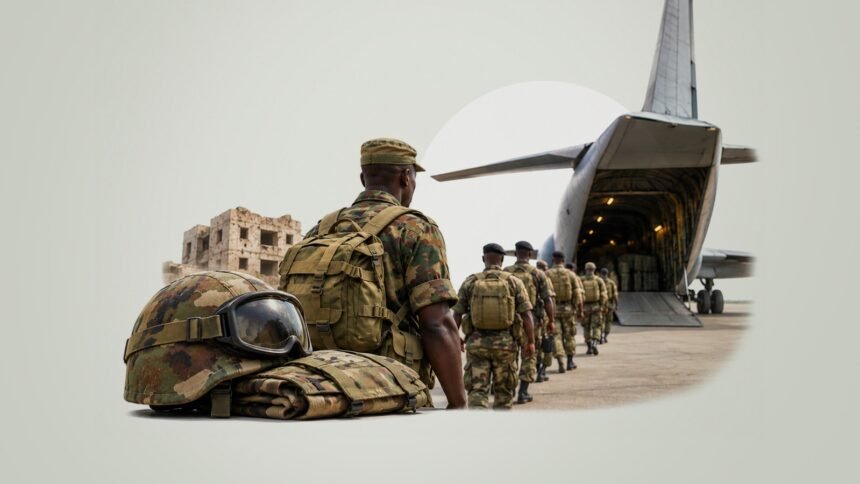
On Monday, Uganda’s acting army spokesperson, Chris Magezi, said the first group of troops deployed to Somalia under a bilateral arrangement with the Federal Government had already arrived back in Uganda, with others to follow within days. All Ugandan forces, including those serving under the current AU mission, are to leave by the end of 2027 in a phased withdrawal. A first contingent of 109 Uganda People’s Defense Forces (UPDF) soldiers is reported to have left Mogadishu on Friday.
The withdrawal marks a turning point for one of Africa’s longest and costliest collective security efforts, and it leaves Somalia facing its insurgency with less outside help and an uncertain funding picture.
What Uganda Built in Somalia
Uganda’s contribution was decisive. After the first deployment in 2007, Ugandan forces played a key role in driving al-Shabaab, the al-Qaeda-linked insurgency, out of Mogadishu and other major towns. They fought alongside the Somali National Army to recapture strategic territory and secure key government installations.
They also stayed through successive changes of mission. AMISOM gave way to the African Union Transition Mission in Somalia (ATMIS), which was meant to hand security responsibilities gradually to Somali forces. In 2025, ATMIS was replaced by the African Union Support and Stabilization Mission in Somalia (Aussom), focused on strengthening Somalia’s security institutions and preparing its forces to take full responsibility.
The UPDF’s own statement describes the exit as the end of Uganda’s “enduring 20-year peace and stabilization support operations in Somalia”, allowing the Somali armed forces to “assume full responsibility for security in the country”.
An Announcement on X, a Visit to Kampala
The decision was made public by Uganda’s army chief, Gen Muhoozi Kainerugaba, who said last week that Uganda had begun pulling out and would hand over security to Somali forces. “As we promised, we have started withdrawing UPDF from Somalia. After 20 years of a lot of blood and sacrifice, we are handing over security to our Somali brothers,” he wrote on X.
The timing is notable. The withdrawal follows a visit to Kampala last week by Somalia’s President Hassan Sheik Mohamud, who met President Yoweri Museveni to discuss Somalia’s security as well as trade and economic ties. The Somali president is reported to have sought to persuade Uganda to extend its military presence; that request has not been confirmed publicly by either government. In remarks during the visit, Museveni urged Somali leaders and citizens to unite in the fight against al-Shabab.
If Mogadishu did ask for more time, the answer appears to have been a schedule rather than an extension: bilateral troops out within days, AU contingents by the end of 2027.
The Numbers on the Ground
An estimated 4,500 troops are in Somalia under the AU mission, alongside about 2,000 deployed through bilateral arrangements. The published figures do not make it fully clear how many of each group are Ugandan. Still, Uganda has long been among the largest contributors, and the departure of its bilateral contingent alone removes a significant force from the field within days.
The bilateral troops matter because they serve under an agreement between Kampala and Mogadishu rather than under the AU mandate. Their withdrawal is immediate, while the AU contingent leaves more slowly. That sequencing gives Somali commanders little time to fill the gaps that the bilateral units leave behind.
A Mission Short of Money
Uganda’s exit comes as AU missions themselves face uncertainty over future funding, with plans to wind down United States and United Nations support. A 12-month transition plan is due to begin in January, giving Somalia and the AU time to look for alternative sources of money.
Funding has been the persistent weakness of African peace operations. Troop-contributing countries supply soldiers, but salaries, equipment and logistics have depended heavily on outside donors. When those donors retreat, contributors face a choice between bearing the costs themselves or withdrawing. Uganda’s decision should be read partly in that light.
Somalia’s security forces, meanwhile, are still fighting a prolonged insurgency that has lasted more than two decades. Recent heavy fighting with al-Shabab in Lower Shabelle shows that the militants remain able to contest territory.
Handing Back the Keys to Somali Security
The goal of every AU mission in Somalia was that Somalis would one day secure their own country. Uganda’s withdrawal forces that moment closer, whether or not Somali institutions feel ready. Self-determination in security is not declared; it is built through trained forces, regular pay, credible command and local trust.
For the AU, the lesson is equally pointed. A continental body that depends on outside donors to pay for its peace operations will always see those operations end on someone else’s timetable. If African states want to lead their own peacekeeping, they will need African financing to match. Uganda’s soldiers have done their share over twenty years. The test now is whether Somalia and its partners can hold what those years secured.