

The Pan-African Paradigm of Extractive Accountability and Environmental Justice
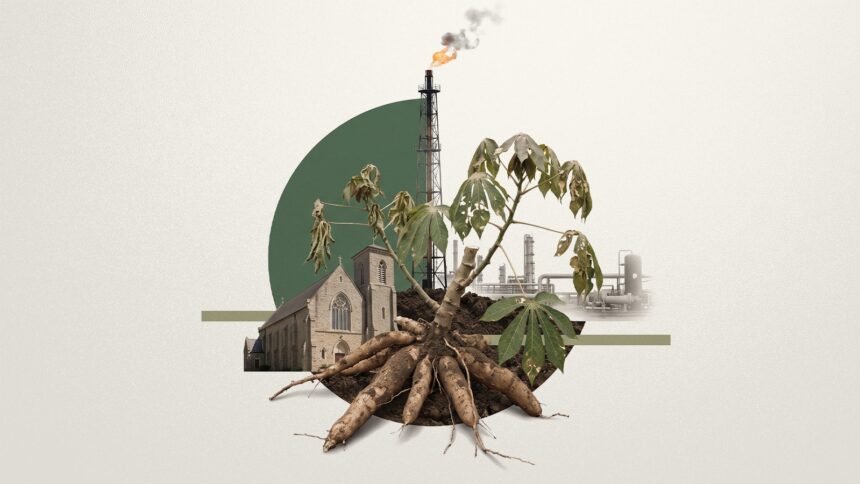
Cassava harvests are collapsing in Kouilou department, and this time it is the Catholic Church, not an international NGO, presenting the evidence. A report co-authored by the diocese of Pointe-Noire and Caritas has accused oil companies operating in the Republic of Congo of accelerating environmental damage through continued gas flaring, naming TotalEnergies, Italy’s ENI, the national oil company SNPC and the firm Wing Wah as the principal contributors to soil, water and air contamination that now exceeds World Health Organization limits in parts of the region. The findings arrive as one more data point in a long-running continental argument over who bears the cost of extraction and who is entitled to hold extractive companies accountable for it. When the institution documenting harm is a diocese embedded in the affected communities rather than an outside monitoring body, the accusation carries a different kind of institutional weight, one rooted in decades of pastoral presence rather than a single fact-finding mission. For a continent whose resource wealth has repeatedly been extracted under regulatory frameworks too weak or too selectively enforced to protect the people living atop it, the Pointe-Noire diocese’s report is a reminder that genuine sovereignty over natural resources requires not just royalty renegotiation but the capacity and political will to enforce environmental law against companies operating with state permission.
A Diocese Turns Investigator
The diocese’s report, produced jointly with the Catholic relief organization Caritas, documents farmers across Kouilou reporting sharp declines in cassava yields alongside unusual diseases affecting fruit trees, many of which are drying out or dropping fruit before maturity. Residents interviewed for the report attribute the damage directly to gas flaring by nearby oil operations, a practice in which unwanted natural gas released during extraction is burned off rather than captured, releasing pollutants into surrounding air, soil and water systems. The diocese’s assessment goes further than anecdotal complaint, asserting that measured contamination levels in the region now exceed limits set by the World Health Organization. This specific, falsifiable claim puts the burden of rebuttal squarely on the named operators and on Congolese regulators who have permitted the activity to continue.
The Companies Named
The report identifies TotalEnergies, ENI, the state-owned Société Nationale des Pétroles du Congo, and Wing Wah as the principal sources of the flaring blamed for the region’s ecological decline. The inclusion of SNPC alongside international majors is notable: it implicates the Congolese state directly in the practices it is also nominally responsible for regulating, complicating any narrative that frames environmental harm in the Republic of Congo as solely the product of foreign corporate extraction rather than a jointly managed extractive apparatus in which the national oil company is an active participant, not a neutral referee.
A Ban Lifted by Exception
Congo formally banned gas flaring in 2007, a policy that should, on paper, have prevented the very practice now blamed for Kouilou’s crop failures. But the government granted exceptions to that ban in 2022, reopening a regulatory pathway that operators have evidently used since. The gap between a nominal legal prohibition and its practical suspension through administrative exception is a recurring feature of extractive governance across the continent: strong environmental law exists, but is frequently hollowed out by carve-outs negotiated quietly between regulators and the companies whose activity that law was meant to constrain. Whether Congo’s government revisits the 2022 exceptions in light of the diocese’s findings will be a meaningful test of whether the ban was ever intended as durable policy or as a symbolic gesture available for suspension whenever commercially convenient.
Precedent: What Amnesty International Already Found
The diocese’s findings echo a 2024 Amnesty International investigation into the same coastal departments, which examined oil spills and smoke emissions linked to TotalEnergies EP Congo, Wing Wah and Metssa Congo, and concluded that Congolese authorities were not doing enough to compel industrial companies to protect human and environmental rights in the communities where they operate. That two independent bodies, a global human rights organization and a local Catholic diocese, have reached substantially similar conclusions roughly a year apart suggests a pattern robust enough to withstand claims that either report reflects an isolated or exaggerated account. It also raises the question of what additional documentation the Congolese government requires before treating the accumulated evidence as grounds for regulatory action rather than another report to be acknowledged and shelved.
Whose Environment, Whose Accountability
The Pointe-Noire diocese’s intervention adds a distinctly local, faith-rooted voice to a body of evidence that international monitors have been building for years, and its emergence from within the affected communities rather than from Geneva or London makes it harder for either the companies or the Congolese state to dismiss as external interference. Genuine environmental sovereignty on this continent will not be achieved by international NGOs alone documenting harm from a distance, nor by national oil companies invoking sovereign resource control as a shield against scrutiny. It will require domestic institutions, churches, courts, and regulators willing to hold both foreign majors and state enterprises to the same environmental standard, and a government prepared to close the exceptions it opened rather than expand them. Kouilou’s failing cassava crop is a small, local measure of a much larger continental reckoning still unresolved.