





Pan-African: The Continental Sentinel
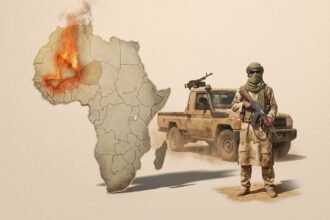
Across the African landscape, the stability of Nigeria is viewed as the cornerstone of regional security. As the continent’s most populous nation, Nigeria’s internal struggle against radicalization is not an isolated event but a sentinel for the wider Pan-African community. The persistence of the insurgency in the Lake Chad Basin remains a primary impediment to the African Union’s “Silencing the Guns” initiative. Achieving a conflict-free continent depends heavily on Nigeria’s ability to transition from a reactive military posture to a holistic, human-centric security model that can serve as a blueprint for other nations grappling with asymmetric threats.
Nigeria’s Terrorism Outlook: The Resilience of the Insurgency
The 2026 security outlook for northeast Nigeria is defined by a troubling surge in the operational lethality of Boko Haram and its splinter, the Islamic State West Africa Province (ISWAP). Despite years of military campaigns, these groups have demonstrated remarkable resilience, transitioning toward highly mobile, motorbike-borne assaults. Recent tragedies in the villages of Pubagu and Mayo-Ladde, where at least 20 civilians were killed after militants overwhelmed local vigilantes, underscore a deteriorating environment. The insurgents have moved beyond traditional strongholds, exploiting the porous boundaries between Borno and Adamawa states to launch coordinated raids on military bases and rural settlements alike.
Counter-Insurgency Efforts in West Africa: The Multinational Response
The fight against terror in the region has necessitated a complex, multi-layered counter-insurgency framework. At the heart of this response is the Multinational Joint Task Force (MNJTF), which coordinates operations between Nigeria, Niger, Chad, and Cameroon. In early 2026, the Nigerian government has redoubled its “intelligence-led” strategy, seeking to decapitate insurgent leadership through precision airstrikes and increased cooperation with the Nigeria-U.S. Joint Working Group. However, the effectiveness of these efforts is frequently tested by the insurgents’ ability to blend into civilian populations and the administrative challenges of securing vast, under-governed territories.
Civilian Protection & Human Rights: The Moral Compass of Conflict
A critical challenge for the Nigerian state is ensuring that the “protection of civilians” remains the primary metric of military success. The recent surge in attacks on villages highlights the extreme vulnerability of rural populations, who often feel caught between the brutality of the insurgents and the heavy-handedness of state security forces. Rights groups have cautioned that the use of aerial bombardment in contested zones carries a high risk of collateral damage, as seen in recent “military misfires” in Borno. Maintaining a commitment to human rights is not merely a legal obligation but a strategic necessity; any perception of state-led injustice serves as a powerful recruitment tool for the very groups the government seeks to dismantle.
Grievances & Justice: Addressing the Roots of Radicalization
The persistence of the insurgency is deeply rooted in long-standing socio-economic grievances and a perceived deficit of justice. Many in the northeast view the state’s failure to provide basic security, education, and economic opportunity as a violation of the social contract. For counter-terrorism efforts to be sustainable, the government must move beyond kinetic warfare toward a “restorative justice” model. This involves addressing the root causes of radicalization, such as extreme poverty and social marginalization, while ensuring that survivors of both militant and state-led violence have access to transparent judicial processes and reparations.
Interfaith Diplomacy & Peace: Building the Social Fabric
In a nation as religiously diverse as Nigeria, interfaith diplomacy is an indispensable tool for long-term peace-building. Insurgent groups frequently attempt to weaponize religious identity to create communal rifts. In response, religious leaders across the Middle Belt and the North are increasingly collaborating on “peace-forward” initiatives that emphasize shared values of sanctity and coexistence. These diplomatic efforts are vital for protecting sacred spaces, such as the churches recently targeted in Kwara state, and for delegitimizing the extremist ideologies that seek to use faith as a justification for terror.
Development: The Ultimate Security Strategy
The ultimate takeaway from Nigeria’s counter-terror struggle is that security is a prerequisite for, and a product of, development. Military force can provide temporary “breathing room,” but lasting peace is only possible through a comprehensive developmental pivot. This requires the reconstruction of the “bread-and-butter” infrastructure of the northeast, schools, hospitals, and markets, that has been decimated by seventeen years of conflict. By investing in the human capital of the region and creating a stable environment for local trade, Nigeria can provide its youth with a future that is not defined by the “madness of war,” but by the promise of shared prosperity.