





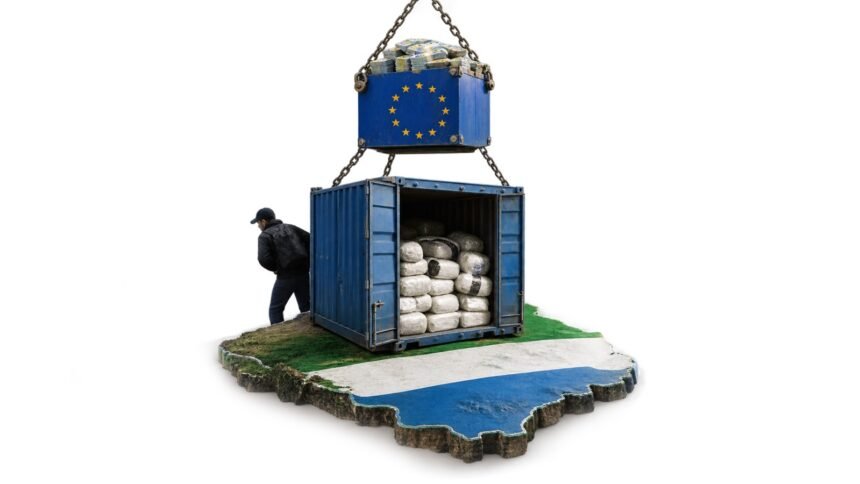
The Pan-African Paradigm of Leverage and Jurisdiction
Eighteen million euros this year, and possibly 22.5 million more next year: that is the price the Netherlands says Sierra Leone is paying for sheltering one man. On Thursday, 1 October 2026, Dutch Justice Minister David van Weel said the European Commission had suspended its financial aid to Sierra Leone over Freetown’s refusal to arrest and hand over Jos Leijdekkers, a convicted cocaine trafficker and one of Europe’s most-wanted fugitives, Reuters reported. The same day, Sierra Leone’s government offered a sharply different account, insisting the delay in EU budget support had nothing to do with any individual.
The episode sits at the intersection of transnational crime, development finance and sovereign jurisdiction. It shows how aid has become an instrument of law-enforcement pressure, and how an African state facing that pressure can contest the story itself.
The Fugitive and the Charge Sheet
According to Reuters, Leijdekkers was sentenced in absentia to 24 years in prison in the Netherlands for smuggling more than seven tonnes of cocaine, and in Belgium he has been sentenced to around 100 years in total across several cases. Sierra Leone Monitor, a Freetown-based outlet, added that he is 34, from Breda, and that a Rotterdam court convicted him in June 2024 of smuggling and of ordering a murder. Reuters reported that he has found refuge and “high-level protection” in the West African country since at least 2023, and that the Netherlands has demanded his extradition without success.
That phrase, high-level protection, carries the real weight of the allegation. It is a claim not merely that a fugitive has slipped through, but that state actors are shielding him. Sierra Leone has not accepted that framing, and no court has tested it. Yet it is the framing that now shapes how Europe treats the relationship.
Aid as an Instrument of Pressure
Van Weel said the suspension of 18 million euros (about $20 million) in payments promised for this year was intended to pressure Sierra Leone to act, and that a further 22.5 million euros due next year might also be withheld if Freetown keeps refusing to cooperate. Reuters said the European Commission did not immediately reply to requests for comment, and Sierra Leone Monitor reported that the Commission had not published any official statement confirming a new suspension.
This is conditionality of a newer kind. Older aid conditions were tied to fiscal targets or governance benchmarks. Here, the stated aim is to secure the surrender of a specific person, with budget support for an entire population as the lever. The asymmetry is plain: a powerful bloc can turn a development partnership into a tool of criminal justice, while the costs fall on public budgets that serve ordinary citizens with no connection to the trafficker.
Freetown’s Counter-Narrative
Sierra Leone’s Information Minister Chernor Bah said the delayed 2026 EU budget support stemmed from procedural issues over an amended financing agreement, not from talks with the Netherlands or any individual case, and that the disbursements are now proposed for 2027 and 2028. Reports presenting the EU’s July decision as a new punitive measure linked to one person “do not reflect the reasons formally communicated to the government,” he said, according to Reuters.
Sierra Leone Monitor reported that, by the government’s account, the Commission communicated its decision in July 2026, citing the late timing of Freetown’s request to amend the financing agreement and the difficulty of completing the required steps within the 2026 reporting cycle. The government acknowledged that the postponement is a setback for budget planning but said it does not amount to a suspension of the wider EU partnership, which it put at 325 million euros in grants for 2021 to 2027.
Two governments, then, are describing the same money in incompatible terms: one calls it a sanction, the other a rescheduling. Until the Commission speaks, both accounts remain claims.
Narco-Trafficking and the West African Corridor
The broader stakes extend beyond one fugitive. When a convicted trafficker of Leijdekkers’ profile is reported to have lived in a country for years, it raises questions about how organized crime networks use states with limited enforcement capacity as safe havens, and about the leverage such networks may acquire over local institutions. Those questions apply to Europe too. Reuters describes Leijdekkers as a European kingpin, and Dutch and Belgian courts handed down the convictions against him: the networks in question are European as much as they are West African.
A security architecture that treats West Africa only as a transit problem to be disciplined, while treating European consumption as background, will always be lopsided. Accountability for the trade has to run in both directions.
The Diplomatic Trajectory
The trajectory from here depends on facts not yet public. If the Commission confirms that the freeze is linked to Leijdekkers, Freetown will face a choice between sovereign defiance and the fiscal pain of losing budget support. If the Commission backs the procedural account, the Dutch minister’s statement will look like an attempt to use a technical delay as public pressure. Either outcome will shape how other African governments read the conditions attached to European money.
Structural Sovereignty and the Rule of Law
Sovereignty is not the right to shelter a fugitive, and it is not the obligation to bow to every extradition demand under financial threat. Structural sovereignty for Sierra Leone means having judicial and police institutions strong enough to decide such cases on their merits, publicly and quickly, so that neither foreign pressure nor domestic protection determines the outcome. It also means development partnerships whose terms are written down and published, rather than argued over through ministers’ statements to the press. Freetown can defend its jurisdiction most credibly by showing it will use that jurisdiction: by stating plainly what legal process applies to Leijdekkers and following it. Europe, for its part, should not hold a nation’s budget hostage to one man while treating the European networks that produced him as someone else’s problem.