




The Pan-African Paradigm of Resource Wealth and Retained Value
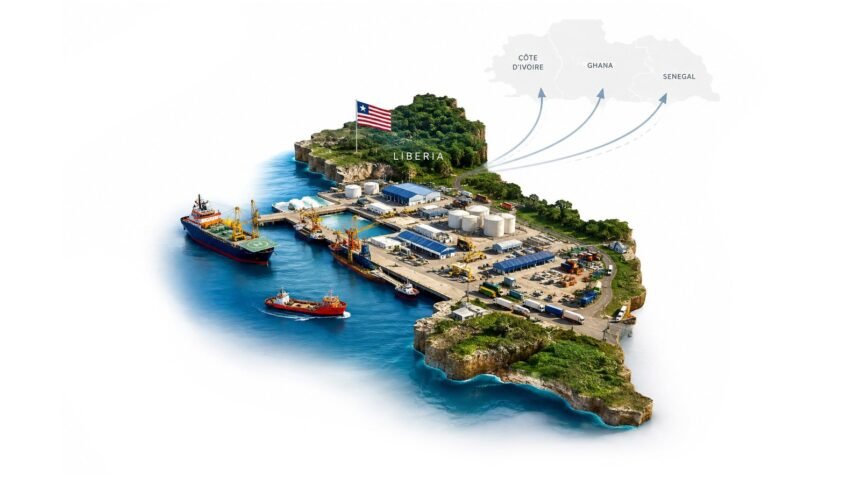
Liberia’s last oil drilling campaign created jobs and contracts, and many of them went to its neighbors. That is the paradox at the heart of a new agreement between the National Oil Company of Liberia (NOCAL) and Nigeria’s Lagos Deep Offshore Logistics Base (LADOL). According to NOCAL, essential oilfield services during that campaign, including waste disposal, logistics, supply chain management and specialised technical support, were sourced from Côte d’Ivoire, Ghana and Senegal, so that substantial economic benefits and employment were realised outside Liberia. The joint development agreement, signed on Friday 2 October in London, is meant to ensure the next drilling cycle does not repeat that pattern.
The deal concerns a logistics shorebase at Buchanan, in Grand Bassa County, a deep-water port with Atlantic access and proximity to Liberia’s offshore blocks. Under the agreement, LADOL, which operates one of Africa’s largest shorebases in Lagos, will serve as technical lead partner, funding and conducting the feasibility study, coordinating engineering design, and building and operating the facility. Both parties described it as the start of a new era focused on local capacity building and economic retention.
Buchanan’s selection is not new thinking. The report notes that the port has long been tipped as the natural hub for Liberia’s oil and gas logistics, and NOCAL describes the project as a massive endeavor in response to the needs of international oil companies, in anticipation of accelerated drilling under petroleum agreements already signed and concessions still to come. What is new is the attempt to lock in a domestic logistics architecture before the drilling begins rather than after.
From Feasibility to Facility
The architecture of the project is still at the planning stage, and it is worth being precise about what has and has not been agreed. According to the report, the feasibility study is expected to begin within 45 days and to last six months, covering land assessment, waterfront and marine access, utilities, commercial viability, geotechnical and topographical surveys, and scoping for an environmental and social impact assessment. A joint steering committee will oversee progress, and definitive project agreements are to be concluded only after the study. The parties also agreed to strict confidentiality and non-circumvention clauses. In other words, this is a framework for a shorebase rather than a construction contract, and its trajectory depends on what the study finds.
Local Content as Economic Sovereignty
NOCAL’s chief executive, Fabian M. Lai, framed the partnership as being about anchoring the value chain of Liberia’s petroleum sector firmly in Liberian soil, so that Liberian companies perform jobs, contracts, training and ancillary services. The reasoning mirrors the local content agenda that LADOL itself invokes for West Africa. The report says the shorebase, once completed, is expected to handle supply vessels, waste management, equipment fabrication, warehousing, fuelling, crew changes and specialized technical services. It projects hundreds of direct jobs during construction and operation and thousands of indirect jobs through Liberian subcontractors, trucking, catering, security and training. Those employment figures are projections attributed to the parties and the report, not independent estimates.
An African Partner, an Asymmetric Market
LADOL’s executive chairman, Sir Oladipo Ladi Jadesimi, described the deal as a sign of confidence in Liberia’s oil and gas potential and of commitment to local content across West Africa, insisting that LADOL sees itself as a partner rather than merely an investor. The intra-African character of the agreement is notable: the technical lead is a firm that describes itself as an indigenous African company, whose flagship Lagos facility was founded in 2000, rather than an external service multinational. Yet the market remains asymmetric. Liberia’s leverage depends on whether international oil companies actually drill. The report cites industry sources saying several production sharing contracts have been signed under the Boakai administration, with more in the pipeline. Still, the pace of exploration will ultimately be set by corporate investment decisions taken far from Buchanan.
Governance Questions the Study Must Answer
The report notes that NOCAL and LADOL would serve as the exclusive developer, operator, and maintenance provider for the facility. Exclusivity can give a project the certainty it needs to attract finance, but it also concentrates control of a strategic node in Liberia’s petroleum architecture. The confidentiality and non-circumvention clauses are standard commercial protections. Yet, public trust in extractive projects in West Africa has repeatedly depended on transparency about terms, revenue sharing, and environmental safeguards. The feasibility study’s environmental and social scoping, and the eventual definitive agreements, will be the moments when Liberians can judge whether local content means broad participation or a narrow concession.
Closing: Sovereignty Over the Support Economy
Resource sovereignty is often imagined as control over oil in the ground. Liberia’s NOCAL is making a subtler argument: that sovereignty also lies in the support economy that surrounds extraction, the vessels, warehouses, waste services and crew changes that can either build domestic capacity or flow abroad. The Buchanan shorebase is a bet that Liberia can capture that layer before the next drilling cycle begins. Its success will depend on the feasibility findings, on whether drilling materializes, and on governance that keeps the project accountable. If those conditions are met, the trajectory could turn a past lesson in leakage into a model of structural sovereignty for West Africa’s smaller frontier oil states. If not, Liberia risks building the base while the value still sails elsewhere.