




The Pan-African Paradigm of External Training and Local Legitimacy
Armies can import doctrine, equipment and instructors; they cannot import the trust of the villages they patrol. Nine years to the day after insurgents first attacked Cabo Delgado on 5 October 2017, an analysis by Borges Nhamirre of the Institute for Security Studies argues that Mozambique’s Defense Armed Forces, the FADM, are losing the battle that matters most. Foreign training has strengthened the army, he writes, but abuses against civilians are undermining the community support needed to defeat the insurgents. The diagnosis is not of a force that lacks skill. It is of a force whose conduct erodes its own strategic foundation.
Nhamirre recalls that in 2017 the FADM was caught by surprise despite three decades of experience in internal conflicts, lacking combat capability, logistics, modern equipment, air assets and military intelligence, and holding scant control over the province. Insurgents later seized district capitals, and in 2021 TotalEnergies suspended its 20 billion dollar gas project, forcing the government to seek external support. That moment turned a provincial insurgency into a question of national economic sovereignty.
A Crowded Architecture of Foreign Assistance
The support that followed was extensive. According to the ISS analysis, the Southern African Development Community Mission in Mozambique helped dismantle insurgent bases, restore state authority and secure maritime and road access. The Rwanda Defense Force helped recover territory key to gas logistics and trained the FADM, as did the European Union, Algeria, the United States and others. Nhamirre judges the EU program the most consequential, channeling roughly 89 million euros into training and non-lethal equipment, with its training mission preparing over 1,600 personnel in 11 Quick Reaction Force companies in subjects that included human rights and international humanitarian law. Algeria is training an FADM battalion, and the United States provides small-unit tactics and combat medicine instruction under its Joint Combined Exchange Training program.
Hardware Gaps and the Search for New Suppliers
Training has not closed the equipment gap. Nhamirre reports that much of the FADM’s gear originates from Russia and China and that personnel describe obsolete and non-functional weapons that have cost lives on the battlefield, alongside insufficient transport for troops and casualty evacuation. The defense ministry has responded with new partnerships: an agreement with India in March to supply equipment and transfer technology for assembling and repairing aircraft, vehicles and patrol vessels, a defense cooperation agreement with Turkey ratified in 2024, and a 1.5 million dollar United States program to improve the management and security of weapons and ammunition. The trajectory is toward diversification of suppliers, but the analysis is blunt that these partnerships have yet to change conditions on the ground.
After SAMIM: Roads, Ransoms and Ambushes
Since SAMIM’s withdrawal in mid-2024, the FADM has led offensives, patrolled major roads and held defensive positions on its own. According to the ISS analysis, insurgent groups that had been confined to remote bases regained momentum, attacking main roads to steal food, abduct drivers and passengers, and demand ransoms. Joint police and army escorts were introduced, but insurgents staged deadly ambushes, killing police officers, soldiers and civilians. This is the classic asymmetric pattern of guerrilla war. Insurgents do not need to outgun the state, Nhamirre notes; small, lightly armed bands survive by hiding in rough terrain far from state power, and by the silence of communities who choose not to report them.
Abuse as Strategic Self-Harm
The decisive variable, in Nhamirre’s account, is conduct. Mozambican troops have repeatedly been accused of sexually exploiting displaced women, killing civilians suspected of collaborating with insurgents, and committing war crimes against captured suspects. These are accusations reported in the analysis rather than adjudicated findings, but Nhamirre adds that reports of civilians killed by the FADM continue despite the EU’s human rights curriculum. Multiple foreign doctrines, he argues, hinder a coherent approach, and political leadership has not filled the gap: President Daniel Chapo’s recommendations in his September speech marking the FADM’s 62nd anniversary did not address respect for human rights in counter-terrorism. Every abuse transfers intelligence and sympathy from the state to the insurgency.
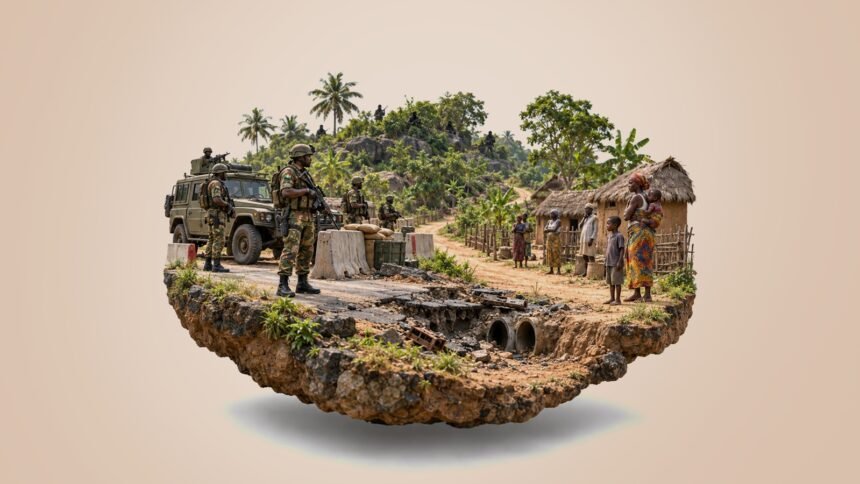
The counter-insurgency logic Nhamirre sets out is straightforward. Effective operations require government forces to distinguish between active rebels and non-combatant community members, and to encourage the latter to cooperate by reporting insurgents’ presence rather than treating them as targets. Where civilians fear the army as much as the militants, that distinction collapses, and the insurgency gains an asymmetric advantage that no quantity of foreign instruction can offset. The battlefield, in this sense, is the relationship between soldier and villager.
Closing: Sovereignty Built From the Village Up
Mozambique’s structural sovereignty over Cabo Delgado will not be secured by the next training contract or equipment deal alone. It will be secured when communities see the army as their protection rather than another source of danger, and therefore choose to report insurgents instead of hiding them. Nhamirre points to the recent establishment of a counter-terrorism center as a source of hope for interagency coordination, conditional on the FADM reversing its culture of abuse and building genuine civil-military cooperation. Nine years into the war, that is the architecture still missing. External partners can supply skills; only the Mozambican state can supply legitimacy, and on current evidence, that remains the asymmetric gap insurgents continue to exploit.