



The Pan-African Paradigm of Showcase Infrastructure and Everyday Vulnerability
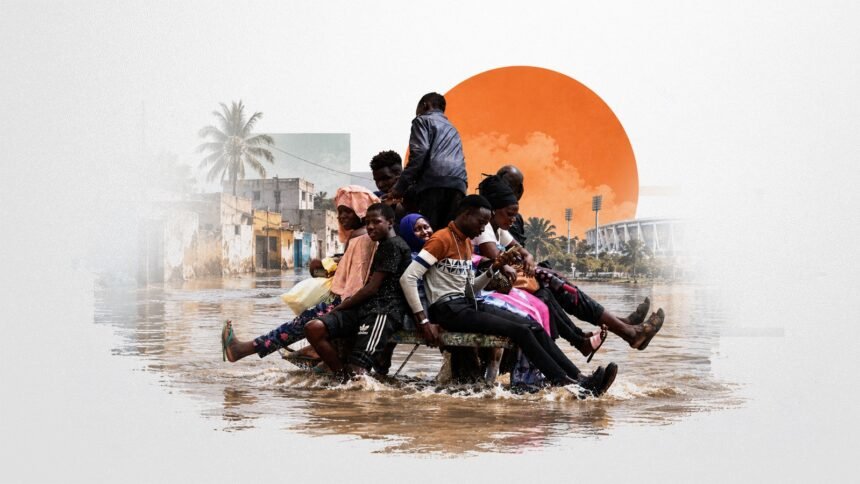
What does it mean for a capital to be ready for the world when it is not yet ready for its own rain? Over the weekend of 3 and 4 October 2026, heavy rains flooded roads and destroyed buildings in Senegal, and the government said several people had been killed while warning of more rain to come. Flash floods in Dakar and elsewhere disrupted traffic, testing the country’s infrastructure weeks before it hosts the Youth Olympic Games, due to open on 31 October. The juxtaposition is not incidental. It exposes an asymmetric architecture in which showcase investment and household exposure move on different timetables.
Senegal’s Interior and Public Security Ministry said in an overnight statement, relayed by the national news agency APS on 5 October, that some rain gauges had recorded cumulative totals above 100 millimeters over 48 hours, causing floods, traffic disruption and material damage, with deaths and injuries recorded notably in Dakar and Matam. The ministry stressed that the toll was provisional and still evolving, and urged residents to avoid submerged roads and weakened buildings.
Counting the Dead Under Uncertainty
Casualty figures in the first hours of a disaster are rarely stable, and the Senegalese case is no exception. Reuters, citing local media, reported that a mother and her child were killed in the Parcelles Assainies district of Dakar after their home flooded. APS identified them as a 25-year-old woman and her four-year-old son, killed after a wall of their compound gave way and water rose inside. APS also reported, citing the victim’s family, that one person was killed and two injured when a shelter collapsed in the Gourel Serigne neighborhood of Matam. At the same time, the ministry said the circumstances of a building collapse in Kaolack were still being assessed.
The Senegalese outlet Senegal Direct reported on 5 October that at least seven people died between Friday evening and Sunday in separate incidents in Dakar, Kaolack, Touba and Matam. That tally should be read with care. The outlet itself described the deaths as occurring in diverse circumstances, including collapses, drownings and an electrocution, and not every case it listed was clearly attributed to the rain. Africalix therefore reports the official position as ‘several’ deaths, per the ministry and Reuters, and the figure of seven as Senegal Direct’s count of weekend fatalities from several causes, pending a consolidated government toll.
Walls, Slabs and the Hidden Housing Crisis
The pattern in the reported deaths is architectural in the most literal sense. A compound wall in Parcelles Assainies, a slab in a Kaolack building that also housed a Quranic school, a dilapidated boundary wall in Touba that Senegal Direct said collapsed on two four-year-old children, killing one, and a collapsed structure in Matam that APS described as a shelter and Senegal Direct as the slab of a hut. Heavy rain is the common backdrop, though police investigations into each case are still open, and aging or poorly maintained construction appears as the recurring multiplier. Senegal Direct itself framed the weekend as highlighting the risks of decaying buildings, intense rainfall, unsafe electrical installations and precarious living conditions. Climate adaptation in West African cities is often discussed in the language of drainage canals and early-warning systems. The weekend’s toll suggests that the building stock inside ordinary compounds is an equally decisive front.
The Olympic Mirror
The Youth Olympic Games, scheduled from 31 October to 13 November according to AFP, have become a lens through which Senegalese residents judge public priorities. AFP reported on 1 October that the 2026 budget allocates roughly 138 million euros to the Games’ infrastructure program and that the French Development Agency has lent 80 million euros for sports facilities, against a backdrop of economic strain after the 2024 discovery of hidden debt under the previous administration. AFP also reported that the IMF froze its program after that disclosure and has only recently reached a new agreement for a 2.2 billion dollar loan still awaiting final approval. These are not contradictions in themselves. A state can build stadiums and drains at once. But the trajectory of public trust depends on whether residents see both being built.
Governance in the Emergency
The ministry’s response, as described by APS, followed the established chain: the Interior Minister, Mouhamadou Makhtar Cissé, instructed the national fire brigade and territorial administration to reinforce mobilization, while governors, prefects and sub-prefects coordinated rescues, damage assessments and assistance at the local level. Cheikh Tidiane Dièye, the minister responsible for water and sanitation, told the broadcaster RFM, as reported by Seneweb, that the government would do everything to fight flooding, including by strengthening prevention, while cautioning that difficult situations can arise beyond certain levels of rainfall. That caveat is honest. It is also a reminder that prevention is a policy choice made long before the clouds arrive, in zoning, building inspection, and drainage maintenance.
Closing: Sovereignty as Safe Shelter
Senegal will be judged by visitors on the quality of its venues. Its own citizens will judge it on whether a wall holds when the rain comes. Structural sovereignty in a warming climate is not only the capacity to host global events or negotiate finance; it is the capacity to guarantee that ordinary homes in Parcelles Assainies, Touba and Matam are not death traps in a heavy shower. The weekend’s floods offer a timely audit, weeks before the Olympic spotlight. If the response is a consolidated toll, a transparent review of building safety in flood-prone districts and sustained drainage investment beyond the Games, the trajectory can bend toward resilience. If not, the next downpour will write the same architecture of loss in the same neighborhoods.