





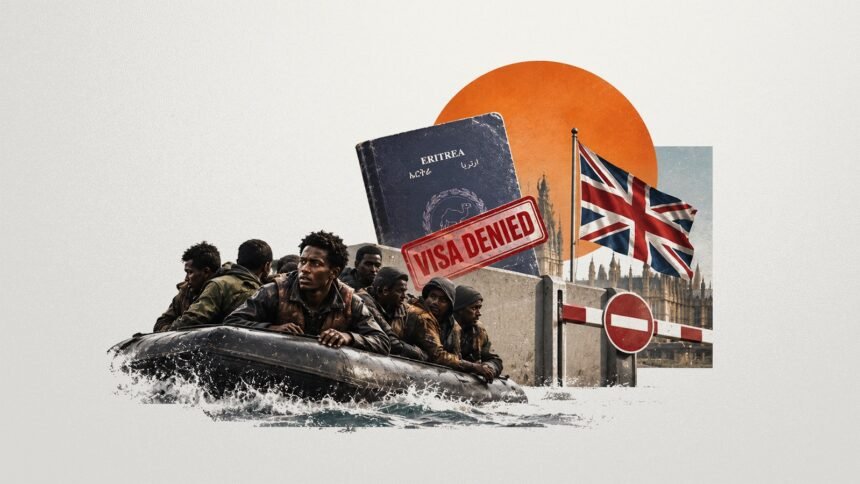
A Returns Dispute Between London and Asmara, and a Country Whose Young People Keep Leaving
Seven. That is how many people were returned from the United Kingdom to Eritrea in the twelve months to June, according to Home Office figures. Over the same period, more than 5,800 Eritreans reached Britain in small boats across the Channel, and Eritreans were the most common nationality among those arrivals, about 18 percent of the total according to the House of Commons Library. Those two numbers sit at the center of a new confrontation. Home Secretary Shabana Mahmood has threatened to ban all Eritreans from entering the UK unless Asmara accepts more returns of small-boat migrants and foreign nationals convicted of crimes.
The first measures took effect on Thursday. Eritrean diplomats may no longer travel more than 60 kilometers outside London without permission, and fast-track visas for Eritrean VIPs have been stopped. The Home Office says the travel limit mirrors restrictions already placed on British officials in Asmara. A total ban on Eritrean entry is the next step held in reserve.
Two Governments, Two Stories
London’s case is simple. The government says Eritrea “abruptly” withdrew co-operation on returns earlier this year. “Eritrea has had every chance to accept the return of criminals and those with no right to be in the UK. Unlike other countries, it has refused,” Mahmood said, adding that she would not hesitate “to impose further measures on other countries refusing to co-operate”.
Asmara tells a different story. Eritrea called the move a “perfunctory political gimmick” and said the UK had not issued a single visa to an Eritrean official since 2023. Its embassy in London accused Britain of refusing “meaningful and appropriate dialogue”, of failing to disclose that some of the people it sent back were criminals still serving prison terms, and of describing returns as voluntary “when clearly, they were not”. Neither government has published the correspondence behind these claims, so the two accounts cannot be checked against each other; what is clear is that the channel for routine co-operation has broken down.
A Tool Used Before
Visa threats have become a standard instrument of British returns policy. Last November the Home Office said it was prepared to suspend visas for countries that fail to co-operate with the return of their citizens. Earlier this year it threatened restrictions against Angola, Namibia and the Democratic Republic of Congo. Restrictions announced against the DRC were later lifted after co-operation improved, and Angola and Namibia agreed changes before any measures were introduced. In each case the pressure fell on African governments.
Dr Madeleine Sumption, director of the Migration Observatory at the University of Oxford, has pointed out why the choice of target matters. The largest groups of people refused asylum and did not return, she said, come from countries such as Pakistan and Bangladesh. “But the collateral damage of a ban on visas for those countries when you have so many international students coming, for example, [and] a lot of people coming on work visas would be much greater than a country like Eritrea.” In other words, Eritrea is a low-cost target, not the biggest part of the problem.
Why Most Eritreans Cannot Be Sent Back
The policy also runs into the facts of who is arriving. Eritrea accounted for roughly 7,000 asylum applications in the last year of data, about 8 percent of the total, Sumption said. “Most Eritreans who come and claim asylum are not removable at all,” she added, because 84 percent are granted protection at the initial decision and more succeed on appeal. About 1,400 were refused at first, a number expected to shrink after appeals. Alongside the seven returned to Eritrea, 244 Eritreans were returned to other countries in the same twelve months, and a further 1,300 Eritreans received UK visas, mostly to join family already settled there.
Those high grant rates reflect conditions at home. Eritrea has been ruled by President Isaias Afwerki since independence from Ethiopia in 1993, after a 30-year war. His People’s Front for Democracy and Justice is the only legal party. There has never been a national election, and the constitution ratified in 1997 has still not been implemented. Independent newspapers were shut down in 2001 after senior party officials published an open letter calling for elections and the constitution to take effect. Only four religions are permitted, and followers of others have been jailed for years. Human Rights Watch has accused the government of widespread repression, including forced labor, conscription, and limits on free expression. National service, which begins with military training in the final year of secondary school, can last for decades. Up to a third of Eritrean-born people are estimated to live abroad.
A Region Under Strain
The dispute lands at a tense moment in the Horn of Africa. Eritrea and Ethiopia have accused each other of aggression in recent weeks: Addis Ababa says Eritrean troops crossed up to 60 kilometers into Tigray. At the same time, Asmara calls that a fabrication meant to justify war. For young Eritreans weighing whether to leave, the prospect of conflict on the border and open-ended conscription weighs far more than any change in British visa rules. A measure that targets Eritrean officials and visitors does little to change the reasons people flee.
There is also a question of scale. More than 20,400 people have crossed the Channel by small boat so far this year, down 40 percent on the same period last year, while there were more than 40,600 returns and deportations from the UK between July 2025 and June 2026. Seven returns to Eritrea are a symbol rather than a driver of those totals.
Leverage Is Not a Migration Policy
Every state has the right to decide who enters its territory, and every state is expected to take back its own citizens. Eritrea has the right to demand that returns be lawful, disclosed and genuinely agreed. But a visa ban applied to an entire nationality punishes students, families and travelers for the conduct of a government they did not elect, and in Eritrea’s case could not elect. African governments facing similar pressure, from Luanda to Windhoek to Kinshasa, have an interest in common rules on returns, negotiated together rather than country by country. Until Eritreans can live at home without indefinite conscription and fear, the boats will keep coming, whatever happens to visas in London.