




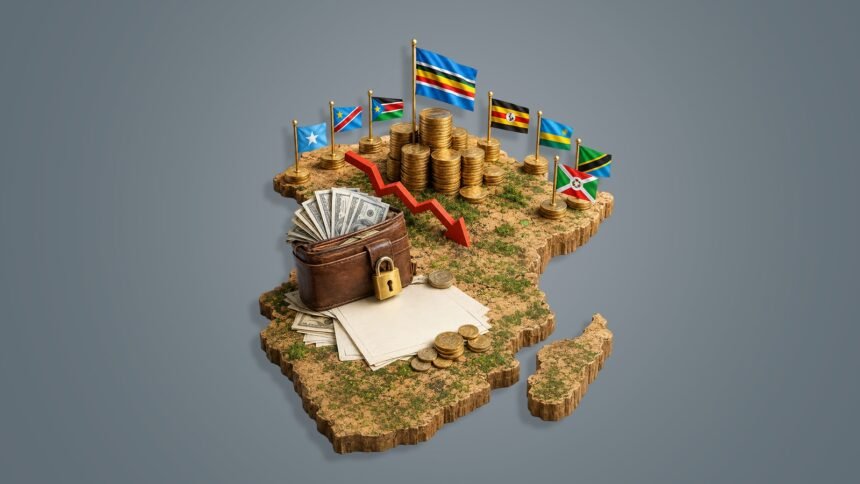
An $89 million pile of unpaid membership dues has pushed the East African Community (EAC) to rethink one of its founding financial principles.
Beginning July 1, the regional bloc will no longer require all member states to contribute equal amounts to its budget. Instead, contributions will increasingly reflect each country’s economic strength, with wealthier economies paying more and poorer members paying less.
The change marks one of the most significant financial reforms since the EAC was revived in 2000 and is intended to help address chronic funding challenges that have disrupted the operations of key regional institutions.
Beginning July 1, member states will no longer contribute equal amounts to the EAC budget. Instead, contributions will be partly determined by each country’s economic strength, marking a major shift in how the organization finances its operations.
While the first approach was intended to promote equality among partner states, it became increasingly difficult to sustain as the Community expanded from three founding members, Kenya, Uganda, and Tanzania, to eight countries, including Rwanda, Burundi, South Sudan, the Democratic Republic of Congo (DRC), and Somalia.
Kenya’s economy, the largest in the bloc, is several times larger than Burundi or South Sudan. Yet all countries were expected to contribute roughly the same amount of about $7 million annually. Over time, several countries struggled to meet their obligations, resulting in a growing funding gap that affected the functioning of EAC institutions.
The financial strain became increasingly visible. Staff salaries were delayed, meetings were postponed, regional programs slowed, and the East African Legislative Assembly (EALA) was forced to suspend its activities during the first half of 2025 due to funding constraints.
By early 2025, outstanding membership arrears had reached approximately $89 million.
But under the new system approved by EAC Heads of State, the annual budget will be financed through a hybrid formula in which half will continue to be shared equally among all member states.
The remaining half will be distributed according to each country’s economic capacity, measured using average nominal GDP per capita over the previous five years.
The data will be sourced from international institutions such as the World Bank and the International Monetary Fund (IMF). The approach is designed to strike a balance between solidarity and fairness.
Every country will continue to contribute equally to part of the budget, preserving the principle of shared ownership. At the same time, wealthier economies will contribute more toward the Community’s financing.
The new formula alters the contribution structure, with Kenya remaining the largest contributor, and its annual payment rising from approximately $7 million to $11.6 million.
Tanzania will contribute $8.2 million annually, followed by Uganda at $7.3 million and Rwanda at $7.2 million. The DRC will contribute $5.9 million, Somalia $5.8 million, South Sudan $5.2 million, and Burundi $4.5 million.
Together, the eight member states are expected to contribute about $55.7 million annually.
The changes go beyond determining who pays what and where, and reflect a broader effort by EAC leaders to place the bloc on a more sustainable financial footing and reduce its dependence on unpredictable contributions.
In March, regional leaders approved additional reforms to address persistent non-payment by member states. Among the measures adopted was a proposal to write off 50 percent of the roughly $89 million in accumulated arrears.
The largest debtor is the DRC, which owes approximately $27.7 million, followed by Burundi at $22.7 million, South Sudan at $21.8 million, and Somalia at $10.5 million.
The EAC is also exploring ways to reduce pressure on its central budget. One proposal under discussion would see EALA members remunerated directly by their respective governments rather than through the Community’s budget.
The reform is ultimately about preserving the EAC’s effectiveness at a time when the bloc has ambitious goals, including deeper economic integration, infrastructure development, trade facilitation, and monetary cooperation.
Without reliable financing, many of these objectives become difficult to achieve. Supporters argue that linking contributions to economic capacity makes the system fairer and more realistic, increasing the likelihood that countries will comply with their obligations.
However, the success of the reform will depend less on the formula itself and more on whether member states consistently honor their commitments.
If implemented successfully, the new funding model could help stabilize the EAC’s finances and strengthen its institutions. If payment challenges persist, the bloc may continue to face the same financial difficulties despite the new formula.
What is clear is that the EAC has now moved away from one of its founding financial principles. After years of budget shortfalls and unpaid dues, the Community is betting that a more flexible and economically driven model will provide a stronger foundation for regional integration.