


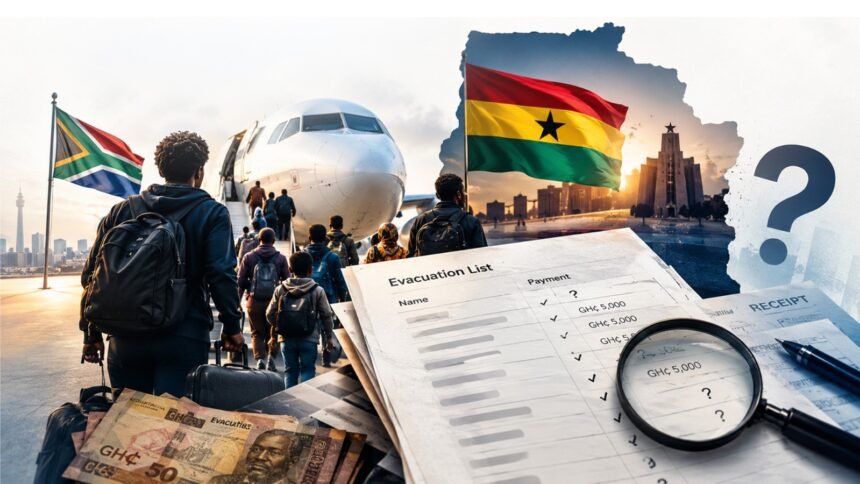
When African Governments Rescue Their Citizens from Hostility Elsewhere on the Continent, the Bill Comes Home, and So Do the Questions About How It Was Spent.
How does a government prove that it brought 1,964 people home and paid each of them what it promised? In Ghana, that question has moved from Parliament to the public airwaves, and on Saturday 24 October it drew answers from the country’s top diplomat in South Africa, a policy analyst, and an independent data review that found gaps in the records.
The operation itself is not in dispute. Between 27 May and 4 September 2026, Ghana evacuated 1,964 of its citizens from South Africa. Foreign Affairs Minister Samuel Okudzeto Ablakwa said on 7 September that the exercise followed a resurgence of anti-foreigner sentiment and intimidation of African nationals since April 2026, particularly in the Durban central business district, linked to vigilante groups including “March and March” and “Operation Dudula”. He said four Ghanaians had lost their lives and that Ghana was the first country to evacuate its citizens.
The Bill as the Ministry Presented It
The minister put the total cost at GH¢49,721,786. Of that, GH¢38,835,512 covered chartered flights, commercial tickets, ground transport, feeding, hotel accommodation in South Africa, and medical care; GH¢10,802,000 went on reintegration and transport allowances; and GH¢84,274 was paid to repatriate the remains of two people. The government itself spent GH¢33,721,786, while Engineers and Planners, a company owned by Ibrahim Mahama, donated GH¢16 million. Ablakwa said each evacuee received a GH¢5,000 reintegration grant and a GH¢500 transport allowance, that the exercise had not been budgeted for, and that the full cost had been paid with no outstanding liabilities.
The minister later released documents in response to a Right to Information request from Nana Asafo-Adjei Ayeh, Deputy Ranking Member of Parliament’s Foreign Affairs Committee, putting more of the payment and flight records on the public record.
What the Records Show, and Do Not
On 11 October, Ayeh said the Minority’s review of those documents found that only 824 names appeared on both payment registers. He said the papers accounted for 926 people on chartered flights and 247 on itemized commercial flights, a total of 1,173, leaving 791 of the 1,964 evacuees not adequately accounted for in the flight records. He also alleged duplicated entries, noted 442 minors in the reintegration register, and called for an independent audit by an accounting firm, with its terms of reference and findings made public.
On Saturday, Isaac Kofi Adjei, who leads a newsroom research team that ran its own independent analysis of the data, said the checks found that some evacuees had not received the GH¢5,000 and GH¢500 allowances. The team also reported duplicate names, payments recorded without signatures, impossible or future dates of birth (which the ministry or the mission in Pretoria later clarified), and no receipts for some spending, including accommodation and transport inside South Africa. Adjei stressed that these were initial findings and said further results from the ministry’s own original data would be released on Monday. These are findings from reviews of the ministry’s documents, not established wrongdoing, and the ministry’s full response to them has yet to be heard.
A Diplomat’s Rebuttal
Benjamin Quashie, Ghana’s High Commissioner to South Africa, rejected claims that some evacuees slept in buses before their flights. “The first one is to state that not a single individual slept in a bus; it was impossible,” he said. He explained that evacuees were brought by mission-paid buses from areas including the Western Cape, the Eastern Cape and East London, and taken to hotels in Pretoria before their flights.
“So because we wanted to save costs, if you are supposed to travel on Wednesday, we get you on a bus on Tuesday,” Quashie said, adding that travelers would spend a day in a hotel and be given food. He accepted one qualification: people coming from the Northern Cape, a journey of 12 or 13 hours, or from Cape Town, about 10 hours, would of course have slept on the bus on the way. “If that is what they mean by sleeping in the bus,” he said.
The Charter Price Debate
The single largest line under scrutiny is the reported aircraft charter cost of GH¢27,180,700. Kay Cudjoe, an associate of the IMANI Center for Policy and Education, cautioned against reading too much into comparisons with other charter quotes. “I think public comparisons with alternative charter prices cannot prove overpricing unless we look at the issues concerning aircraft charter,” he said. Comparisons may raise legitimate questions, in his view, but they do not settle them on their own.
That leaves the debate where many audits begin: with figures that are large, partly documented and contested. The government says it moved quickly to save lives in an emergency it had not planned for. The Minority and independent reviewers say emergency spending still has to be reconciled name by name. Both positions can be true at once, which is why an audit matters.
Rescue, Then Account
Ghana moved first to bring its citizens home when anti-foreigner violence put them at risk, and few would argue it should have waited. But a state’s right to act on behalf of its people abroad rests on the trust of the people at home who pay for it. Every unsigned payment and every name that appears twice weakens that trust, whatever the final explanation.
An independent audit with public terms of reference, as the Minority has requested, would serve the government as much as its critics. It would show whether the GH¢5,000 promised to each returnee reached them, and it would set a standard for the next evacuation, because, given the pressures on migrants within Africa, there may well be one.