



An El Niño Summer That Arrived Before the Rain
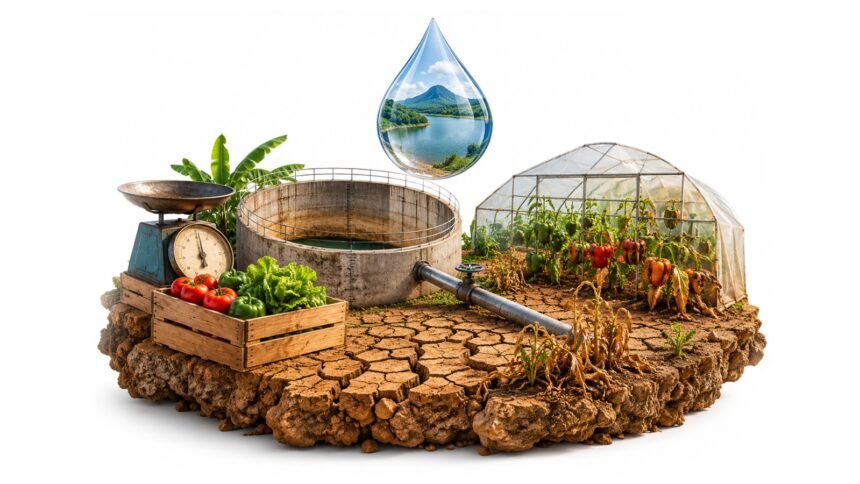
Fields are drying out, and peppers are burning inside greenhouses, yet at the auction floor a pound of tomatoes has been fetching just a few rupees. That is the paradox facing farmers in Mauritius this November. A severe drought, driven by the heat of a very strong El Niño, has cut yields and pushed up the cost of irrigation, while the prices many growers receive have not risen to match. The outcome is a squeeze from both sides, with consumers told to brace for dearer food and producers saying they already sell at a loss.
For an island state that depends on a handful of reservoirs for its water, the episode is a test of how small economies absorb climate shocks. It also adds weight to an argument that African and other small island governments have pressed for years: that their vulnerability needs to be recognized in how international lenders and climate funds treat them.
A Reservoir Running Low
Water supply has tightened since September. The country’s largest reservoir, Mare aux Vacoas, stood at 32.4 percent of capacity on 16 November, and has been put at 33 percent more recently, down from 74 percent a year earlier. The main reservoirs taken together were at 47.2 percent in mid-November, and the Bagatelle dam at 49.1 percent.
The Central Water Authority (CWA) has not yet tightened restrictions. Still, its Director-General, Shiam Thannoo, has warned it could ask people to cut consumption further and harden the measures if summer rains are delayed. The authority is rerouting supply so that parts of the lower Plaines-Wilhems, including Vacoas and parts of Rose-Hill and Quatre-Bornes, draw on Bagatelle rather than Mare aux Vacoas. Water levels in its boreholes have fallen by 40 percent, according to Thannoo, and they now supply about 9,000 cubic meters a day. In some areas fed by the Midlands Dam, supply can be limited to six hours a day, and tanker lorries and 30-cubic-meter communal tanks now serve households in places such as Vacoas, Phoenix and Curepipe.
Forty Percent Lost on One Farm
On a farm on the outskirts of Port Louis, sustained high temperatures have stunted vegetable growth. “For the past three months, since the start of this issue in Mauritius, we have had an impact of around a 40 percent loss in our production. If this continues, it’s going to increase, of course,” said Dharshini Anishta, who heads a local agricultural company.
The damage extends beyond open fields. “The temperature outside and inside has increased by two or three degrees more. That’s why these peppers get burned like that,” said farmer Seesurrun Madhan, describing crops grown under cover. Amarjeet Beegoo, an agricultural consultant and grower, said production costs have risen by 30 to 40 percent, largely because of the extra spending on irrigation, on top of higher fuel prices.
Soaring or Stable? Two Views of the Market
Accounts of what this means for shoppers differ. Some descriptions of the crisis say food prices have soared. Mauritian farmer organizations gave a more nuanced picture in mid-November. Kreepalloo Sunghoon, secretary of the Small Planters Association, said retail vegetable prices were “more or less stable”, but that coriander, thyme and other herbs had already become more expensive, and that lettuce and cucumbers could follow. Kailash Ramdharry, spokesperson for the FALCON farmers’ network, said prices remained accessible despite a small rise for tomatoes, of about 5 rupees per half kilo, and that there was no shortage.
Beegoo described an even starker picture at the wholesale auction, where he said prices were at historically low levels. A pound of tomatoes had dropped from 25 rupees to 5, he said, as a glut of vegetables planted at the same time since July met weaker festive-season demand and consumer worries about pesticide misuse. His warning is that the drought’s real effect on prices may come later: if small growers stop planting until December, March and April could bring shortages and a price spike.
Seeds, Storage and the Search for Finance
The government has rolled out measures to support production, including drought-resistant crop varieties and water storage facilities. “Our research center is producing drought-resistant seeds, and we’re working with financial institutions like the World Bank and IMF,” said Arvin Boolell, Minister of Agro-Industry, Food Security, Blue Economy and Fisheries. “Now they are coming to terms and giving recognition to the specificity of small island development,” he added. Local organizations are pushing for practical, low-cost water storage so farmers can ride out long dry spells. Growers want more direct help: Beegoo has called for a guaranteed floor price at auction for three months and for the Agricultural Marketing Board to buy surplus carrots and cabbages.
The outlook offers limited relief. The Mauritius Meteorological Services said in its summer outlook of 27 October that El Niño had reached very strong intensity and would keep intensifying. It expects summer rain to begin in the last week of November, with total summer rainfall of about 1,100 millimeters, or 80 percent of the long-term mean, with temperatures on some days more than 3 degrees Celsius above average and highs around 36 degrees on the west coast.
Resilience That Cannot Be Imported
Mauritius has the institutions and the income to respond better than many of its neighbors, which is precisely why its struggle is instructive. If a well-governed island can see a farm lose 40 percent of its output in three months and its main reservoir fall to a third, the case for building water storage, heat-tolerant seed and fairer prices for growers before the next El Niño is hard to dispute. Those choices sit with Mauritians and their government. Outside finance can help, but control over food and water in a warming climate will come from decisions made on the island, and made early.