





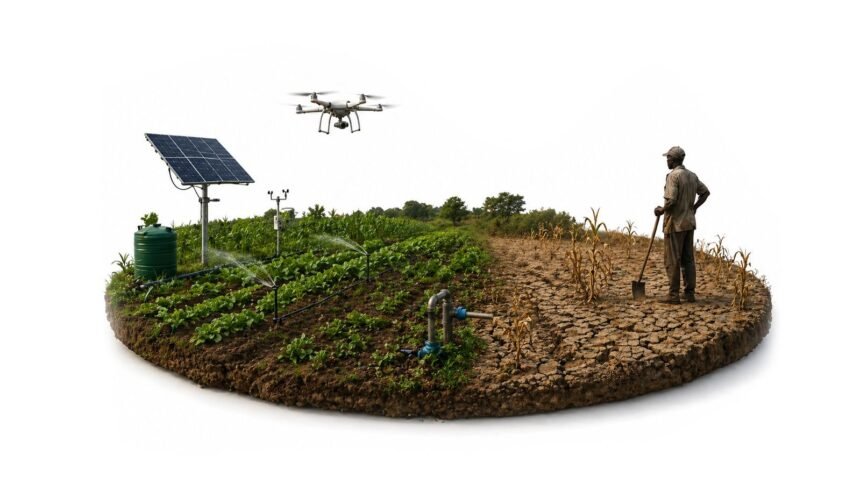
Attel on Nairobi’s Mombasa Road in late March, the screens behind the podium showed lush green fields and drone footage of solar‑powered irrigation schemes.
In the room, however, the conversation at the third Climate Change Global Business Summit on Africa kept circling back to a more prosaic concern: who would actually pay for climate‑smart agriculture at the scale the continent now needs.
Kenyan ministers urged investors to back climate‑resilient seeds, digital weather services and efficient irrigation as a frontline defense for food security in a warming world.
Beyond the main hall, agribusiness executives and development bankers traded figures on Africa’s climate finance gap. Analysts reminded them that Africa currently receives only a fraction, roughly a quarter, of the adaptation finance it needs, and that global pledges to double adaptation funding are unlikely to be met before 2025.
In panel after panel, the message was the same: the technologies exist and the projects are emerging, but the money is still not moving fast enough to keep pace with the climate shocks already hitting farms from the Sahel to Southern Africa.
This story matters now because African governments are pushing climate‑smart agriculture to protect food security amid more frequent droughts and floods, even as climate finance and adaptation support remain far below what the continent’s own plans say is needed.
Continental Needs and Missing Capital
The Nairobi summit is part of a broader shift in how African institutions talk about climate and agriculture. Instead of framing farmers only as victims of erratic rains and heatwaves, speakers from Kenya, Ethiopia and Ghana highlighted local experiments, conservation agriculture, digital advisory platforms and drought‑tolerant crop varieties, which they describe as climate‑smart pathways for feeding a growing population.
The idea, popularized by the World Bank and others, is to combine three objectives: higher productivity, greater resilience and lower emissions where possible.
Kenya’s cabinet secretary for agriculture, Mutahi Kagwe, used the summit to issue a pointed warning to developed countries and global investors: back Africa’s climate‑smart agriculture, or risk wider disruption of global food systems.
He pointed to domestic investments in renewable energy, irrigation and climate‑smart farming technologies, and to more than 250 million dollars already secured for climate projects. Still, he stressed that the scale of need far exceeds national budgets. The message was not simply a plea; it was an insistence that Africa must help shape climate finance rules if it is expected to keep exporting food and stability into a volatile world.
Analyses from African and global think tanks provide the hard numbers behind that plea. A joint assessment by the Climate Policy Initiative and the Global Center on Adaptation estimates that Africa received around 29.5 billion dollars in climate finance per year in 2019–2020, of which roughly 11.4 billion dollars, about 39 percent, went to adaptation.
African countries’ own nationally determined contributions, however, imply adaptation needs of around 580 billion dollars between 2020 and 2030, leaving a projected gap of more than 450 billion dollars this decade if trends do not change. UNEP’s Adaptation Gap reports add that actual adaptation flows to developing countries fell from about 28 billion dollars in 2022 to 26 billion dollars in 2023, even as impacts intensified.
On official platforms, African leaders have begun to frame this as a question of global governance as much as finance. At COP30 in Belém, they backed a new climate finance target of 1.3 trillion dollars a year by 2035 and a tripling of adaptation finance, but also highlighted “insufficient support for the finance, technology and capacity building needed” to turn promises into projects.
For climate‑smart agriculture, the stakes are immediate: without predictable, concessional finance, countries risk being forced back into short‑term food import strategies each time drought or floods hit, undermining efforts to build resilient local value chains.
How Climate Hits Farms First
In rural northern Ghana, the language of climate‑smart agriculture translates into day‑to‑day decisions for smallholder farmers, who choose between old seeds and new varieties, or between rainfed fields and small drip systems.
In recent years, programs backed by the African Development Bank and the Global Agriculture and Food Security Program have helped some communities adopt practices such as mulching, water harvesting, and drought‑tolerant maize, supported by concessional loans and grants.
Farmers and local cooperatives report higher yields and more stable incomes when the rains fail, but they also describe the fragility of these gains when credit and insurance are not sustained.
Across Kenya’s Rift Valley, producers who export vegetables and flowers have begun integrating climate‑smart practices to maintain contracts with European buyers, including shifting irrigation schedules, using digital weather forecasts, and experimenting with regenerative techniques that preserve soil moisture.
These exporters tend to have better access to commercial finance and technical advice, often through value‑chain programs or blended‑finance facilities. Small and medium‑scale farmers in the same counties growing maize, beans, or sorghum rarely enjoy the same level of cushioning. For them, the shift to climate‑smart practices often requires upfront investments in new inputs, tools or storage that local banks still regard as risky.
At the Nairobi summit, private financiers acknowledged this reality but pushed back on the idea that they alone can change it. Representatives from regional banks and agrifinance funds argued that they need clearer pipelines of bankable projects, stronger extension services and better climate data to assess risk.
They also pointed to regulatory and policy uncertainty regarding land rights, input subsidies, and cross‑border trade as major constraints on scaling investments. In their view, climate‑smart agriculture is not inherently unbankable; it is entangled in broader governance questions that make returns unpredictable.
Meanwhile, farmers’ organizations and civil society groups worry that the push for climate‑smart agriculture can mask unequal access to support. In parts of southern Africa, they note, projects have prioritized commercial estates or large cooperatives. At the same time, poorer smallholders, specially women farmers, struggle to meet the formal requirements attached to loans or climate funds.
This raises an uncomfortable question: if climate‑smart agriculture becomes another label attached to a limited set of better‑resourced actors, what happens to the majority who still farm without reliable credit, insurance or climate information?
The quietly revealing reality is that, in much of rural Africa, climate‑smart agriculture is still less a technology choice than a credit decision made far away from the fields.
The Politics of Climate Finance
The gap between rhetoric and reality exposes several policy fault lines. The first concerns where governments choose to direct scarce public funds. Kenya and a handful of other countries have begun to align national budget lines with their climate‑smart agriculture strategies, funding extension services, irrigation schemes and early‑warning systems.
Elsewhere, climate‑smart language appears in strategies and summit speeches. Still, agricultural budgets remain dominated by generalized subsidies for fertilizers or fuel, which can be politically popular but are often poorly targeted for resilience.
A second fault line lies in the structure of climate finance. African negotiators and analysts have repeatedly argued that current global mechanisms are too slow, too fragmented and too focused on project‑by‑project approvals, making it hard to fund the kinds of landscape‑scale or multi‑country programs climate‑smart agriculture requires.
Efforts to reform the Green Climate Fund, the loss and damage mechanisms, and new adaptation windows could, in principle, unlock larger and more predictable flows. Yet there is unease that new pledges, even when delivered, may still come in forms, short‑term grants, narrow pilots, that do not allow African institutions to plan decades‑long transformations in land and water management.
A third tension concerns who sets the standards for what counts as climate‑smart. International institutions and investors often bring in frameworks that prioritize measurable emissions reductions alongside resilience and productivity gains.
African policymakers and farmer groups, while not rejecting mitigation goals, emphasize that, for a region that contributes a small share of global emissions, the priority is keeping people fed and livelihoods secure under harsher conditions.
This can create friction when global criteria for climate finance favor projects with clear carbon metrics over those whose main benefits are avoided crop losses, stabilized rural incomes or reduced conflict over scarce water.
Across West and East Africa, some governments have started experimenting with ways to navigate these fault lines. In Senegal and Côte d’Ivoire, authorities are piloting integrated landscape programs that blend domestic budgets, climate funds and private investment to support agroforestry, water management and market access.
In Ethiopia and Mozambique, large‑scale land restoration and soil programs have been framed as both climate‑smart agriculture and employment schemes. The results are uneven, but they suggest that where African states can align ministries, local authorities and financiers around a shared vision, climate‑smart agriculture can move beyond pilot plots to reshape rural economies.
As 2026 unfolds, African negotiators are preparing for another round of climate talks where adaptation metrics, finance targets and food systems will be central. Regional development banks and national treasuries are under pressure to demonstrate their ability to absorb and deploy larger flows of climate finance effectively. At the same time, farmers still wait for concrete changes in how credit, insurance, and extension reach them.
The unanswered question is whether this latest wave of climate‑smart agriculture summits and strategies will finally close the gap between capital and fields—or whether, a decade from now, African farmers will still be told that the world recognizes their vulnerability. At the same time, funding remains stuck at a fraction of what their own plans say is needed.