





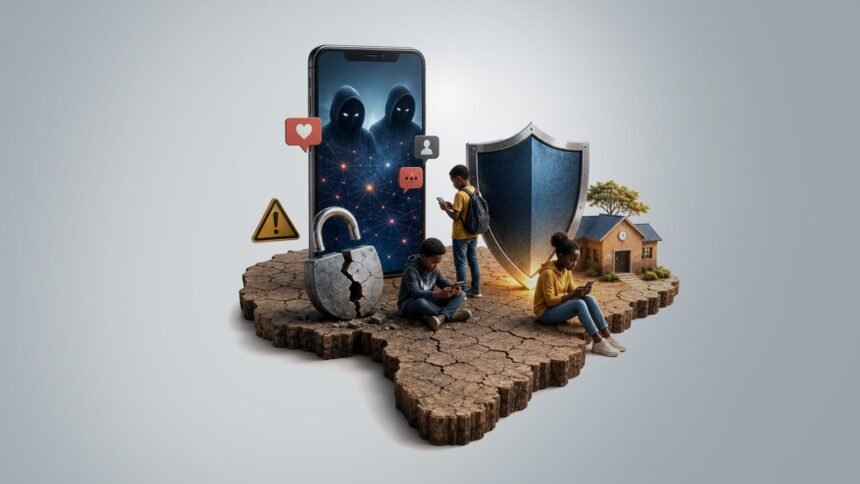
The Pan-African Paradigm of Child Protection in the Digital Age
Twenty million children, one in five of those surveyed between the ages of twelve and seventeen, were subjected in a single year to some form of technology-facilitated sexual exploitation or abuse — and fewer than one in a hundred of those experiences were ever reported to a police officer, social worker, or helpline. The scale documented in UNICEF’s new report, “Through Children’s Eyes: How Digital Technologies Enable Child Sexual Abuse,” released September 3 and drawing on research spanning several African countries including Kenya, Ethiopia, Mozambique, Namibia, Tanzania and Uganda, forces a reckoning that goes beyond individual platform failures or national policy gaps. It exposes a structural mismatch between the speed at which digital technology has embedded itself in African children’s daily lives and the pace at which protective institutions, legal frameworks and family support systems have adapted to govern that technology. Addressing it will require treating digital child protection as a matter of continental self-determination, not merely technical compliance imposed by foreign platforms headquartered thousands of miles from the children they affect.
The Anatomy of Digital Harm
The report’s findings, drawn from nationally representative surveys of roughly 21,000 internet-using children across 21 countries alongside in-depth interviews with 100 survivors, break the abuse into specific categories: over 15 million children exposed to unwanted sexual content, 9 million pressured into sexual conversations or image-sharing against their will, and 4 million whose own images were shared without consent. Nearly 60% of documented cases occurred on mainstream social media platforms, including Facebook, Instagram, Snapchat, TikTok and WhatsApp, with a further 14% occurring within online games, a distribution that implicates the design choices of platforms used daily by hundreds of millions of young Africans, not merely the behavior of isolated bad actors. Perhaps most striking is the finding that 57% of cases involved someone the child already knew, a peer, a romantic partner, a friend or family member, complicating the assumption, still dominant in much public messaging, that strangers primarily perpetrate online abuse.
The Human Cost Behind the Statistics
UNICEF Executive Director Catherine Russell described the findings as revealing “a painful reality,” noting that children were subjected to exploitation often in the very digital spaces where they learn, play and connect with friends. The report’s qualitative interviews capture the psychological toll in terms statistics alone cannot: children affected were found to be four times more likely to report suicidal thoughts, self-harm, or behaviors associated with acute distress, with the risk of suicidal ideation more than eight times higher among affected children in some surveyed countries. More than 40% of cases were never disclosed to anyone at all, a silence UNICEF attributes primarily to children simply not knowing where to turn, a gap that speaks directly to the absence of accessible, trusted reporting infrastructure across much of the continent.
Where African Institutions Fit the Data
The African countries included in this research, spanning both an earlier 2020-2021 survey round (Kenya, Ethiopia, Mozambique, Namibia, Tanzania, Uganda) and the broader 21-country dataset released this week, sit within a research initiative called Disrupting Harm, a joint project of UNICEF, ECPAT International and INTERPOL. That an initiative of this scale required a decade of cross-institutional collaboration to produce usable data underscores how thin the existing evidence base has historically been for policymakers across the continent attempting to legislate against a threat that, until recently, was poorly quantified. Without reliable data, African child protection agencies have often been left responding reactively to individual cases rather than designing systemic interventions calibrated to the true scale of the problem.
The Governance Gap Technology Companies Have Left Open
UNICEF’s recommendations are explicit about where responsibility should be redistributed: platforms must be made safer by design, with stronger privacy defaults, restrictions on unsolicited adult contact with minors, and better detection and reporting mechanisms built into the products themselves rather than left to overstretched national regulators to police after the fact. For African governments, many of which lack the regulatory leverage that the European Union or United States can exert over globally headquartered technology companies, this asymmetry is particularly acute. The report’s call to “strengthen laws, regulation and accountability” and to address emerging harms including AI-generated sexual abuse material lands at a moment when several African states are still building the basic institutional architecture, dedicated cybercrime units, trained child protection officers, functioning helplines, that such enforcement would require.
Shifting the Burden of Protection
The report’s most structurally significant recommendation may be its insistence on shifting the burden of protection away from children themselves and toward families, schools, communities and states. That reframing matters because it resists a familiar and ultimately self-defeating instinct: treating digital child safety as an individual vigilance problem rather than an institutional one. For African governments serious about digital sovereignty, in the fullest sense of the term, protecting children online cannot be an afterthought bolted onto broader digital economy ambitions. It must be built into the continent’s technology governance architecture from the outset, with reporting systems children trust, laws that keep pace with emerging harms, and a redistribution of accountability that finally places responsibility where the evidence says it belongs: not on the twenty million children who were harmed, but on the platforms, laws and institutions that failed to protect them.