





The Pan-African Paradigm of Strategic Autonomy and Structural Sovereignty
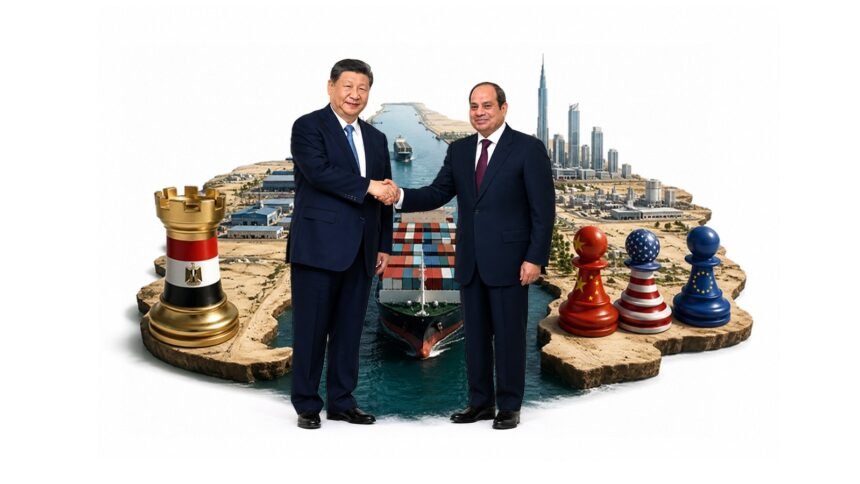
A 21-gun salute and a first Cairo visit in a decade greeted Xi Jinping this week. Still, the real substance sat behind closed doors at the Ittihadiya presidential palace, where Abdel Fattah el-Sisi and his Chinese counterpart signed off on the third phase of an industrial zone already worth roughly $4 billion and home to 200 companies. The timing was not incidental. As a six-month US-Iran war continues to threaten global maritime trade through the very waterway Egypt’s economy depends on, Cairo’s decision to deepen its Suez Canal partnership with Beijing reads as something more than routine diplomacy; it is a statement of structural sovereignty from a state determined not to be reduced to a pawn between Washington and Beijing. For a continent whose ports, canals and trade corridors have historically been leveraged by outside powers for their own strategic ends, Egypt’s calculated hedging offers a template: engagement with multiple poles of global power, on terms Cairo itself sets. The paradigm at stake is not simply bilateral friendship but the harder question of who gets to write the rules of transit, investment and alignment across African infrastructure, and whether the answer can, for once, run through African capitals rather than around them.
The Suez Canal Economic Zone as Institutional Architecture
The agreement signed this week is not a single investment but an expansion of an entire institutional apparatus. The Egyptian-Chinese industrial zone, anchored in the Suez Canal Economic Zone, is entering its third phase, building on a footprint that Egyptian officials say already comprises 200 operating companies. Cairo has not disclosed a figure for the new tranche of investment, a deliberate ambiguity that itself signals the asymmetric information dynamics at play in Global South infrastructure diplomacy; recipient states often reveal only what serves their negotiating position with other creditors and partners. What is measurable is the trade relationship underpinning it: Chinese customs data put Beijing’s trade surplus with Egypt at $12 billion in just the first seven months of 2026, a figure that illustrates how thoroughly Chinese manufactured goods have penetrated the Egyptian market even as Cairo positions itself as an investment destination rather than merely a purchaser. The zone’s expansion during a period of acute regional volatility suggests Beijing is treating the canal corridor as a long-horizon strategic asset, insulated as far as possible from the turbulence of the wider Middle East.
Sisi’s Independent Foreign Policy Doctrine
In an opinion column published in Egyptian media just a day before the summit, Sisi articulated what analysts are calling a doctrine of independent foreign policy, language that echoes the non-aligned movement’s mid-century vocabulary while updating it for an era of great-power competition over trade routes and critical minerals. Sisi framed the China relationship explicitly around “strengthening the role of the global south,” a formulation that positions Egypt not as a client state of either Washington or Beijing but as a broker within a multipolar order. The rhetoric arrives days after the US Treasury sanctioned the Emirati branch of Banque Misr, Egypt’s second-largest bank, over alleged support for Iran, a reminder that Cairo’s balancing act carries real financial risk. Egypt remains one of the largest recipients of US military aid. It has historically served as a key Middle East mediator. This role gives it leverage Washington is reluctant to jeopardize even as it tightens sanctions enforcement elsewhere in the region.
Megaprojects and the New Administrative Capital
Chinese capital has become deeply embedded in Sisi’s signature infrastructure agenda, most visibly in the New Administrative Capital rising 50 kilometers east of Cairo, much of which is Chinese-financed. This is not incidental to the Suez Canal announcement but part of a coherent pattern: Beijing’s involvement spans transport corridors, urban megaprojects and industrial manufacturing simultaneously, giving China multiple points of structural leverage within the Egyptian economy that extend well beyond any single canal-zone agreement. Streets across greater Cairo, a megacity of more than 26 million people, were lined this week with Chinese and Egyptian flags and joint billboards of the two leaders, an unmissable visual signal to both domestic and international audiences about the depth of the relationship Cairo is cultivating.
Military Cooperation and the Widening Security Dimension
The economic partnership sits alongside a deepening military one. Egypt, which under Sisi has become one of the world’s largest weapons buyers, hosted major joint air combat exercises with the Chinese military in August featuring Beijing’s J-16 fighter jet, a level of defense cooperation that would have been unthinkable for a historically US-aligned military just a decade ago. The two leaders’ talks this week also touched on the wider US-Iran conflict, with both governments calling for a “comprehensive agreement to end the war,” according to Sisi’s spokesperson. However, no further detail on additional agreements signed during the visit was disclosed. China, as a major buyer of Iranian oil, has its own direct stake in de-escalation, giving Cairo and Beijing overlapping incentives to project a shared diplomatic posture even as their economic entanglement deepens.
Reclaiming the Canal as African Leverage, Not Just Transit
What Egypt is attempting, and what the rest of the continent will be watching closely, is to recalibrate what canal diplomacy can mean for an African state in an era of contested global supply chains. For over a century, the Suez Canal has been treated primarily as a transit asset to be secured by whichever outside power had the greater interest in unimpeded shipping. Cairo’s approach this week, extracting industrial investment, trade surplus notwithstanding, and defense cooperation in exchange for continued access, suggests a shift toward treating the canal as a genuine instrument of national leverage rather than a passive geographic inheritance. Whether this model of calculated non-alignment can be replicated by other African states holding comparably strategic infrastructure, from ports in Djibouti to rail corridors in East Africa, will determine whether Egypt’s approach becomes a continental template or remains a singular case shaped by Cairo’s unique geography. Either way, the underlying claim that African infrastructure should be negotiated from a position of agency rather than dependency is one likely to recur as the world’s major powers continue competing for footholds across the continent.