





The Pan-African Paradigm of Agricultural Sovereignty and Resource Self-Determination
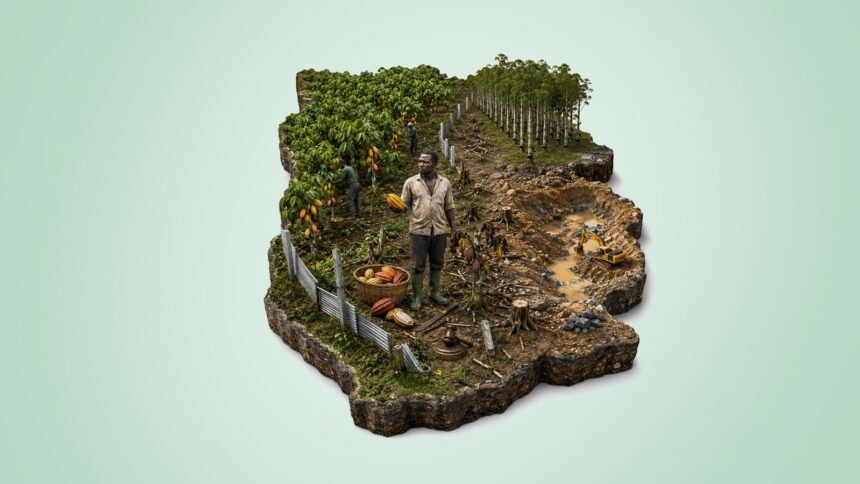
Across the African landscape, the question of who controls land, and for what purpose, remains one of the continent’s most persistent structural fault lines, a legacy of colonial-era extraction that independence never fully resolved. Ghana’s newly passed Ghana Cocoa Board Bill, 2026, which grants cocoa farms “protected” status and criminalizes unauthorized land-use conversion, with penalties of up to 20 years in prison, sits squarely within this paradigm. On its surface, the bill responds to a genuine crisis: cocoa land nationwide is being cleared for mining and rubber plantations, contributing to Ghana’s declining cocoa output even as Ghana and neighboring Ivory Coast together produce half the world’s supply of the commodity. But the farmers whose livelihoods the law claims to protect are themselves pushing back, arguing they were not adequately consulted before parliament passed it. This is the recurring tension of agricultural sovereignty on the continent: policies designed at the institutional level to preserve a strategic national resource can, without genuine grassroots participation, reproduce the very sense of dispossession they are meant to prevent, leaving farmers caught between ecological protection and economic self-determination.
A Bill Born of Vanishing Trees
The Ghana Cocoa Board Bill, approved by parliament in late July, bars anyone, including the farmers themselves, from converting cocoa farms to other uses without approval from market regulator COCOBOD, with exceptions only for board-sanctioned rehabilitation. The legislative intent is straightforward: curb the conversion of cocoa land to mining and other crops, a trend that has measurably contributed to Ghana’s declining output as portions of farmland nationwide are cleared for rubber cultivation and mining. President John Dramani Mahama has not yet signed the bill into law, nor offered a timeline for doing so, leaving it in a legislative limbo that has become the focal point of farmer advocacy. The structural logic of the bill reflects a genuine institutional concern: cocoa remains one of Ghana’s most strategically important export commodities, and its erosion through land conversion threatens both national export revenue and the livelihoods the law claims to protect, even as the mechanism chosen to protect it, criminal penalties for farmers, has become its most contested feature.
Farmers Caught Between Protection and Prosecution
The Ghana Cooperative Cocoa Farmers and Marketing Association Limited, an umbrella body for cocoa farmer cooperatives, has said it supports measures to protect farms but wants several provisions reviewed and better explained to growers before the bill becomes law. Its administrator, Moses Djan Asiedu, articulated the farmers’ central anxiety: land that has become commercially unproductive may need to be repurposed. Yet, the bill as written could expose farmers to prosecution for exactly the kind of adaptive land management smallholders have long practiced. “We agree the tree must be protected because that is the source of our livelihood, but we have critical situations where a farmer may have to cut down a diseased farm and plant another crop that will bring him or her income,” Asiedu said. This is the structural bind at the heart of the dispute: a law aimed at preserving collective agricultural sovereignty risks, in its current form, criminalizing the individual economic self-determination of the very farmers whose long-term livelihood security it claims to serve, a tension minority lawmakers in parliament have echoed in their own objections.
The Extractive Matrix: Mining, Rubber, and the Erosion of Cocoa Land
The bill’s underlying rationale reflects a broader extractive matrix reshaping land use across cocoa-growing regions of West Africa, where the same land can be converted to small-scale and industrial mining, rubber plantations serving global tyre and manufacturing supply chains, or left in cocoa cultivation whose returns to individual farmers, subject to volatile global commodity pricing, often lag behind the immediate cash incentives mining or rubber conversion can offer. This asymmetry, between the long-term national interest in preserving cocoa as a strategic export and the short-term individual incentive to convert land to more immediately lucrative uses, is precisely what the bill attempts to structurally correct through legal compulsion rather than economic incentives. Yet compulsion without consultation risks generating the same resentment that extractive land policies have historically produced across the continent, when decisions about resource use are made in the capital and enforced against communities whose day-to-day survival depends on flexibility the law does not accommodate. Ghana’s challenge, then, is to build a land-use architecture that protects the strategic commodity without foreclosing the adaptive economic self-determination that farmers say they still require.
COCOBOD’s Institutional Defense and the Politics of Dismissal
COCOBOD has firmly rejected the farmers’ criticism, with head of public relations Jerome Sam telling local media that the parliamentary minority’s objections were politically motivated and that the bill was drafted to help farmers, not harm them. This institutional posture, dismissing grassroots and opposition concerns as political opportunism rather than engaging with their substance, is itself a familiar pattern in how agricultural policy is contested across the continent, where regulatory bodies often possess more structural authority than the farmer cooperatives meant to hold them accountable. Whether COCOBOD’s confidence is well-founded or whether it reflects an institutional reluctance to revisit legislation already through parliament remains to be tested by Mahama’s decision on whether to sign the bill as written or return it for revision. The episode illustrates a recurring asymmetry in agricultural governance: the technical expertise and drafting authority concentrated within regulatory institutions like COCOBOD versus the lived, granular knowledge cocoa farmers hold about which provisions will function on the ground and which will criminalize necessity.
Toward a Cocoa Economy Built on Farmer Sovereignty
Ghana’s cocoa land dispute is, at root, a question of whose sovereignty a resource-protection law is meant to serve: the nation’s strategic interest in preserving its share of a commodity that, alongside Ivory Coast, supplies half the world’s cocoa, or the individual farmers whose adaptive land decisions have long sustained that supply against disease, soil exhaustion, and market volatility. Genuine agricultural self-determination requires reconciling both: a protective legal architecture strong enough to deter conversion to mining and rubber, paired with mechanisms flexible enough to let farmers manage diseased or unproductive land without fear of a twenty-year prison sentence. President Mahama’s decision on whether to sign the Ghana Cocoa Board Bill as passed, or send it back for the consultation farmers say they were denied, will signal whether Ghana’s institutions can absorb grassroots feedback before legislation hardens into law. As mining and rubber continue to encroach on cocoa land nationwide, the stakes extend beyond Ghana’s borders to every West African economy dependent on smallholder agriculture: sovereignty over land, ultimately, must be built with farmers, not merely legislated over them.