





The Pan-African Paradigm of Cultural Sovereignty and Creative Self-Determination
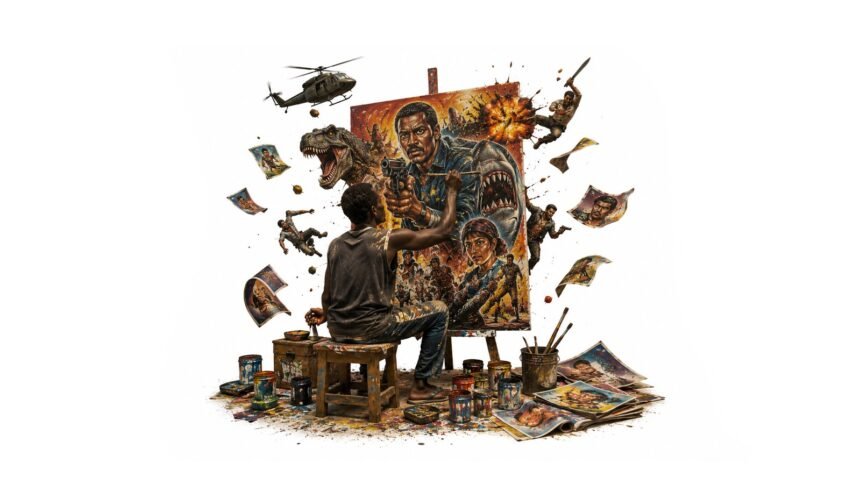
Across the African landscape, cultural forms born of scarcity and improvisation have repeatedly proven among the continent’s most enduring exports, transforming localized, informal practices into globally recognized art forms that reclaim narrative authority on African artists’ own terms. Ghana’s tradition of hand-painted film posters, born in the late 1970s out of the practical necessity of neighborhood video clubs seeking to attract audiences with imagery more compelling than the original studio artwork, exemplifies this pattern precisely. What began as competitive, often wildly inaccurate reinterpretations of foreign films has evolved into a globally collected art form, its practitioners now fielding commissions from international buyers willing to pay hundreds of dollars for works once dismissed as ephemeral promotional material. This trajectory, from improvised local necessity to recognized artistic tradition, mirrors a broader continental pattern in which African creative practices, initially undervalued or dismissed by external observers, are gradually reclaimed as sites of genuine artistic innovation and cultural sovereignty. This is the Pan-African paradigm of creative self-determination in its most vivid form: artists asserting interpretive authority over global cultural products, transforming constraint into a distinctly African visual language now sought after on the artists’ own economic terms.
From Video Clubs to Global Collectibles
The practice of hand-painting film posters emerged directly from Ghana’s neighborhood video club circuit, where organizers realized that official studio posters failed to draw sufficient audiences, prompting local artists to create their own promotional imagery instead. Competition among painters working for rival video clubs to produce the most compelling, often sensationalized, interpretation of a film’s plot became a defining feature of the practice throughout the 1980s and 1990s, before the spread of household televisions and personal video players caused the video club business model, and with it much of the original demand for the posters, to collapse around the turn of the century. Yet this apparent obsolescence proved temporary: the posters had already attained international visibility through books and gallery exhibitions abroad, and rare or historically significant pieces became sought-after collectibles, setting the stage for a renewed wave of commissioned work driven by online marketing and a receptive audience of international film enthusiasts eager to own a piece of this distinctly African visual tradition.
The Architecture of Artistic License
Central to the posters’ enduring appeal is what scholars describe as an African tradition of “visualizing the invisible,” a creative license through which artists incorporate scenes, imagery, and dramatic embellishments absent from the films they ostensibly depict. Joseph Oduro-Frimpong, director of the Center of African Popular Culture at Ashesi University, explains that because audiences had typically not yet seen the films being advertised, painters could freely engage in what practitioners themselves term “imaginative painting,” incorporating invented, often sensationalized elements to heighten anticipation. Artist Benjamin Amartey, known professionally as Stoger, described the process as using imagination “to make scenes that will attract people,” a philosophy that treats fidelity to source material as entirely secondary to visual and emotional impact. This deliberate departure from strict representational accuracy constitutes not a failure of craft but a distinctive artistic methodology, one that positions Ghanaian poster painters as active co-authors of the cinematic experience rather than passive illustrators of someone else’s narrative.
Institutional Preservation and the Deadly Prey Gallery Model
The contemporary revival of this tradition owes much to the structural bridge-building undertaken by Deadly Prey Gallery, co-founded in 2012 by former Chicago video store owner Brian Chankin and Ghanaian collector Robert Kofi, who had spent his childhood working as a promotional “hype man” for video centers in Winneba. The gallery now works with fifteen artists, including veteran painter Jeaurs Affutu, known as Heavy J, connecting them directly to an international customer base, predominantly American, willing to commission works starting at $600, depending on canvas size and thematic preference. Kofi’s role extends beyond simple brokerage into active creative direction, providing detailed feedback to artists such as Stoger on works in progress, in one instance requesting “uglier cat scenes” and dirtier depictions of spaghetti for a poster advertising the film Gummo. This institutional model, pairing informal artisanal production with structured international distribution, illustrates a replicable framework for sustaining African creative traditions that might otherwise fade for lack of viable domestic economic support.
Backlash and the Ethics of Reinterpretation
The posters’ interpretive liberties have not been without consequence, occasionally provoking anger from audiences who felt misled by imagery bearing little resemblance to the films actually screened. Kofi recounted being physically assaulted in the 1990s after moviegoers who had watched the action film Double Impact discovered it contained no beheading scene, despite one being prominently illustrated on the promotional poster. These episodes of backlash underscore the genuine stakes embedded in the posters’ creative license: audiences paying to watch a film based on promotional imagery experienced real consequences when that imagery diverged too dramatically from the product delivered, complicating any straightforward celebration of the tradition’s inventiveness with the more uncomfortable reality that such artistic embellishment operated within a commercial transaction where audience trust, and occasionally physical safety for the artists themselves, was directly at stake.
Preserving a Tradition, Reclaiming a History
As Kofi’s own words frame it, the ongoing work of Deadly Prey Gallery and its associated painters amounts to “preserving a tradition” and, more fundamentally, “preserving a history” that risked erasure as Ghana’s video club economy dissolved into obsolescence. The posters now displayed at Accra’s Center for National Culture, alongside works commissioned by collectors worldwide, represent more than nostalgic ephemera; they constitute a durable record of a uniquely African approach to visual storytelling, one that transformed economic necessity into an enduring artistic methodology later recognized on the global stage. For a continent whose informal creative economies are too often dismissed as transitional or derivative, Ghana’s hand-painted poster tradition offers a compelling counter-narrative: that improvisation born of scarcity can mature into a genuinely sovereign artistic form, commanding both cultural respect and international economic value squarely on its originators’ own terms, a template for how the broader project of African cultural self-determination might proceed elsewhere.