


A Raised Motorway Through Warraq and a Long Record of Road Deaths
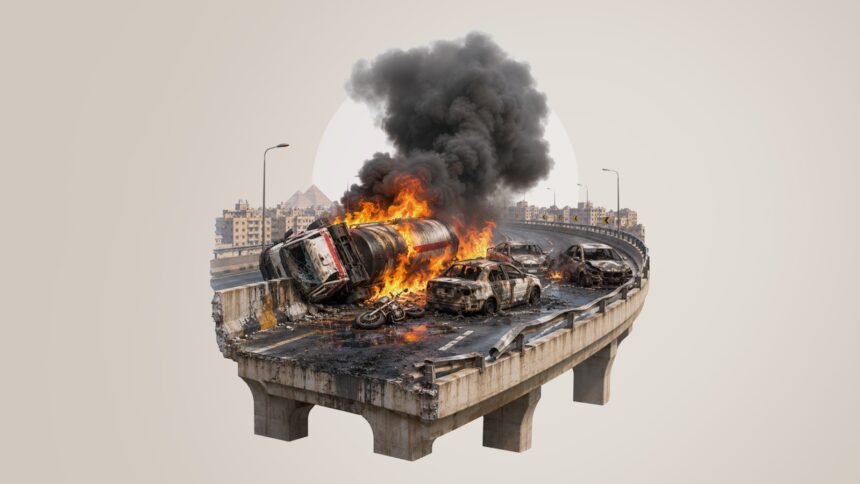
On Wednesday evening, a driver stuck in traffic on the raised ring road around Cairo watched the burning fuel truck ahead of him and counted bodies being lifted from cars. Ahmed Sameer said he saw at least eight. “It was a huge fire; the cars got stuck together because of the fire,” he said. “It was a shocking scene.” By Thursday, the toll stood at 31 dead and at least 21 injured; more than two dozen cars and motorcycles had been charred, and Egypt’s public prosecutor said a man had confessed to causing it.
The crash happened on the stretch of the ring road that runs through Warraq, a densely populated neighborhood in Giza, part of Greater Cairo, to the north of the old city center. Hospitals nearby treated patients for burns and smoke inhalation.
Road crashes are among the most ordinary ways that Africans die, and among the least discussed. In many fast-growing African cities, the roads that carry fuel and commuters run through crowded districts, and the systems meant to keep them safe, from enforcement to maintenance to emergency response, are tested by every crash. The Warraq fire is a North African case of a continental problem: infrastructure that moves fuel and people at speed through crowded districts, with little margin when something goes wrong.
What the Prosecutor Says Happened
On Thursday, the public prosecutor’s office announced the arrest of a motorist it accuses of causing the crash. According to the prosecutor, the man confessed to driving at 110 kilometers an hour along the ring road and clipping the tanker with the side of his car as he changed lanes. “Upon questioning the suspect and confronting him with the findings of the investigation… he confessed to committing the act,” the office said.
The prosecutor’s statement set out the sequence in some detail. While moving between lanes and overtaking, the left side of the man’s car struck the right rear of the tanker; he lost control of the steering and his car veered to the far right of the road. At the same moment, one of the tanker’s tires burst. The truck swung into the central reservation, hit the concrete barrier and overturned, spilling fuel that caught fire.
Authorities have not named the suspect. They said he was traveling with his father at the time. He has not yet been tried, and the confession is so far known only through the prosecutor’s account.
An Earlier, Different Explanation
The prosecutor’s version is not the first explanation to circulate. Before the arrest, sources close to the investigation said that a high-voltage cable had fallen in front of the fuel truck, causing its driver to lose control. The two accounts are not reconciled in the public record: one places the trigger outside the vehicles, in the road’s power infrastructure, and the other places it with a speeding private car. The difference matters, because it decides whether the lesson is about one driver or about the road itself.
The health ministry described the death toll as preliminary. Health Minister Khaled Abdel Ghaffar said the injured had been taken to nearby hospitals and later visited the scene and the wards. The public prosecutor’s office said DNA testing was underway to identify the victims, a sign of how badly many of the bodies were burned.
A Road Reopened Within Hours
The speed of the official response was striking. Emergency services reopened the raised motorway hours after the crash, with bulldozers and diggers shoving the burnt-out wrecks to the side of the carriageway. A spokesperson for the health minister said the remnants of the accident had been cleared.
President Abdel Fattah al-Sisi expressed his condolences to the victims in a statement. A cabinet minister said on Thursday that 10 million Egyptian pounds, about $182,000, had been donated to the families of the dead, and the sports minister said all state-run celebratory activities would be canceled in the aftermath.
Reopening a vital artery quickly is a practical necessity in a city of Greater Cairo’s size. It also means the physical evidence of what failed on that stretch of road, from the barrier to the overhead cables, was moved within hours. That places more weight on the investigation’s own findings and on how fully they are published.
Thousands of Deaths a Year
Egypt has a poor transport safety record. Deadly traffic incidents claim thousands of lives every year, and speeding, bad roads and weak enforcement of traffic laws are the main causes of most crashes. Poor maintenance and violations of traffic rules are routinely cited when collisions happen. The country has also suffered several deadly fires in recent years.
The Warraq crash joins a long list. In January 2016, 21 people were killed and 16 injured in a multi-car pile-up on a road near the southern province of Beni Suef. Each such disaster brings condolences, compensation and arrests; fewer bring visible changes in how fuel is moved through cities or how fast traffic is allowed to flow on elevated roads above homes.
What Accountability Should Cover
Holding an individual driver to account is necessary, and the courts will now test the prosecutor’s case. But a public safety response that ends with one arrest would leave the larger questions untouched. Those include the routes and hours that fuel tankers may use through dense neighborhoods, the condition of tires on heavy goods vehicles, the speed limits and their enforcement on the ring road, and the state of the overhead power lines that an earlier account blamed.
Egyptian authorities have the information to answer those questions: an investigation file, a confession, forensic work on the vehicles and the road. Publishing a full account of what failed, and what will change, would serve the families of the 31 dead better than the speed with which the wreckage was cleared.
Safety as a Measure of Self-Rule
For African states, the ability to keep citizens safe on their own roads is one of the plainest tests of self-government. It does not depend on foreign donors or global markets; it depends on rules, maintenance and enforcement that governments set and fund themselves. Greater Cairo depends on elevated roads like the one that burned in Warraq. The fire is a reminder that the value of that investment rests on what happens on those roads every day, and that a state’s authority is measured not only by how quickly it reopens a motorway, but by whether the next tanker passes through Warraq without incident.