




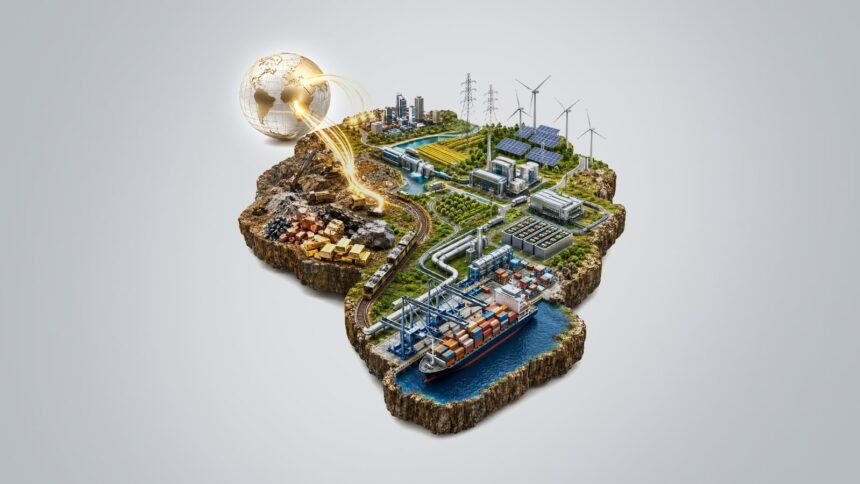
Africa is increasingly important to the global economy, particularly for food security and supply chains, clean energy and manufacturing; these resources make it a major destination for foreign investment. The central question is how international partnerships support African countries to process more of their natural resources locally.
The 21st century has brought major social, economic and environmental challenges. Climate change pressure on natural resources, food insecurity and energy demand are reshaping the global economy. Industrialization once helped many countries build wealth and technological capacity, but it also contributed to emissions, environmental degradation and unequal access to resources.
Today, the challenge is not simply to industrialize, but to do so in a cleaner, fairer and more sustainable way. Africa has often entered global markets mainly as a supplier of raw materials. At the same time, the continent possesses abundant renewable energy potential, critical minerals, agricultural land, strategic waterways and a young population.
Its geographic position also gives it a central role in trade between Africa, Asia, Europe and the Middle East. These assets create a major opportunity, but only if African countries can use investment to build industries rather than merely export resources.
Africa’s Resources and Potential Prosperity
Africa is becoming an important destination for investors from Europe, Asia, the Middle East and other regions. Climate change and the global transition to clean energy have increased demand for the minerals required for batteries, electric vehicles, power grids and renewable energy technologies.
The continent also has major solar and wind potential, alongside ports and transport corridors that can support regional and international trade.
Many African countries still lack sufficient industrial capacity to process their natural resources locally. This means that minerals and agricultural products are often exported in raw or low-value forms, while finished goods are imported at a much higher cost.
Investment should therefore be assessed not only by its headline value but by whether it supports local value addition, technology transfer, skills development, infrastructure and employment.
African leaders have built institutions and developed clear long-term strategies to manage partnerships and international collaboration. African Union frameworks call for investment and international partnerships to align with national development plans, regional integration and continental priorities, rather than allowing external actors alone to determine where capital is directed.
The African Union’s Agenda 2063 provides a long-term vision for an integrated, prosperous and peaceful continent, while the African Continental Free Trade Area creates opportunities to expand intra-African trade and build regional value chains.
Africa is not a passive recipient of foreign influence. African governments, regional institutions, and citizens have the right to set conditions for investment, protect strategic sectors, and ensure that partnerships contribute to national and continental development goals.
What Do UAE Investments Mean for Africa?
The United Arab Emirates has become an increasingly important economic partner for African countries. UAE companies announced more than US$110 billion in projects across Africa between 2019 and 2023, with more than US$70 billion directed toward green energy and renewable energy projects.
These figures demonstrate the scale of UAE interest in the continent, although announced projects and investment commitments should not automatically be treated as capital already spent or projects already completed.
UAE investment is spread across sectors including agriculture, ports, minerals, renewable energy, and infrastructure. These sectors can contribute to achieving the AU 2063 Agenda when projects are transparent, environmentally responsible and aligned with African priorities. They can also raise important questions about sovereignty, local benefits, strategic infrastructure and the management of natural resources.
Financial Times investigation examined the UAE’s commercial, industrial and security presence in Africa, with particular attention to Sudan.
A Financial Times investigation examined the UAE’s expanding commercial, industrial and security presence in Africa, including allegations concerning possible links between gold investment, regional influence and the conflict in Sudan.
Abu Dhabi and Rapid Support Forces rejected allegations made against them. The episode underlines why investment in fragile and conflict-affected settings requires transparency, independent scrutiny and effective public oversight
The discussion should not assume that Africa lacks agency. African governments have the responsibility to negotiate agreements that protect their public interest, ensure accountability and build long-term national capacity.
Major projects and opportunities
Several large projects show both the potential and the complexity of UAE-linked investment in Africa.
In February 2024, Egypt announced an agreement with an ADQ-led UAE consortium to develop Ras El-Hekma, a 170-square-kilometre site on the Mediterranean coast.
Egyptian officials described the US$35 billion package as the country’s largest foreign direct investment agreement.
The US$11billion of the stated total involved converting existing UAE dollar deposits at Egypt’s central bank into Egyptian pounds, rather than new cash inflows.
Egypt retained a 35% stake in the development.
In Mauritania, a consortium involving the UAE’s Masdar, Egypt’s Infinity and Germany’s Conjuncta signed a memorandum of understanding with Mauritania’s Ministry of Petroleum for a green-hydrogen project estimated at US$34 billion. The project aims to produce up to 8 million tonnes of green hydrogen annually.
It could help position Mauritania as a major supplier of green fuels, but its success will depend on financial closure, infrastructure, water management, environmental safeguards and meaningful local economic benefits.
It is important not to confuse this project with Mauritania’s separate AMAN green hydrogen proposal, which is associated with CWP Global and has been estimated at around US$40 billion. A clear distinction between projects, investors, costs and stages of development is essential in reporting on the green hydrogen sector.
The government of Morocco and the state-owned National Office of Electricity and Drinking Water signed agreements with an Emirati-Moroccan consortium for energy and water infrastructure projects estimated at more than US$14 billion.
The plans include seawater desalination facilities and a 1,400-kilometer high-voltage transmission line to carry renewable electricity to major urban and industrial centers. The projects are intended to strengthen water security and energy independence, with investment projected through 2030.
These investments show that foreign capital can support major infrastructure and renewable energy projects. But Africa’s interest should not be limited to hosting large projects. The stronger objective is to use investment to establish local industries, expand access to electricity and water, develop technical expertise, and create African-owned value chains.
What Foreign Investment Should Deliver
Foreign investment can help address Africa’s infrastructure gap, improve energy access, support food systems and create new opportunities for trade. Ports, roads, power networks, storage facilities, digital infrastructure and water systems are all essential for industrial development.
Investment must respond to African needs and priorities, not only the commercial interests of external partners. Africa’s critical minerals are particularly important in the global transition to clean energy.
Demand for cobalt, copper, lithium, manganese, graphite and other materials is growing as countries expand battery manufacturing, renewable power and electric transport.
African countries should ensure that this demand does not reproduce an extractive model in which resources leave the continent while manufacturing, innovation and higher value-added jobs remain elsewhere.
The next phase of investment must help transfer technology, strengthen local industries and develop regional supply chains. Africa has a clear opportunity to become more than a supplier of minerals for the global clean energy transition. It can become a producer of components, equipment and eventually clean energy technologies.
Climate finance, carbon markets and international climate funds can also play a role, particularly in supporting vulnerable communities and adaptation. Yet these mechanisms must be designed carefully. Climate finance should not become another form of extraction or create new burdens for countries already facing debt, climate impacts and limited fiscal space.
Sovereignty, Security and Long-Term Partnership
Investment in strategic sectors such as ports, minerals, energy, water and telecommunications must be governed by a clear national vision.
Tahese sectors affect sovereignty, security and long-term economic independence. African governments should evaluate not only the financial value of a proposal, but also its impact on public control, local employment, environmental security and national resilience.
Sudan illustrates the importance of this approach. Conflict, insecurity and political instability can delay long-term projects, weaken oversight and make communities more vulnerable. Across Africa, political instability and governance challenges remain barriers to sustainable investment.
These conditions do not mean the continent should reject investment; they underline the need for stronger institutions, transparent agreements and accountable partnerships.
The UAE’s growing role in Africa attracts attention because of the scale of its announced investments, and its focus on infrastructure, energy and logistics.
The real measure of success will not be the number of agreements signed or the size of headline figures alone, but also whether these partnerships enable African countries to turn their resources into industrial power, create value at home and build a more independent and sustainable future.