






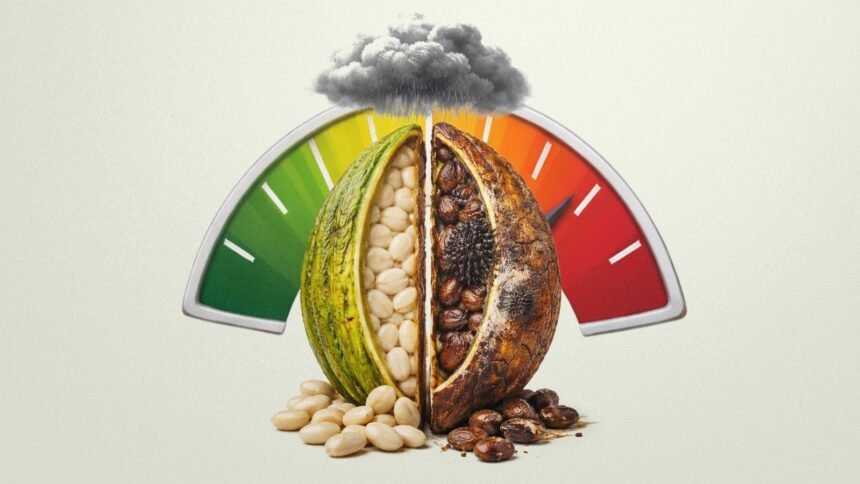
Pan-African Cocoa Legacy: Enduring Roots Amid Shifting Sands
Cocoa farming in Africa embodies a profound Pan-African legacy, intertwining cultural heritage with economic vitality across the continent. Introduced in the late 19th century, cocoa swiftly became a cornerstone of livelihoods, particularly in West Africa, where it supports millions of smallholder farmers. This crop, derived from the Theobroma cacao tree, thrives in humid tropical climates and yields beans essential to global chocolate production. Africa’s dominance in cocoa output—accounting for over 70 percent of global output—stems from fertile soils and traditional agroforestry systems that blend cocoa with shade trees, fostering biodiversity and soil health.
Yet, this legacy faces unprecedented upheaval. Historical practices, honed over generations, emphasized sustainable cultivation in shaded groves to mitigate heat and preserve moisture. However, rapid urbanization, deforestation, and now intensifying climate shifts erode these foundations. In nations like Ghana and Côte d’Ivoire, cocoa has long symbolized resilience and communal prosperity, but recent seasons reveal vulnerabilities. Over the past decade, erratic weather patterns have compounded age-old challenges, transforming bountiful harvests into tales of scarcity. This Pan-African narrative urges a reevaluation, blending ancestral wisdom with modern innovations to safeguard cocoa’s role in continental sustenance and trade.
Cocoa Powerhouses: Pillars of Production in a Volatile Era
Africa’s cocoa powerhouses form the backbone of global supply, with West African nations leading the charge. Côte d’Ivoire reigns supreme, producing around 40 percent of the world’s cocoa, followed closely by Ghana at 20 percent. Together, these titans yield over 2 million tonnes annually, sustaining economies where cocoa accounts for up to 10 percent of GDP. Cameroon and Nigeria contribute significantly, with outputs bolstering regional diversity—Cameroon’s fertile volcanic soils and Nigeria’s expansive plantations adding resilience. Smaller players like Ecuador and Indonesia pale in comparison, underscoring Africa’s unrivaled scale.
These powerhouses exemplify agri-business prowess, yet they grapple with intertwined challenges. Smallholder farms, averaging under 5 hectares, dominate production, employing labor-intensive methods that yield modest yields of 400-500 kilograms per hectare. Recent data from 2025-2026 highlights a rebound in some areas due to improved rains, but overall output dips amid disease and weather woes. Ghana’s harvest, for instance, halved in recent years before a partial recovery, while Côte d’Ivoire contends with land degradation. This Pan-African mosaic reveals a sector ripe for transformation, where leading nations must pivot toward sustainable models to maintain their global stature and empower rural communities.
Climate Change Onslaught: Ravaging Africa’s Cocoa Heartlands
Climate change unleashes a relentless onslaught on Africa’s cocoa landscapes, reshaping terrains once ideal for cultivation. Rising temperatures—projected to climb 2-3 degrees Celsius by mid-century—exacerbate evapotranspiration, drawing moisture from soils and plants faster than it can be replenished. In West Africa, where cocoa requires stable warmth below 32 degrees Celsius, excessive heat waves now plague over two-thirds of growing regions, adding weeks of debilitating conditions each year. Erratic rainfall patterns compound this: prolonged droughts desiccate pods, while intense floods spread fungal diseases such as black pod, slashing yields by up to 40 percent in affected seasons.
This climatic turmoil manifests regionally. In Côte d’Ivoire and Ghana, the epicenters, severe contractions are occurring in suitable areas—up to a 50 percent loss in Côte d’Ivoire alone—as optimal altitudes shift from 100-250 meters to 450-500 meters. Conversely, eastern zones like Cameroon and Nigeria may gain arable land, with projections of 11-20 million additional hectares of arable land. Yet, inter-annual variability spikes, with pests and viruses migrating into new territories, disrupting supply chains. The 2024-2025 crises, marked by El Niño-driven extremes, underscore this: global surpluses turned deficits, inflating prices before a 2026 downturn. Africa’s cocoa heartlands, vital for Pan-African agri-business, now teeter on a precipice, demanding urgent recalibration to avert widespread livelihood collapse.
Agri-Business Resilience: Weathering the Climatic Storm
Amid the climate’s fury, Africa’s cocoa agri-business demonstrates remarkable resilience, adapting through innovative practices that blend tradition with technology. Smallholders, who comprise 90 percent of producers, address yield declines by integrating agroforestry—intercropping cocoa with shade trees such as banana or rubber—to buffer against heat and retain soil moisture. This approach not only curbs deforestation but enhances biodiversity, reducing vulnerability to pests amplified by warming. In Ghana, where production rebounded modestly in 2026 despite payment woes, farmers use pruning and fertilizer to bolster tree vigor and counter drought-induced stress.
Economic pressures intersect with climatic ones, as seen in Ghana’s recent financing shifts. Traders’ reluctance to pre-finance amid falling global prices—down 20 percent in 2026—exacerbates delays and hinders investments in resilient varieties. Yet Pan-African initiatives shine: cooperatives in Côte d’Ivoire and Cameroon promote drought-resistant hybrids that yield 30-60 percent more under stress. Digital tools, like weather apps, empower timely planting adjustments, mitigating flood risks. This resilience fortifies agribusiness chains, from bean processing to export, ensuring Africa’s cocoa sector remains a pillar of development despite the storm’s intensity.
Adaptation Imperatives: Forging Paths Through Uncertainty
Adaptation emerges as an imperative for Africa’s cocoa farmers, weaving Pan-African ingenuity into strategies that confront the climate’s caprice. Core tactics include adopting resilient varieties engineered for heat and drought tolerance, potentially boosting yields by 30-45 percent in vulnerable zones. Staggered planting and mulching preserve soil health, while irrigation systems—though resource-intensive—shield against erratic rains. In Nigeria and Cameroon, expansion into newly suitable areas leverages projected gains, but demands sustainable planning to avoid deforestation.
Education and training amplify these efforts: programs targeting women and youth demystify climate-smart techniques, fostering diversification into non-farm activities or intercropping with staples. Ghana’s associations advocate for timely maintenance, such as pruning in January, which is critical amid payment delays that threaten loan servicing. Pan-African collaborations, such as AU-backed hubs, integrate digital forecasting with traditional knowledge, reducing variability. Yet, barriers persist—financing gaps of billions hinder scalability. These imperatives not only safeguard harvests but propel agri-business toward equity, empowering smallholders to thrive in an uncertain climate.
Development Horizons: Envisioning a Thriving Cocoa Future
Africa’s cocoa future beckons transformative development, harmonizing climate adaptation with Pan-African growth. By 2030, the sector could swell to a trillion-dollar market if resilient practices prevail, harnessing 60 percent of global arable land. Investments in value addition—local processing to curb import dependence—promise job surges, outpacing manufacturing growth. Ghana’s 2026 challenges, such as overpriced beans amid surpluses, highlight the need for policy reforms: aligning farmgate prices with market prices while subsidizing adaptation.
Pan-African visions emphasize unity: free trade under AfCFTA could amplify intra-continental exchanges, reducing volatility. Climate-smart hubs foster youth-led innovations, from AI-monitored farms to carbon-credited agroforestry, mitigating emissions. Challenges like aging trees and gender disparities loom, but opportunities abound—demographic booms spur demand for processed goods. As cocoa evolves from export staple to development engine, it promises food security, economic sovereignty, and environmental stewardship, illuminating horizons where Africa’s harvest endures and prospers.


