






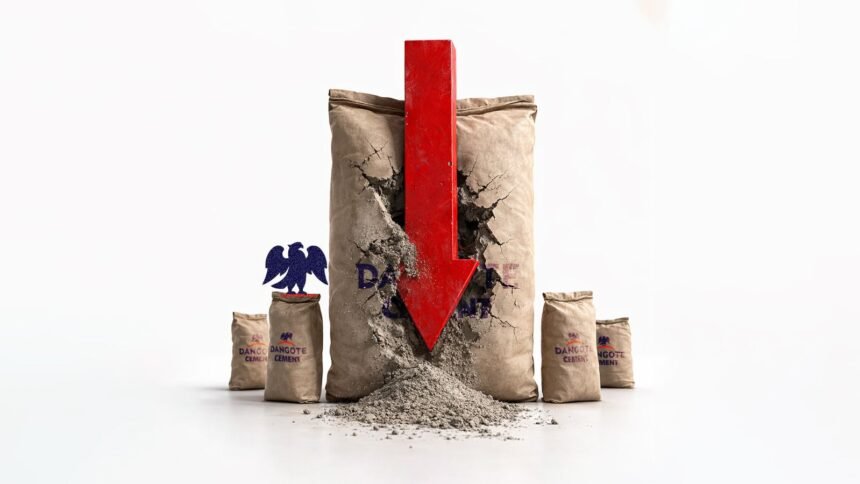
Dangote Cement’s Cameroon unit suffered a sharp setback in 2025, with sales volumes dropping 14.1% to 1.2 million tons as post‑election unrest disrupted economic activity in key cities.
The decline from 1.4 million tons in 2024 represents a loss of roughly 200,000 tons at the company’s Douala plant, which has an installed capacity of 1.5 million tons.
Cameroon’s construction sector had already been grappling with higher input costs, delayed public‑works payments, and tighter credit conditions, and the political crisis turned what might have been a modest slowdown into a sharp shock for cement demand.
According to audited financial statements cited by Business in Cameroon and other local outlets, Dangote Cement directly linked the slump to uncertainty and protests following Cameroon’s October 2025 presidential election.
The announcement of official results sparked demonstrations and clashes in several urban centres, including Douala, the country’s economic capital and home to the Dangote plant, temporarily paralysing construction sites, logistics networks, and retail cement sales.
In some neighbourhoods, contractors halted works pre‑emptively amid fears of looting or damage to equipment, while haulage companies scaled back operations as roadblocks and security checkpoints multiplied.
The Cameroonian downturn weighed on Dangote Cement’s broader pan‑African performance. Group figures show total African volumes slipped 1.6% to 11.0 million tons in 2025, while pan‑African EBITDA fell 14.8% to 294.1 billion naira, with margins narrowing from 23.3% to 20.2% as weaker demand in Cameroon combined with headwinds in Senegal, Ethiopia, Ghana, and South Africa.
The episode underscores how localised unrest in a single market can ripple through a regional balance sheet, tightening margins even when overall group volumes remain broadly resilient.
Despite the hit, management remains upbeat about Cameroon’s medium‑term prospects. The company is banking on a pipeline of planned and ongoing infrastructure projects, including the Douala–Yaoundé highway and multiple road and bridge schemes, to drive a rebound in cement demand once the political environment stabilises.
Government plans to use infrastructure as a lever for growth, alongside housing programmes and industrial estates, could provide a floor for demand if budget execution and disbursements improve.
Dangote, which broke a decades‑long Cimencam monopoly when it entered Cameroon in 2015, continues to see Cameroon as a strategic growth market in Central Africa.
The group is also pressing ahead with a wider expansion push across the continent. On 28 February 2026, Aliko Dangote signed a US$1 billion engineering and construction deal with China’s Sinoma International Engineering to support new capacity and upgrades in Cameroon and six other African markets.
For Dangote, the Sinoma partnership is designed not only to add capacity, but also to modernise plants, cut unit energy costs, and position the group to capture market share when demand rebounds across its African footprint.
In Cameroon specifically, the company is weighing whether to expand the existing Douala facility or revive a long‑discussed plan for a new 1.5‑million‑ton plant in Nomayos, near Yaoundé.
Analysts say the final investment decision, and the pace of any demand recovery, will hinge on how quickly Cameroon can restore investor confidence after the electoral turmoil and demonstrate a credible commitment to macroeconomic stability.
Beyond the immediate numbers, the 2025 results highlight a broader dilemma for African industrial champions: scale brings efficiencies and regional influence, but it also magnifies exposure to sudden political shocks in key markets.
For Dangote Cement, Cameroon’s downturn is both a warning about political‑risk concentration and a test of its long‑term bet on Central Africa’s infrastructure and housing needs.





