





The Pan-African Paradigm of Youth and Self-Presentation
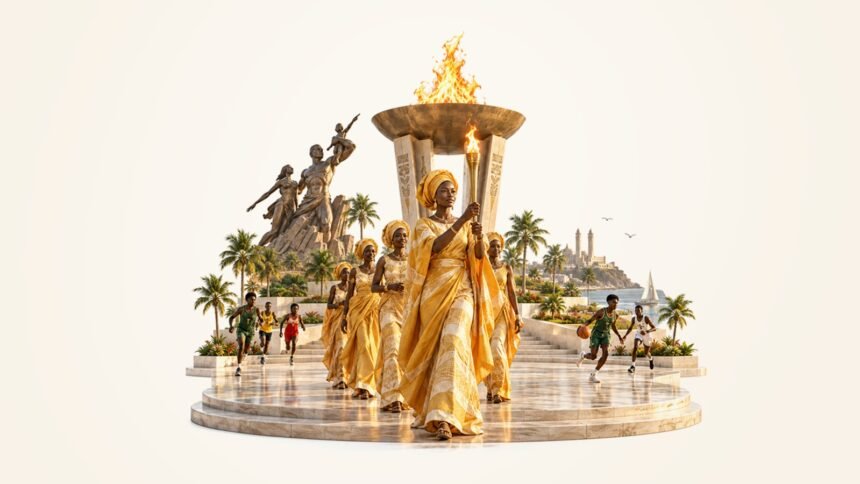
One hundred women dressed in saffron and gold walked a waterfront plaza in Dakar on Saturday, carrying a flame that had traveled four thousand kilometers from a parabolic mirror in Athens to a continent hosting an Olympic sporting event for the first time in the modern Games’ 130-year history. The arrival of the torch for the Dakar 2026 Youth Olympic Games is, on its surface, a matter of ceremony: music, dancing, a procession of “lingeer,” women bearing a Wolof title once reserved for queens, moving past portraits of the African diaspora’s most consequential figures. But ceremony of this scale is never only ceremony. It is a claim, staged in public, that African cities can convene the world’s youth on their own soil, under their own protocols, without mediation by a former colonial capital or a wealthier continent’s broadcasting calendar. For a population that is, demographically, the youngest on Earth, the symbolism of self-presentation carries a weight that outsiders often miss: it is a rehearsal for the argument that African institutions can build, host, and govern their own future, rather than merely supplying its athletes and its raw materials to arenas built elsewhere.
Lingerie and the Architecture of Ceremonial Sovereignty
The choice to entrust the flame to one hundred Senegalese women was not incidental. Organizers selected figures from culture, sport, and commerce, dressing them in flowing traditional garments and yellow headwraps as they carried the torch to Dakar’s Place du Souvenir Africain, a plaza built explicitly to commemorate the African and diasporic experience. Gacirah Diagne, one of the lingerers, framed the moment as generational: the Games, she said, would inspire young people across a continent whose median age remains under twenty. Senegalese basketball legend Mame Maty Mbengue lit the Olympic cauldron, deliberately pairing elite sporting achievement with civic ritual. This is the structural logic beneath the spectacle, an institutional decision to make the transfer of Olympic fire an act of intergenerational transmission, “the passing of values between generations,” rather than a broadcast-friendly photo opportunity borrowed wholesale from European precedent.
An Institutional Matrix: From Singapore to Diamniadio
The Youth Olympic Games, first convened in Singapore in 2010 as a smaller, younger sibling to the senior Olympics, has never before been staged on African soil. The inaugural African edition falls to Senegal, a country whose diplomatic and cultural capital in West Africa has grown steadily over the past decade, and is itself a data point in the recalibration of which nations get entrusted with global sporting infrastructure. Beginning October 31 and running through November 13, the Games will convene roughly 2,700 athletes aged fifteen to eighteen, competing across 35 sports in Dakar and the satellite cities of Diamniadio and Saly. The presence of International Olympic Committee president Kirsty Coventry, herself Zimbabwean and the first woman and first African to hold that office, situates the Dakar Games within a broader institutional shift: African representation is moving from the periphery of Olympic governance toward its administrative center.
Fourteen Regions, Four Hundred Torchbearers
Beyond the opening ceremony in the capital, the flame’s itinerary is itself a statement of national inclusion. Starting Monday, the torch begins a 3,600-kilometer tour through all fourteen of Senegal’s regions, carried by more than 400 torchbearers before returning to Dakar for the formal opening. This is not merely logistics; it is a deliberate act of national self-inscription, ensuring that a Games nominally hosted by a capital city becomes, through the relay’s choreography, a project claimed by every province and community the flame passes through, from the rural interior to the Atlantic coastline. In a region where infrastructure spending often concentrates in capital cities at the expense of provincial development, a torch relay engineered to touch all fourteen regions carries an implicit argument for equitable national participation in a moment of continental prestige.
Reclaiming the Ledger of Global Sport
For decades, the calculus of global sporting mega-events has run in one direction: African athletes travel outward, to European academies, American universities, and Gulf training camps, while the infrastructure, broadcasting revenue, and institutional prestige of hosting remain concentrated elsewhere. The Dakar Youth Olympics inverts that ledger, if only partially and only for a fortnight. It asserts that hosting capacity- stadiums, logistics, security, and hospitality for thousands of visiting delegations- is not a privilege reserved for wealthier regions but a structural competency that African states are entitled to develop and demonstrate. As the flame completes its cross-country tour and the Games themselves commence at the end of October, the deeper measure of success will not be medal counts but institutional continuity: whether Senegal’s investment in youth sporting infrastructure survives the closing ceremony, and whether the continent’s claim to convene its own global spectacle becomes a durable pattern rather than a singular exception. In that sense, the flame carried through fourteen regions this month is less an ending than an opening argument, one Senegal, and the continent behind it, is only beginning to make.