





The Pan-African Paradigm of Health Security and Productive Capacity
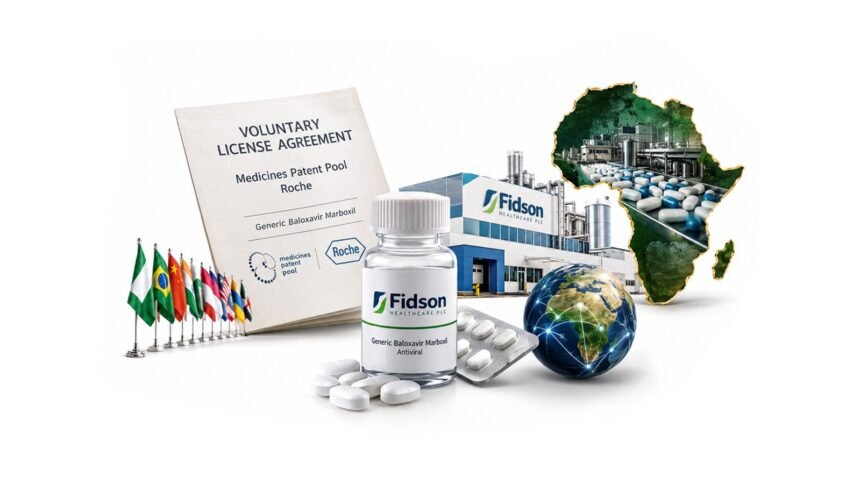
Eleven manufacturers, nine countries, one molecule. When the Medicines Patent Pool announced on September 25 that it had sublicensed the production of generic baloxavir marboxil, an influenza antiviral, one name on the list belonged to Lagos: Fidson Healthcare Plc, which disclosed its selection this week. The announcement is modest in tone but weighty in implication for a continent that imported the overwhelming share of its medicines during the pandemic years and learned, painfully, how supply chains behave in a crisis. Pharmaceutical sovereignty is not achieved through declarations; it is built license by license, factory by factory and regulatory approval by regulatory approval. Reclaiming the capacity to manufacture what Africans need to survive is among the most concrete forms of self-determination available.
The License and Its Reach
Under a voluntary licensing agreement between the Medicines Patent Pool, a United Nations-backed public health organization, and the Swiss company Roche, Fidson is one of eleven manufacturers chosen to develop, manufacture and supply generic versions of baloxavir. The selected producers come from Brazil, China, India, Indonesia, Malaysia, Nigeria, Uganda, Ukraine and Vietnam. The license covers 129 countries, with production subject to regulatory authorization in each. The Patent Pool said the arrangement is intended to diversify supply pathways for influenza treatment, support regional production and strengthen preparedness for future outbreaks and pandemics. For Nigeria, the significance lies in being counted among the producers rather than the purchasers.
Technology Transfer and the Selection Process
Selected manufacturers gain access to technical data, reference products for bioequivalence studies and other support designed to facilitate product development and regulatory approval. The Patent Pool said it chose them through an open expression of interest process and an assessment of their technical and regulatory capacities and their commitment to producing quality-assured products. That structure matters. Competitive, criteria-based selection places African firms on the same footing as their global peers, and the embedded technical support addresses the practical barrier that often prevents licensed production from becoming real production: the difficulty of demonstrating equivalence to regulators. It is an institutional pathway rather than a charitable gesture.
Regional Production as Preparedness
The Patent Pool noted that manufacturers in different regions would help build production capacity closer to the populations the medicines are intended to serve. Proximity is more than a logistical advantage. It shortens delivery times during an outbreak, reduces exposure to export restrictions and currency shocks, and keeps pharmaceutical expertise, employment and quality assurance within national borders. Nigeria’s selection, alongside Uganda’s, signals that the continent is beginning to appear in licensing maps that were historically drawn elsewhere. Yet a license is a starting point, and the recurring challenge for African producers remains financing, reliable power, skilled technicians and regulatory harmonization across fragmented national systems.
From License to Market: The Unfinished Work
The same week brought a reminder of what is at stake in the wider health landscape, with the World Health Organization reporting that drug-resistant bacterial infections kill one million people annually, a figure carried in Nigerian coverage alongside the Fidson news. The juxtaposition underscores that production capacity must expand across the therapeutic spectrum, from antivirals to antibiotics. Nigeria is also reported to be developing a digital health architecture to integrate its health systems, a complementary step that could connect manufacturing to surveillance and procurement. The paradigm that emerges is of a health sovereignty built from several parallel strands: licenses, factories, regulators and data systems.
Reclaiming the Medicine Cabinet
The measure of success will not be the press release but the pharmacy shelf. If Fidson secures regulatory authorization and delivers affordable, quality-assured baloxavir, it will demonstrate that African manufacturers can participate in global licensing regimes and meet their standards. That demonstration carries continental weight, encouraging further licenses, investment and policy support. The aspiration of the African Union and national governments to produce a far greater proportion of the continent’s medicines locally depends on precisely such incremental proof. Self-reliance in health is accumulated one approved product at a time, and each one narrows the distance between dependency and sovereignty.