





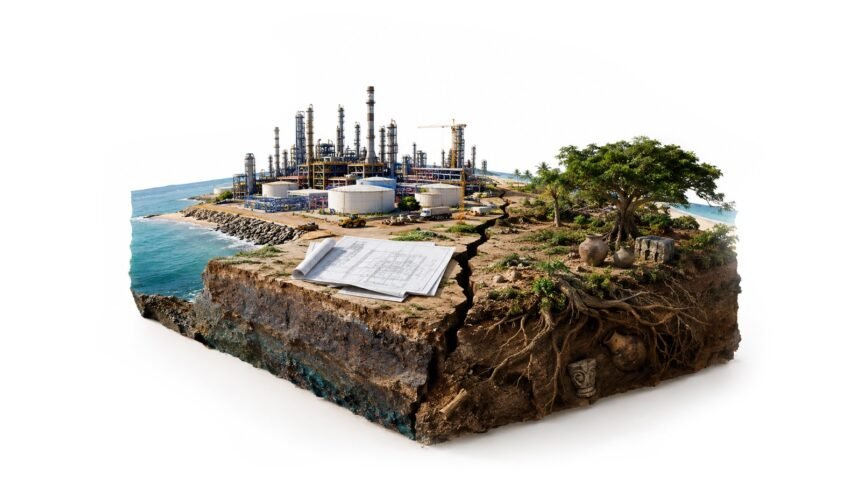
The Pan-African Paradigm of Industrial Ambition and Communal Inheritance
Seven hundred thousand barrels a day, sixteen billion dollars, and a coastline that more than 130 residents call their ancestral heritage. When Nigerian billionaire Aliko Dangote and Kenya’s President William Ruto walked amid heavy machinery at the groundbreaking ceremony in Lamu on September 30, the spectacle projected confidence. Within days, a second legal challenge arrived to puncture the choreography. The collision between mega-project finance and community claims is one of the defining tensions of African development in this decade. Reclaiming the continent’s industrial future requires reconciling the scale of capital with the legitimacy of consent, and the Lamu refinery has become an early test of whether that reconciliation is possible.
A Second Legal Hurdle
The Consumers Federation of Kenya filed a petition with the Public Private Partnerships Petition Committee, as its Secretary General, Stephen Mutoro, announced on X. The group alleges that key details of the project have not been made public and wants any non-compliant approvals set aside and reconsidered. It also seeks disclosure of the government’s plan to take a stake in the refinery, including the acquisition vehicle, the share class, the payment terms and evidence of public participation. The petition thus reframes the dispute from one about land into one about transparency, treating the refinery as a public-private partnership whose terms belong to the citizens who may ultimately underwrite it.
The Land Question in Lamu
The first challenge came from more than 130 residents who filed suit claiming that the land where the plant is being built is their ancestral heritage. A hearing is scheduled for October 14. Land in coastal Kenya carries layered histories of customary tenure, colonial-era titling and state acquisition, and a single judgment rarely resolves disputes of this kind. Their significance is structural: they ask whether communities are partners, beneficiaries, or obstacles in projects framed as national and regional priorities. How courts and officials treat the residents’ claims will signal the extent to which property rights and customary ownership are respected when large investments arrive.
Dangote’s Response and the Question of Tone
At the groundbreaking, Dangote shrugged off the land rights claim and expressed confidence that construction would proceed, remarking that anybody who wants to cause trouble would find his side ready. A Dangote Group spokesperson declined to comment on the new petition, and a Kenyan government spokesperson did not immediately respond to a request for comment. The rhetorical posture is revealing. Investors accustomed to negotiating with governments sometimes underestimate how legal and civic institutions can slow a project, and confrontational language risks hardening opposition among communities whose cooperation is essential to the refinery’s long-term operation.
Regional Stakes and the 2030 Horizon
Dangote intends to replicate his group’s 700,000-barrel refinery in Nigeria, and he has offered regional governments a combined 30 percent stake in the Lamu facility, which is scheduled for completion in 2030. The offer positions the project as a vehicle for East African industrial integration, potentially reducing the region’s dependence on imported refined fuels. That prospect is attractive at a time of volatile energy markets, yet the governance questions are inseparable from the economic ones. A regional stake is only as valuable as the transparency of the arrangements through which it is held, and the consumer federation’s demand for disclosure goes to the heart of that matter.
Reclaiming Development on Terms of Consent
Africa needs refining capacity, industrial employment and energy security, and projects of this magnitude can deliver them. But a development model that relies on speed over consent invites the very delays it seeks to avoid. The more durable path pairs capital with accountability: published terms, genuine public participation and respect for communities who have inhabited the land for generations. If the Lamu refinery proceeds on that basis, it could become a template for continental industrialization. If it proceeds despite unanswered questions, it will serve as a cautionary tale in the long struggle to align African economic ambition with African self-determination.