





The Pan-African Paradigm of Climate Vulnerability and Institutional Preparedness
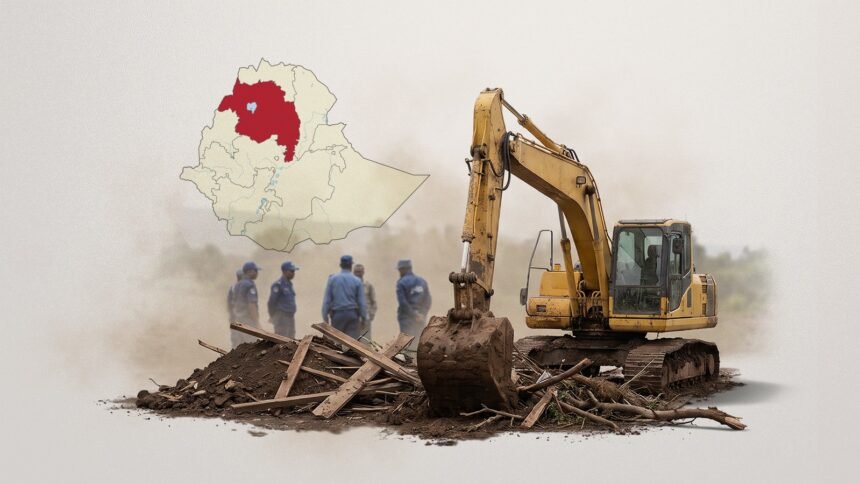
Across the African landscape, the widening gap between accelerating climate volatility and the institutional capacity to withstand it has become one of the continent’s most urgent structural challenges, and the deadly landslide that struck near the Tsadkane Mariam Monastery in Ethiopia’s Amhara region this week is a stark illustration of that trajectory. Fourteen people are confirmed dead after the ground gave way in the North Shewa zone, according to the state-run Amhara Media Corporation, with search teams and excavation machinery still working to recover bodies as this brief goes to print. While the precise trigger has not been officially confirmed, independent reporting points to the heavy rains that define Ethiopia’s June-to-September rainy season, a seasonal pattern that has become increasingly erratic and intense as regional climate patterns shift. This tragedy sits within a broader continental paradigm: African nations, despite contributing a fraction of global greenhouse gas emissions, disproportionately bear the physical and institutional burden of adapting to a destabilized climate, often without the early-warning systems, land-use planning frameworks, or emergency response architecture that wealthier nations take for granted. Reclaiming genuine climate resilience for Africa will require not just disaster response in the aftermath of tragedy, but a systemic recalibration of how the continent invests in anticipatory infrastructure before the ground gives way again.
The Site: Sacred Ground, Structural Risk and the North Shewa Terrain
The landslide’s location near a monastery in North Shewa is not incidental to understanding its impact. Ethiopia’s highland terrain, characterized by steep escarpments and historically significant religious sites often built into hillside topography for spiritual and defensive purposes, creates a structural vulnerability matrix in which communities, pilgrims, and religious infrastructure cluster in precisely the zones most susceptible to saturation-triggered slope failure. The Amhara Media Corporation’s report did not specify what precipitated the collapse, reflecting a broader pattern across the region in which disaster attribution often lags behind the human toll, complicating the systemic analysis needed to prevent recurrence. What is clear is that search-and-recovery operations, reliant on the deployment of excavation machinery to a monastery site, likely without extensive prior engineering assessment, illustrate the reactive posture that characterizes disaster-response infrastructure across much of rural Ethiopia. This is not a critique of individual response teams, who are working under difficult conditions, but a diagnosis of a structural gap: the absence of predictive geological mapping and slope-stability monitoring in regions where both population density and rainfall intensity are converging toward higher landslide risk.
Rainfall Recalibration: Ethiopia’s Rainy Season in an Era of Climate Instability
Ethiopia’s main rainy season, running from June through September, has long shaped agricultural cycles and settlement patterns across the Amhara highlands. Still, the intensity and unpredictability of seasonal rainfall have shifted markedly in recent years, a trajectory consistent with broader climate volatility trends documented across the Horn of Africa. Independent reports attributing this week’s landslide to heavy rains fit within a pattern in which historically manageable seasonal precipitation increasingly produces saturation events beyond what slopes, drainage infrastructure, and soil retention systems were designed to withstand. This asymmetric climate burden, in which regions with the least responsibility for global emissions face escalating exposure to extreme rainfall, flooding, and slope failure, has become a recurring theme across Ethiopia, Uganda, Kenya, and the wider East African highlands, where similar landslide tragedies have struck in recent years. The structural sovereignty implication is significant: without meaningful investment in climate adaptation architecture, including reforestation, terracing, and early-warning rainfall monitoring, communities in geologically vulnerable zones will continue to absorb the human cost of a climate crisis they did not create, underscoring the urgency of continental climate finance mechanisms that direct resources toward anticipatory rather than purely reactive infrastructure.
Institutional Response and the Limits of Reactive Disaster Architecture
The response to this week’s landslide, coordinated through Amhara regional authorities and state media channels, followed a familiar pattern across the continent: rapid dissemination of casualty figures, mobilization of search-and-recovery machinery, and a public information vacuum around causality and prevention. This is not unique to Ethiopia; it reflects a continental pattern in which disaster management institutions are frequently structured around response rather than anticipation, a legacy of historically limited fiscal space for investment in geological surveying, hazard mapping, and community-level early-warning systems. Ethiopia’s federal and regional disaster risk management architecture has made meaningful strides in recent years, particularly in drought- and famine-early warning systems developed in the wake of past humanitarian crises, but slope-failure and landslide-specific monitoring remains comparatively underdeveloped. The Tsadkane Mariam Monastery tragedy should prompt a recalibration of how disaster risk resources are allocated, extending the institutional lessons learned from drought preparedness toward the equally lethal, if less chronically visible, threat of landslide risk in Ethiopia’s highland zones. A truly resilient disaster architecture treats all climate-linked hazards, not merely the most historically prominent ones, as equally deserving of anticipatory investment.
Regional Echoes: A Continental Pattern of Highland Vulnerability
Ethiopia’s Amhara tragedy does not exist in isolation within the African context. Highland communities across Uganda’s Bududa district, Kenya’s Rift Valley escarpments, and the Democratic Republic of Congo’s eastern hills have experienced deadly landslides in recent years, often during peak rainy seasons and in areas where population pressure has pushed settlement into increasingly marginal, slope-vulnerable terrain. This recurring continental pattern suggests the need for a coordinated, Africa-wide approach to landslide risk mapping and hazard-informed land-use planning, potentially coordinated through African Union disaster risk reduction frameworks or regional bodies such as the Intergovernmental Authority on Development. Rather than each nation independently absorbing the institutional learning curve after tragedy strikes, a shared continental knowledge architecture, drawing on geological survey data, satellite rainfall monitoring, and community engagement models that have proven effective in one country, could accelerate the recalibration needed across the wider East African highland belt. The Amhara landslide, in this sense, is both a local tragedy and a continental data point, one more entry in an accumulating record of climate-linked disaster that demands systemic rather than purely national responses.
Toward Anticipatory Sovereignty: Reclaiming Resilience in Ethiopia’s Highlands
The fourteen lives lost near Tsadkane Mariam Monastery this week represent both an immediate humanitarian tragedy and a call to structural action. As search teams complete their grim recovery work in North Shewa, the deeper task facing Ethiopian authorities, and the continental institutions that support them, is building an anticipatory disaster architecture capable of identifying vulnerable slopes, monitoring rainfall intensity, and evacuating at-risk communities before catastrophe strikes rather than after. This is fundamentally a question of sovereignty: the ability of African nations to protect their own populations from climate hazards without waiting for external humanitarian response to arrive after the damage is done. Ethiopia’s experience developing early-warning systems for drought and famine offers a template that can and should be extended to landslide and slope-failure risk across its highland regions. As the rainy season continues through September, with further precipitation likely across the Amhara highlands, the imperative for accelerated investment in predictive, community-centered disaster infrastructure has never been more urgent, a recalibration that would allow Ethiopia, and the wider region, to reclaim genuine agency over its climate resilience trajectory rather than simply counting losses after each season’s rains recede.