





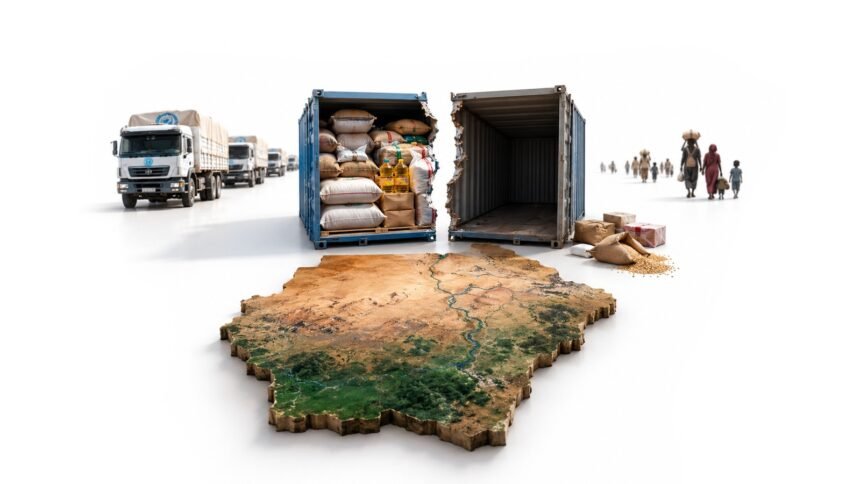
The Pan-African Paradigm of Humanitarian Abandonment and Structural Neglect
Two hundred and six million dollars. That is what the World Food Programme has received so far this year to help feed nearly twenty million hungry Sudanese, against $645 million received over the same period last year, a collapse of roughly half even as the underlying crisis has only deepened. Sudan’s war between the army and the paramilitary Rapid Support Forces has displaced up to fourteen million people, ruined harvests and gutted an economy that was already fragile before the fighting began, producing what the WFP’s own acting head now calls the world’s largest hunger crisis. What distinguishes this moment from earlier phases of the conflict is not a lack of humanitarian access; aid teams increasingly can reach the people who need them, but a lack of the funding required to make that access meaningful. A presence without resources behind it is, functionally, a promise the humanitarian system cannot keep, and Sudan is now the clearest illustration of how thoroughly international donor architecture can hollow out even where the will to help nominally still exists. Reclaiming food security for Sudan’s displaced will require donors to close a gap the country cannot close on its own.
A Funding Cliff in Darfur
Speaking to Reuters from Darfur after touring the region, WFP acting Executive Director Carl Skau described a striking reversal like the crisis: “we have (a) presence that we are not fully utilizing because of the lack of funding,” he said, noting that access, long humanitarians’ greatest obstacle in Sudan, is no longer the binding constraint. The organization now faces a funding gap of just under $300 million to sustain current operations. “This year, we’re about half what we were in terms of funding last year,” Skau said, a shortfall that has forced the WFP to narrow its focus from the nearly twenty million Sudanese facing hunger to the five million assessed as most in need, of whom it has recently managed to scale coverage up to four million.
Rationing Survival in Tawila and El Obeid
The practical effect of that funding gap is visible in the size of individual rations. In Tawila, North Darfur, now a makeshift home to roughly one million displaced people, the WFP reaches everyone monthly, but only with a half ration covering two weeks of food. “It’s not clear how they really are surviving the other two weeks,” Skau acknowledged. In El Obeid, the central Sudanese city that has absorbed roughly one million people fleeing the war since it began in April 2023, WFP assistance now reaches only those who arrived in the past several months, leaving longer-settled displaced populations without support. “We are providing, but less and less,” Skau said. “A year ago it was better because of resources.”
Al-Fashir’s Silence After Genocide’s Hallmarks
Perhaps the starkest illustration of Sudan’s collapse is al-Fashir, once home to roughly one million people, where a Rapid Support Forces attack last year “bore the hallmarks of genocide,” according to independent investigators. The WFP has recently begun providing aid in the city. Still, Skau reported “little sign of life having returned,” a description that captures both the scale of the violence that emptied it and the slowness of any recovery even where humanitarian access now technically exists. The city stands as a grim marker of what happens when conflict, funding collapse and displacement compound each other over an extended period rather than resolving.
A Donor Retreat With Global Roots
Sudan’s crisis is compounded by a broader retreat among the international donors who once anchored the global humanitarian system. The International Organization for Migration warned on Monday that emergency relief supplies, shelter materials, sanitation items and household goods for hundreds of thousands of displaced Sudanese could run out within weeks without urgent funding, and that the wider aid system itself can only keep functioning until December absent new money. IOM Director General Amy Pope was direct: “We simply can’t turn our back on the people of Sudan,” adding that “the entire humanitarian system could collapse within weeks if we don’t act now.” The agency says 8.6 million people remain displaced within Sudan and needs just $15 million to sustain aid delivery to roughly 305,000 people through the rest of the year, a comparatively modest figure against the scale of need. The retreat traces substantially to the Trump administration’s cuts to billions of dollars in foreign assistance to UN agencies and charities, compounded by other major donor nations citing tight budgets and rising defense spending.
Reclaiming a Humanitarian System Sudan Cannot Depend On
Sudan’s hunger crisis is no longer primarily a story about access, logistics, or the physical difficulty of reaching displaced populations across a war-torn country; it is a story about the willingness of the international system to pay for the access it has already secured. That distinction matters because it reframes the crisis as a choice rather than an inevitability: the routes into Tawila and El Obeid and al-Fashir exist, the humanitarian infrastructure to distribute aid exists, and what is missing is the roughly $300 million that would let the WFP alone close its immediate gap. For a continent whose humanitarian emergencies are too often narrated as intractable, Sudan is a case where the intractability lies specifically in donor decisions made in capitals far from Darfur, not in any structural impossibility on the ground. Reclaiming food security for millions of displaced Sudanese remains, for now, a matter of political will rather than logistical capacity, a distinction donors have yet to act on with the urgency Skau and Pope are both describing.