





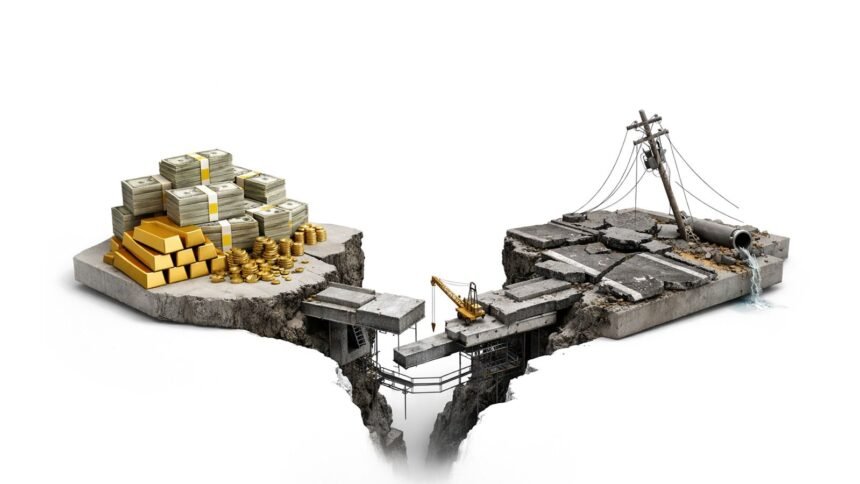
At Cape Town’s waterfront, delegates filed into the glass‑fronted convention center beneath banners promising to ‘connect people, places and opportunities.’ Inside a hall ringed by booths for engineering firms, development banks, and consulting houses, the talk was about concrete, cables, and cash.
The Infrastructure Africa Summit, held March 2–3 at the Cape Town International Convention Center, presents itself as a hub for governments, financiers, and project developers from across the continent. This year’s meeting is framed by a blunt challenge: turning Africa’s vast infrastructure needs into bankable projects that can draw serious capital.
The stakes are enormous. Recent projections suggest the continent will need about 130 to 170 billion dollars a year in infrastructure investment to sustain current growth, particularly in energy, transport, water, and digital connectivity.
Yet actual spending falls far short, leaving what analysts routinely describe as a yawning gap. That deficit shows up in daily life, in power cuts that stall factories, potholed roads that slow trade, and patchy broadband that shuts communities out of digital markets.
This summit, and the deals and relationships forged on its sidelines, offers a window into Africa’s struggle to close that gap on its own terms: balancing a rush of interest from global investors with demands for sustainability, regional integration, and industrialization.
Background and Stakes
Infrastructure Africa has grown over the past decade into one of the continent’s better‑known infrastructure investment gatherings, drawing more than 1,500 attendees from over 60 countries to its 2026 edition, according to organizers. The event’s framing is unapologetically commercial. Promotional materials promise access to “project opportunities,” “leading‑edge innovation,” and “lucrative investment prospects” in sectors from energy and transport to water and digital networks.
Behind the marketing, however, lies a stubborn set of numbers. The African Development Bank and other institutions have warned for years of an annual infrastructure financing shortfall of tens of billions of dollars. A 2025 briefing on Infrastructure Africa 2026 put the continent’s infrastructure demand at 130 to 170 billion dollars a year, while current financial flows cover less than half of that.
The need cuts across sectors. In energy, grid expansion, interconnections, and new generation projects are essential to meet growing demand and support industrialization. Transport corridors, roads, railways, ports, and airports are critical to making the African Continental Free Trade Area, a flagship initiative to create a single market of 1.4 billion people, more than just a diplomatic achievement.
Water and sanitation systems lag behind population growth in many cities. And digital infrastructure, from fiber‑optic backbones to data centers, is increasingly seen as a prerequisite for competitiveness.
Against this backdrop, the Cape Town summit positions itself as “a platform for action — not just dialogue,” promising to help convert early‑stage ideas into “investment‑ready assets.”
Human Stories and Real-World Examples
For all the talk of billions, the conversation at Infrastructure Africa often boils down to surprisingly granular problems. In one breakout session on “making projects bankable,” a municipal official from a mid‑sized West African city describes the frustration of overseeing an aging water system that leaks almost as much as it delivers. “We have plans on paper,” he says, “but we don’t have the technical studies or the credit rating to convince lenders.”
On the other side of the table sits an investment manager from a South African infrastructure fund, leafing through a stack of project summaries. She says her firm is under pressure from institutional investors to deploy capital into Africa, including into climate‑aligned projects. “The money is there,” she says, “but we need projects that can show clear revenue streams, credible governance, and environmental standards.”
It is precisely this gap, between urgent needs on the ground and the requirements of global capital, that the summit’s organizers say they want to bridge. A 2025 preview noted that Infrastructure Africa 2026 would bring together project sponsors, government principals, financiers, and development institutions to focus on “transforming early‑stage infrastructure projects into bankable, investment‑ready assets.”
Sector‑focused panels aim to ground that ambition in specific examples. Sessions on “Africa’s Transportation Corridors” highlight efforts to upgrade road and rail links between landlocked countries and coastal ports, pointing to new backbone highways and regional rail projects that promise to cut travel times and logistics costs.
Discussions on “Powering Progress” explore everything from regional power pools to off‑grid solar, with participants debating how to blend public funds, development finance, and private investment to keep tariffs affordable.
Digital infrastructure has its own track. Speakers outline plans for cross‑border fiber routes, new data centers, and “smart city” initiatives that hinge on reliable connectivity. For young tech entrepreneurs in the audience, the question is less about policy frameworks and more about whether they will finally see faster, cheaper bandwidth beyond capital cities.
Policy, Debate, and Expert Views
Beneath the upbeat language of opportunity, Infrastructure Africa exposes several core tensions in how the continent finances its growth.
One is the balance between public and private roles. Development finance institutions and multilateral banks remain key players in funding large projects, especially where returns are uncertain or social benefits are high. But summit materials and media coverage emphasize the need to “mobilize private capital” and expand public‑private partnerships to close the investment gap. Advocates of this approach argue that, with public budgets under strain, private investors are essential to quickly scaling up infrastructure.
Critics and some civil society voices, while less prominent on the program, warn that poorly structured deals can saddle governments with hidden liabilities, raise user fees, and constrain policy choices down the line. They call for more transparency in contract terms and a stronger role for parliaments and communities in scrutinizing major projects.
Another debate centers on the quality and orientation of investment. Organizers of Infrastructure Africa 2026 highlight themes such as “Unlocking Africa’s Hydrogen Economy,” “Advancing Sustainable Water Infrastructure,” and “Digital Infrastructure: Broadband, AI and Smart Cities,” reflecting a desire to align new projects with climate goals and technological shifts. Proponents say this is essential if Africa is to avoid locking itself into high‑carbon, low‑productivity systems.
Yet in the corridors outside the plenary hall, some officials talk about the difficulty of sequencing. For a country with frequent power cuts and limited fiscal space, the immediate priority is adding megawatts to the grid, even if the cleanest option is more expensive in the short term. Others worry that a narrow focus on “bankability” risks sidelining projects in poorer or conflict‑affected regions where returns are harder to guarantee but needs are greatest.
Regional integration is a recurring motif. The African Continental Free Trade Area, which formally began trading in 2021, depends on physical links as much as on tariff schedules. One panel on “Infrastructure for a Connected Continent” frames roads, rail, ports, and fiber‑optic networks as the backbone of AfCFTA’s promise. “Without corridors that actually move goods, people, and data, a free trade agreement stays on paper,” says a representative from a regional economic community.
As the summit closes, its success will not be measured only in the number of business cards exchanged or memorandums of understanding signed. Participants will be watching in the months that follow for signs that flagship projects move from concept to construction, that regulatory reforms ease bottlenecks, and that conversations in Cape Town translate into more reliable power, smoother logistics, and better connectivity on the ground.
For now, the symbolism of the gathering is hard to miss: in a city that has long been a gateway between Africa and global markets, officials and investors are once again trying to redraw the continent’s infrastructure map. Whether the roads, rails, and fiber lines they envision will serve primarily to extract value or to knit together a more inclusive, connected Africa is a question that will be answered far from the conference halls, in the neighborhoods, border posts, and business districts where these projects eventually land.