






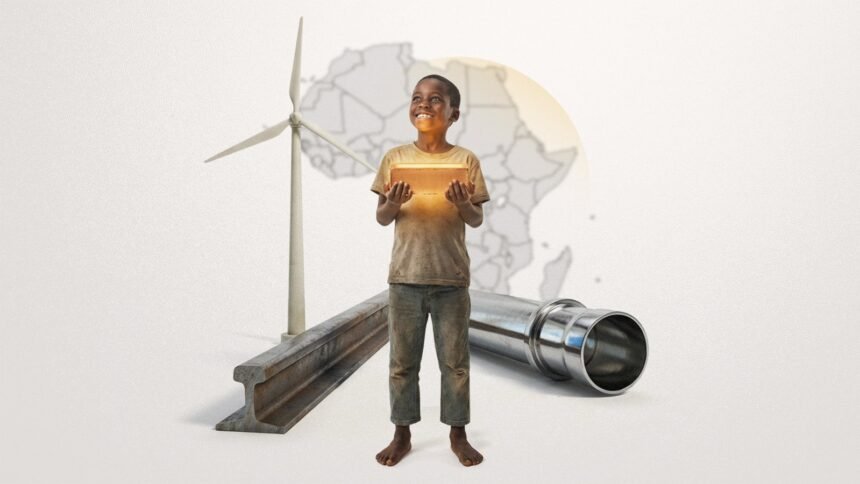
Infrastructure is an organized system of resources necessary for the effective operation of a
community or business. It is divided into complex infrastructure, such as transportation,
communication, energy, and water and sanitation networks, and soft infrastructure, which
comprises the institutions that maintain the economic, social, and health standards of a country.
Infrastructure is the foundation upon which a society’s economic and social processes are
based and contributes to their continuity and efficiency.
The Importance of Infrastructure in the African Union Agenda:
Infrastructure is of paramount importance to the African continent, as it forms the foundation for
achieving development and economic and regional integration. Strengthening infrastructure
facilitates trade and transportation and improves the quality of life. The African Union’s Agenda
2063 reflects the strategic role of infrastructure in achieving development and prosperity for the
The African continent. Sustainable Development Goal 9 (SDG 9), which focuses on resilient infrastructure, is a key objective for Africa and has been incorporated into the African Union’s Agenda for Sustainable Development. It aims to develop infrastructure comprehensively and sustainably. The SDGs related to infrastructure include, in particular, SDG 9: “Build resilient infrastructure,” along with SDG 6 on clean water and SDG 7 on energy, which support infrastructure goals. The gap between current levels of infrastructure investment and the level needed to achieve the Sustainable Development Goals is expected to grow to as much as 18 trillion dollars by 2040. The needs are enormous, and the investment required from the government and the private sector is considerable.
Why is the Infrastructure necessary to a Society?
Infrastructure powers businesses and connects workers to their jobs and citizens to opportunities for healthcare and education. It creates opportunities within communities, and an economy needs reliable infrastructure to link supply chains and facilitate the movement of goods and services. The importance of infrastructure lies in providing an easier life and in shortening the time and effort in the daily life of ordinary citizens or business owners in the country, because it simply provides safe roads, power generation stations that are continuously in production, sewage networks that are constantly maintained, communication networks, and other necessary infrastructure that will necessarily achieve the well being of citizens in the country.
What is infrastructure development?
Infrastructure development, or economic development, is the process of improving specific components of the infrastructure vital to the growth of a country or company. It involves developing essential products and services to enhance the quality of life and stimulate long-term economic growth. Additionally, it encompasses a range of plans to improve existing facilities, systems, and services within a country.
The main types of infrastructural development include:
- Telecommunications.
- Water Supply and Management.
- Power and Energy(including traditional and renewable sources).
- Aviation (airports, air traffic control, heliports).
- Recreation Facilities (parks, playgrounds, public beaches).
- Roadways (roads, highways, tunnels, bridges).
- Waste Management (waste collection, treatment plants, recycling facilities).
- Railway (rails, train stations, tunnels, bridges).
- Bridges (different types, such as arch, cable, beam bridges).
The Programme for Infrastructure Development in Africa (PIDA)
The Programme for Infrastructure Development in Africa (PIDA) is the African Union’s strategic framework and multi-sectoral initiative for the development of priority continental and regional infrastructure by 2040. It was established to implement the Abuja Treaty and to create the African Economic Community. PIDA is a joint program of the African Union Commission, the New Partnership for Africa’s Development Planning and Coordination Agency (NEPAD), and the African Development Bank. The program was announced following extensive efforts since
January 2012 in Addis Ababa, where the Heads of State and Government of the African Union
formally adopted the Declaration of the Programme for Infrastructure Development in Africa. The program focuses on four key development sectors that are the cornerstone of development
on the continent and which African countries desperately need. These sectors are considered
paramount: energy, transport, transboundary water, and information and communications
technology (ICT).
The program aims to create an integrated, resilient infrastructure that lays the foundations for economic development and integration across the continent. It also seeks to empower civil society and the private sector to participate in sustainable and inclusive infrastructure development. The program strives to create large, competitive markets and strong networks to promote cross-border trade, create jobs, and advance the African Continental Free Trade Area (AfCFTA). The program targets developing transport links, promoting top-down transformation, and increasing energy access by 70% by 2040. According to this report, the African Union launched the African Energy Efficiency Programme and Alliance at COP29 to boost energy productivity in Africa. Her Excellency Dr. Amani Abou Zeid emphasized the goal to increase energy productivity by 50% by 2050 and 70% by 2063, aligning with the global target to double efficiency by 2030. The programme promotes energy-efficient practices across sectors like power, industry, agriculture, buildings, and transport, aiming to reduce emissions, cut costs, and support a sustainable energy future through multi-stakeholder collaboration.
Progress in the Four Sectors of the Program for Infrastructure Development in Africa (PIDA), according to the African Finance Corporation’s State of Africa’s Infrastructure Report 2025:
As previously mentioned, the Program for Infrastructure Development in Africa (PIDA) focuses on developing four key sectors: Energy, Transport, Transboundary Water, and Information and Communication Technology (ICT). This section will examine the progress achieved in these
sectors based on the African Finance Corporation’s State of Africa’s Infrastructure Report 2025.
We will start with the transportation sector. Over 7,000 kilometers of railway lines are under
construction or planned, signaling a potential doubling of rail development pace in the next
decade. The launch of the Digital Map of African Railways enhances coordination and investor
visibility; the road quality and density show persistent disparities in the outside mining corridors.
In the Energy Sector: In 2024, the African continent added over 6.5 GW of utility-scale electricity capacity. Approximately 4.1 million homes were connected to electricity, and the per capita usage was.
Electricity consumption is stagnant or declining in some regions. In the Water Sector: Access to clean water has improved, and sanitation and irrigation systems, vital for health and agriculture, but the indicators are less detailed in this report. The ICT: The landing of ultra-modern subsea cables and the expansion of terrestrial fibre have unlocked vast bandwidth, boosting digital infrastructure. Targeting rural connectivity is a priority, especially where rural population gaps exceed 60% to 70% to reduce the access deficit.
The Luanda Financing Summit for Africa’s Infrastructure Development:
The third Africa Infrastructure Financing Summit held in Luanda from October 28-31, 2025,
under the patronage of His Excellency Joao Manuel Gonçalves Lourenço, President of Angola
and Chairperson of the African Union, yielded significant results for strengthening infrastructure
development across the African continent..
The conference recommended the necessity of financing and partnerships to support projects in
the areas of transport, energy, digital transformation, water, and sanitation. Major development
projects were presented, such as the Inga hydroelectric dam project, the Lobito Corridor railway,
and regional ICT cables. Participants agreed on the need to mobilise resources to meet Africa’s
annual infrastructure investment requirements, estimated at approximately 130 billion.
How Insufficient Infrastructure Hinders Growth and Seizes Opportunities
for a Sustainable Future:
Infrastructure plays a key role in economic growth and poverty reduction. Conversely, the lack of infrastructure affects productivity. It raises production and transaction costs, which hinders
growth by reducing the competitiveness of businesses and the ability of governments to pursue
economic and social development policies.
The African continent faces a significant infrastructure deficit and challenge, which
is evident in the competitiveness of African countries and their products, particularly those in
sub-Saharan Africa. Weak infrastructure has resulted in a 2% annual growth rate, a figure that
affects all African countries and necessitates a comprehensive and integrated regional Action
and concerted efforts.
The primary benefit of regional infrastructure lies in enabling the formation of large, competitive
markets, replacing the current collection of small, isolated, and inefficient markets. Shared
regional infrastructure is the only solution to the problems of small size and unfavorable location. One of the most essential benefits of regional infrastructure is its impact on intra-African trade. Despite the substantial gains many countries have made in GDP in recent years, the remarkable inefficiency of infrastructure in Africa has hampered integration efforts, impeded
growth, and drained national resources, both public and private. By improving the competitiveness of African producers and making goods more accessible to millions of consumers, Africa will experience growth in intra-regional and inter-regional trade as a percentage of total trade. Regional infrastructure also leverages and enhances synergies
between sectors.
The continent faces development challenges estimated at approximately $108 billion annually,
with a continuous need for investment ranging between $130 billion $170 billion per year to
support development and infrastructure. The annual development gap for 2025 is projected to
be between $50 billion and $90 billion, with the cumulative deficit expected to increase to $1.6
trillion by 2030 if the continent’s challenges are not addressed. Weak technical and technological capacities are among the obstacles hindering project implementation, as the lack of data and information poses a challenge to project monitoring and evaluation.
The lack of balanced development in Africa has widened the gap between urban and rural areas, and the repercussions of climate change and limited technology adoption further complicate the situation. This necessitates concerted action and sufficient funding from all stakeholders, including governments and the private sector.
The Pillars of Africa’s Infrastructure Growth: Coordinated Leadership and Sustainable Infrastructure
In regional projects, infrastructure challenges become increasingly complex. Moving forward with sustainable infrastructure challenges becomes increasingly complex. To move forward with sustainable infrastructure development in Africa, Joint coordination among governments is essential, along with a platform for dialogue and discussion to build the political will for continental projects. We need to develop financing mechanisms for development and infrastructure projects, and multilateral and private banks play a significant role in facilitating investment and providing financial resources. The continent needs to combine regional efforts. There is a continental need to address the financing problem by providing mechanisms to attract investors to the infrastructure sector and to tackle debt and default. These challenges can be addressed through capacity building, community and stakeholder engagement, and the provision of transparent, accountable mechanisms for monitoring project progress. The African continent has enormous potential to accelerate infrastructure development efforts. We need the political will and joint action to overcome the challenges to sustainable development across the continent.


