






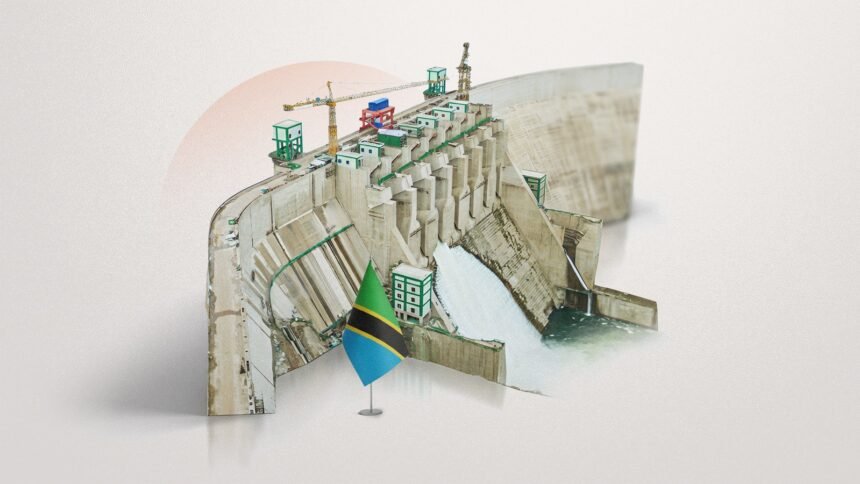
The Julius Nyerere Hydropower Plant in Tanzania was fully completed in March 2025, following the issuance of the Taking Over Acceptance Certificate for its ninth and final generating unit. All nine units are now in commercial operation, delivering a total installed capacity of 2,115 MW to the national grid. The capacity exceeds Tanzania’s recent peak demand, effectively ending nationwide power shortages and positioning the country for a new phase of power transmission expansion and regional energy integration.
Tanzania’s New Hydropower Giant
The Julius Nyerere Hydropower Project (JNHPP) is now one of the most extensive hydropower facilities in Africa. The Project comprises nine turbines, each producing around 235 MW, feeding electricity into Tanzania’s national grid, and making the project a cornerstone of Tanzania’s power mix and long-term energy security strategy.
The JNHPP includes a main concrete gravity dam approximately 1,025 metres long and about 130 meters high, supported by four auxiliary saddle dams that together create a total storage capacity of around 34 billion cubic meters. The reservoir has already reached roughly 33 billion cubic meters, surpassing the minimum operating level required for stable turbine operation and year-round power generation.
Regulation of river flows is intended to reduce flood risks, enhance water security, and support irrigation, linking energy security with food security and rural development. The project is not only a power plant but also a national development asset, anchoring
long-term plans for industrialization, regional trade, and climate-resilient growth.
Tanzania– Egypt Partnership and Industrial Expertise
Both governments have framed the JNHPP project as a symbol of the strategic relationship between Tanzania and Egypt. The president of Egypt is closely following the progress during construction.
The JNHPP is built on the Rufiji River in the Stiegler’s Gorge area of the Ngorongoro Region. The JNHPP is developed by a consortium of two Egyptian companies, Arab contractors, and El Sewedy Electric under a contract with Tanzania’s Ministry of Energy and the
state-owned Tanzania Electric Supply Company (TANESCO) in a flagship example of the South-South Cooperation
The New Phase in Tanzania’s Power Sector
Tanzania has moved from chronic power deficits to a position of structural surplus, creating space to meet rapidly growing demand driven by industrialization, urbanization, and population growth. Tanzanian Electric Supply Company (TANESCO), a wholly state-owned utility responsible for generation, transmission, and distribution on mainland Tanzania and Zanzibar, is the off-taker and system operator for the new plant.
Grid upgrades are essential if electricity from JNHPP is to reach remote regions, support productive energy use, and enable cross-border power trade. In the medium term, the project will catalyze Tanzania’s economic transformation by providing reliable, affordable electricity to key sectors, including mining, manufacturing, agro-processing, and services, as the JNHPP guaranteed thousands of jobs and opportunities during construction.
This surplus creates opportunities to accelerate rural electrification, improve supply reliability in urban and industrial centers, and reduce reliance on fossil-fuel-based generation. The plant therefore plays a dual role: stabilizing the domestic power system and underpinning a broader shift towards cleaner, more sustainable energy sources in Tanzania’s power mix. The hydropower surplus positions Tanzania to become a potential power exporter within regional markets such as the Eastern Africa Power Pool and the Southern African Power Pool, reinforcing energy cooperation and integration..


