





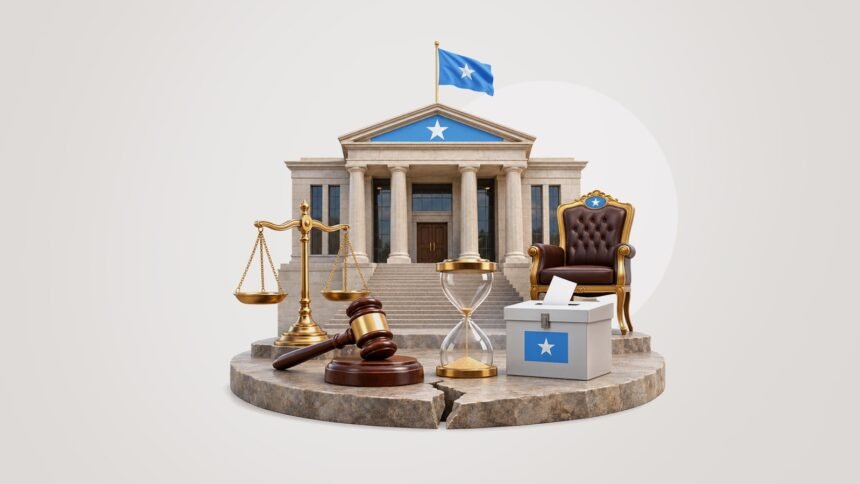
A Mandate That Stopped Being a Mandate
What happens when a president keeps governing after the date his own constitution said he should leave? In Mogadishu on Thursday, Somalia’s Supreme Court gave an answer that few expected to survive the week. Five judges of the Constitutional Division ruled that the mandates of the federal parliament, the federal government, and President Hassan Sheik Mohamud expired in 2026: parliament and government on 14 April, the presidency on 15 May, and that actions taken by those institutions after those dates are unconstitutional, unlawful, and null. The court ordered political actors to agree on an election framework within 30 days and to hold elections within 90 days.
The ruling lands in a capital already tense over a one-year “transition” that Mohamud’s government declared after May, citing constitutional amendments passed in March and the need to prepare the country’s first nationwide democratic elections. The opposition called the extension a power grab. Violent protests followed in Mogadishu. Thursday’s judgment says the March amendments did not expressly apply to institutions already in office, so the four-year terms in the 2012 Provisional Constitution still governed the sitting parliament and president.
What the Judges Actually Said
The case began with a petition by former president Sharif Sheik Ahmed challenging both the amendment process and the legal consequences of the changes to the 2012 Provisional Constitution. The court rejected the first limb. It held that Sharif lacked standing under Article 86 to attack the amendment process itself. It accepted the second limb: whether measures that flowed from the amendments, especially the lengthening of federal mandates, were legally valid.
On that point the judges were blunt. Amendments that introduce new terms of office, they said, must state clearly whether the new length applies to institutions already sitting or only to those elected afterward. Where an amendment is silent, the new term does not attach automatically to the incumbents. Their original mandates remain. Applying that rule, the court found that federal terms stayed at four years under the 2012 text because the 2026 amendments never said they applied to those already in office.
Parliament’s two houses therefore lost their mandates on 14 April 2026. Mohamud’s term ended on 15 May. The government’s mandate expired with parliament on 14 April, because its authority derives from a parliament that can grant and withdraw confidence. After those dates, the court said, the institutions had no authority to exercise constitutional and legal powers. Everything done by virtue of those powers after expiry is void.
Caretaker, Not Commander
The judgment does not dissolve the state overnight. It says the federal government is the only body constitutionally authorized to run a caretaker administration, but that a caretaker may conduct only routine affairs. It may not take decisions or measures beyond day-to-day administration. That distinction matters in a country still fighting Al-Shabaab and negotiating with donors who have grown impatient with stalled political timelines.
International military support is already thinning. Uganda said this week it will pull all its troops out of Somalia by the end of next year, ending a presence that has underpinned African Union missions for nearly two decades. Donors have cut funding for military tracks, frustrated at the lack of political progress. A court order that compresses the electoral calendar into 90 days arrives just as the security umbrella is being folded back.
The Night Before the Verdict
Late on Wednesday, before the judgment, Mohamud dismissed Chief Justice Bashe Yusuf Ahmed and said he would appoint a replacement. Unconfirmed reports said Ahmed had been detained. Justice Salah Sheik Ibrahim Dhiblawe led the five judges who signed Thursday’s ruling; Bashe Yusuf was not among the signatories. Separate Somali reporting has described security deployments around the court after the verdict and judges seeking shelter with opposition figures. Those accounts remain contested and have not been independently verified for this brief.
What is not contested is the sequence: a presidential dismissal of the chief justice on the eve of a ruling that strips the presidency of a legal claim to a full remaining year, followed within hours by a judgment that treats the sitting institutions as caretakers with a short clock.
Opposition, Donors and the Street
For the opposition that rallied against the transition year, the court has converted a political demand into a legal timetable. Consensus within 30 days and ballots within 90 days are an order, not a suggestion. For Mohamud’s camp, compliance means accepting that March’s amendments did not buy extra time for those already in office. Resistance means governing against an explicit Supreme Court holding that every post-expiry act of power is void.
Ordinary Mogadishu residents have already paid for the quarrel in protest crackdowns and uncertainty over when, and under whose rules, they will next choose leaders. Al-Shabab does not pause for constitutional litigation. Each week of disputed authority is a week in which the state’s claim to speak with one voice frays further in the districts where the insurgency still collects taxes and ambushes convoys.
Who Writes Somalia’s Next Mandate
The Horn does not need another open-ended transition justified by the difficulty of organizing a vote. Somalia’s own judges have now said the clock already ran out in April and May, and that only a caretaker may hold the fort while parties settle an electoral framework. Real self-determination here means Somali institutions finishing what Somali voters and clans began: a timetable they own, not one extended by those whose terms have ended. Ninety days is short. A vacuum lasting into 2027 would be longer and costlier for everyone who lives under it.