




The Pan-African Paradigm of Ecological Restitution and Community Ownership
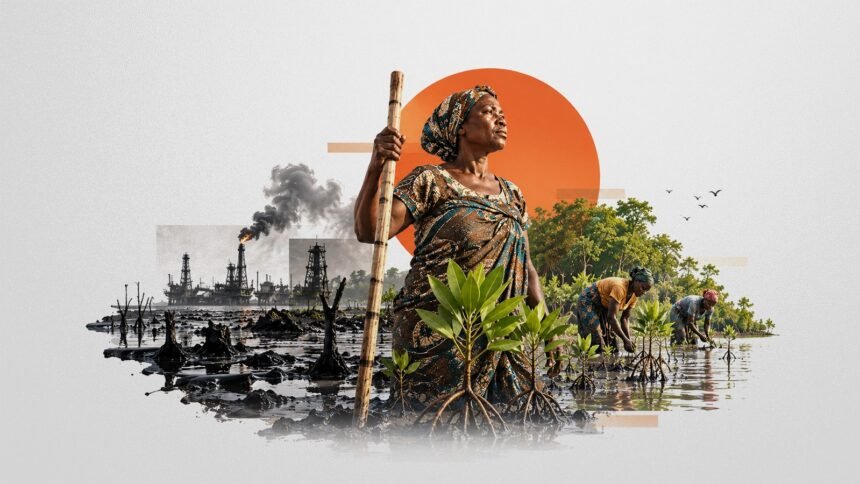
A two-meter stick pressed into mud marks where the next mangrove seedling will go, and in Teenama, in the Yorla oilfields of Ogoniland, that humble instrument has become a tool of sovereignty. The women who wield it are repairing land that more than five decades of oil production left poisoned, and they are doing so on terms they set themselves. In the Pan-African paradigm of self-determination, environmental justice is not charity delivered from outside; it is the restoration of a community’s authority over its own soil, water and livelihood. The Niger Delta has long stood as a symbol of extractive harm, from the 1995 execution of Ken Saro-Wiwa and eight other campaigners to the oil spills that blackened creeks. The story of Martha Agbani and the women she trains shows another trajectory, one in which the people most affected by degradation become the authors of its repair. Reclaiming the delta begins with who holds the stick.
From Grief to Restoration
Agbani grew up with the smell of crude in the air and watched mangroves rot along the riverbanks. Her mother, Theresa Terabiewaa Agbani, was an activist, and the state’s hanging of Saro-Wiwa and his colleagues in 1995 opened her eyes, she says, to what lay behind the destruction of her hometown. After her mother died in 2003, she founded the Lokiaka Community Development Center to support female Ogoni farmers in caring for the environment and restoring mangroves. Since 2018, its teams have restored three million mangroves and reclaimed 190 hectares of swamp forest, and Agbani has trained more than 400 women, many of whom have replicated the training in their own communities. The institutional design is deliberate: instead of classrooms, women are taken into swamp forests and supervised by experienced restorers, building skills inside the ecosystem they intend to heal.
The Scale of the Damage
The numbers describe a wound that no single program can close. Roughly 1,000 hectares of mangroves were directly destroyed in the 2008 Ogoniland spill, according to Dr Ferdinand Giadom, deputy project director of the Bodo Mediation Initiative, and he estimates more than 500,000 barrels of crude have spilled into the environment in under 20 years. Shell was ordered to pay 55 million pounds to local people after two large spills in 2008 and 2009. Giadom is blunt about the consequences: two decades, in his words, have been lost, along with the livelihoods of people who fished and gathered shellfish in mangrove-lined creeks. The Niger Delta’s mangrove system, which covers around one million hectares, is the largest in Africa and the third-largest in the world, and it provides nurseries for aquatic life, coastal protection, carbon storage and income for millions.
Learning by Planting, Failing and Adjusting
Restoration, the women found, is as much craft as conviction. When they started planting in 2018, they set seedlings too close together, and the canopies crowded one another out. Joy Lebewi, trained at Agbani’s center, now works with about a dozen other women using the spacing stick, and they have planted more than 150,000 saplings in the Teenama wetland. An invasive species, the south-east Asian nipa palm, complicates the work by crowding out native mangroves and blocking access for local people, so men from surrounding communities clear it to prepare ground for planting. Erabanabari Kobah, an environmental scientist from Ogoniland, cautions that planting in unsuitable areas will not secure long-term success, and that the measure is what happens to a forest over time. The institutional lesson is adaptive: local knowledge, iteratively corrected, outperforms imposed templates.
Who Plants, Who Decides
Collins Lebeteh, an environmentalist working in community-led conservation, puts the central point plainly. What matters is who does the planting, because women who depend on degraded ecosystems are often left out of decisions about restoring them. Agbani agrees, and her goal is for restoration to become a process that communities own and control, rather than another top-down intervention. Her organization also trains local fishers in species identification and in managing mangrove buds. This approach reframes gender inclusion from a tick-box to a structural requirement of effective ecological governance. When women, fishers and farmers set priorities, restoration aligns with livelihoods, and the return of mud crabs and fish becomes both an ecological and an economic indicator of progress; in Agbani’s words, life is returning.
Restoration as Sovereignty
None of this absolves polluters or states of responsibility. Cleanup oversight such as the Bodo initiative, compensation orders, and regulatory enforcement remain indispensable, and the work of 400 women cannot substitute for them. But the Ogoni example proves that communities need not wait for perfect institutions to begin reclaiming agency. Reclaiming the delta, in the fullest sense, means embedding community ownership in cleanup contracts, financing local restoration enterprises, and ensuring that women hold decision-making seats at every table where the delta’s future is discussed. The mangroves of Ogoniland are a ledger of what extraction cost; the saplings are an entry in a different account, one that records what a self-determining community can build when it holds the stick.