





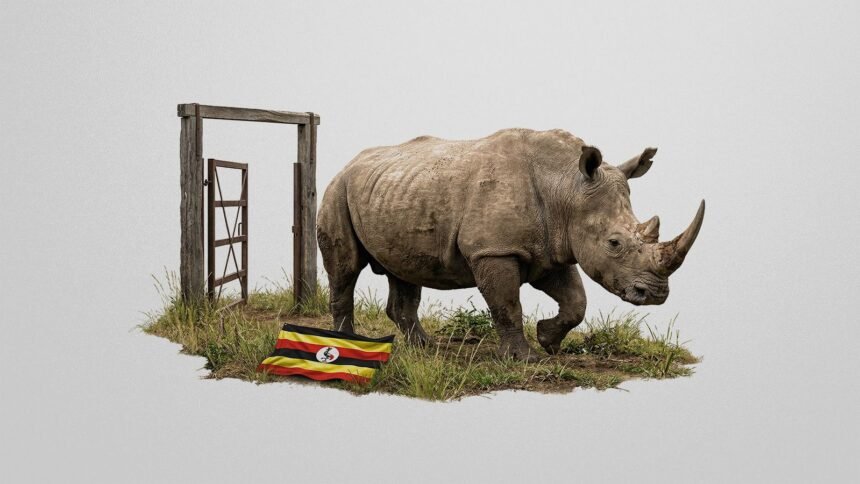
Just after dawn, the metal crate fell silent. The thump of the truck had faded into the distance, and a two-ton southern white rhinoceros stood blinking in the dust, facing the open grasslands of Kidepo Valley, a landscape where its kind had not roamed freely since 1983, when poachers killed the last one.
For the rangers in green fatigues watching from a distance, the animal’s first, tentative steps onto the ocher earth marked more than the end of a long night of transport from central Uganda. It marked the visible beginning of a years-long effort to restore a species that had gone extinct in the country’s wild, with help from a neighbor.
In March, Uganda’s wildlife authority began a phased reintroduction of rhinos into Kidepo, a remote park in the country’s northeast, moving the first animals from a private breeding site and a ranch in central Uganda into a newly built sanctuary inside the park.
Additional rhinos are expected to follow later this year, including animals from Kenya under one of Africa’s first cross-border wildlife exchanges, in which Uganda will send two endangered species in return.
The Bigger Picture
The late 1970s and early 1980s wiped out Uganda’s wild rhinos, victims of intensive poaching and political instability that left parks underfunded and poorly guarded. Since 1983, Kidepo Valley National Park, an expanse of rugged hills and savanna abutting the borders with Kenya and South Sudan, has had no rhinos at all.
The country’s attempt to reverse that loss began in 2005, when a breeding program was established at Ziwa Rhino Sanctuary after rhinos had become extinct in the wild. With imported animals and strict protection, the population slowly climbed. By early 2026, Uganda had 61 rhinos, according to the Uganda Wildlife Authority, including eight brought from South Africa in late 2025 to diversify the gene pool.
“The return of rhinos to Kidepo Valley National Park is a major milestone in Uganda’s conservation journey,” said Dr. James Musinguzi, the wildlife authority’s executive director, at a ceremony flagging off the first two rhinos from Ziwa to Kidepo in mid-March.
A total of eight animals are slated for the park in this initial phase, wildlife officials say, as part of a national strategy to restore rhinos to portions of their historical range.
Kidepo was chosen after feasibility studies examined habitat, security, and ecological needs. Officials describe it as one of Uganda’s most intact savanna ecosystems, where reintroducing large grazers, such as rhinos, could help restore what one senior biodiversity official called the park’s “ecological completeness.”
Human Stories and Real-world Examples
For rangers in Kidepo, the animals’ return has changed both the park’s daily rhythms and its risks. The Uganda Wildlife Authority and partners have carved out a dedicated rhino sanctuary within Narus Valley, equipping it with fencing, access roads, firebreaks, ranger housing, water systems, and monitoring equipment.
The design is meant to give the animals space to roam while keeping them under close watch in the early years of reintroduction.
On a recent week, two southern white rhinos from a private ranch in Nakasongola District, about 100 kilometers north of Kampala, were tranquilized, loaded into metal crates, and driven more than 400 kilometers to Kidepo. Two more followed later in the week, part of the staged movement of animals from multiple sites into the park.
“This occasion symbolizes the start of a renewed chapter for rhinos in Kidepo Valley National Park,” Dr. Musinguzi said, thanking conservation partners for what he described as crucial technical, financial, and logistical support. Those partners include Global Conservation, the Uganda Conservation Foundation, and tourism bodies that see rhinos as a future draw for visitors.
Local communities around Kidepo, long familiar with elephants and buffalo, and with occasional crop damage, are now being asked to imagine rhinos as an asset. Tourism officials say the reintroduction could enhance the park’s appeal and help channel more revenue into jobs and infrastructure in Uganda’s remote northeast. However, those benefits will depend on security and sustained investment.
Policy, Debate, and Expert Views
The most novel part of the Kidepo project lies just across the border. In partnership with the Uganda Conservation Foundation and the Uganda Wildlife Authority, conservation groups say five white rhinos are scheduled to be transferred from Kenya to Kidepo in March, in exchange for two endangered wildlife species that Uganda will send to Kenya.
An additional five rhinos are to come from Ziwa, bringing the planned founding population to a blend of domestic and foreign origins.
The agreement is being billed by those involved as one of Africa’s first formal cross-border wildlife exchanges, a step beyond the more familiar transboundary parks and joint patrols. Jeff Morgan, executive director of Global Conservation, said the translocations “show that Uganda is stable again for tourism, national parks are being protected, and Ugandans and international visitors can watch rhinos in their natural setting.”
Conservationists say such exchanges could help spread risk and improve genetic diversity for small, isolated populations of endangered species.
But they also raise practical and political questions: how to share costs between sending and receiving countries, how to manage animals that cross human borders freely, and what happens if diplomatic relations sour while animals are mid-journey or already relocated.
Security remains a concern. Demand for rhino horn in parts of Asia, where it is used in some traditional medicines and as a status symbol, has driven black-market prices to levels that can exceed those of gold, according to wildlife officials and research cited by conservation groups.
Uganda has reduced poaching incidents in recent years through tougher enforcement, yet officials acknowledge that any return of rhinos to the wild carries renewed risk.
Who Pays for Hope?
The rhinos now stepping into Kidepo’s sunlit clearings are still few, and their new home, for all its beauty, is highly managed: fenced perimeters, patrol roads, cameras, and firebreaks cut through the landscape like scars of precaution. For the foreseeable future, veterinarians will monitor their health and movements, and any signs of breeding will be watched closely.
More rhinos are expected later this year, including those from Kenya, if logistics and security conditions hold. If the experiment works, if the animals settle, breed, and help revive the park’s ecological dynamics without a surge in poaching, Kidepo could become a model for other reintroductions and exchanges in East Africa, officials and conservationists say.
In the meantime, the sight of a rhino’s horn cutting across the horizon here, in a park that had forgotten that shape for more than 40 years, is enough to suggest that the story of extinction is not yet finished.
In this remote valley at the edge of three countries, the question of who owns wildlife, and who will pay to protect it, is being quietly rewritten, one lumbering animal at a time.