



The Pan-African Paradigm of Electoral Sovereignty and Constitutional Resilience
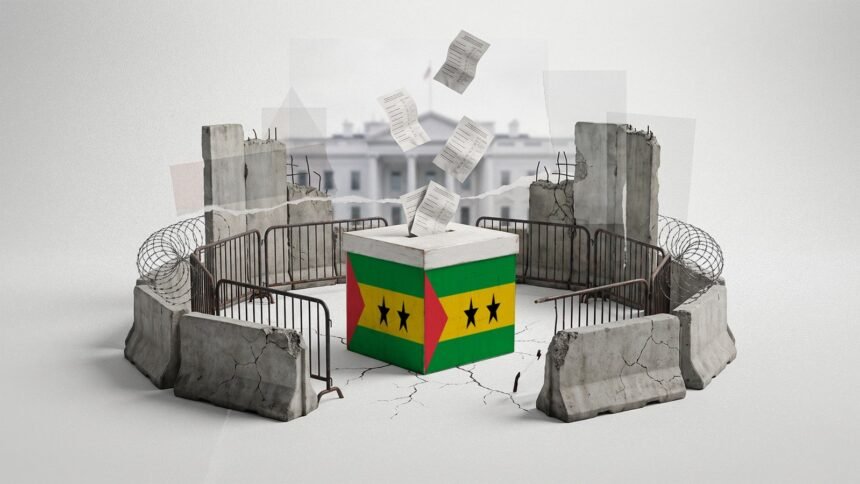
Across the African landscape, election day carries a weight that extends far beyond the ballot box, becoming a referendum on whether young democracies can withstand the centrifugal pressures of factionalism, institutional capture, and economic hardship. Nowhere is this dynamic more vividly rendered than in São Tomé and Príncipe, the tiny island nation off Africa’s western coast, where voters went to the polls on Sunday to select a president amid a lingering constitutional crisis. The contest, pitting an incumbent against the very party that once elevated him, is emblematic of a broader continental pattern: the fracturing of ruling coalitions into rival power blocs, each claiming the mantle of legitimate governance. For a nation of barely 142,000 registered voters, the stakes are outsized, testing whether São Tomé’s four-decade record of peaceful, competitive elections can survive an era of executive-legislative brinkmanship. This is the Pan-African paradigm of electoral sovereignty at its starkest: small states navigating the architecture of constitutional order while larger geopolitical currents, maritime security, offshore energy, diaspora politics, press in from every side. What unfolds on this island will speak to a continent-wide struggle to reclaim democratic self-determination from the fault lines of internal discord.
Institutional Architecture Under Strain
The roots of Sunday’s tense contest trace back to January of last year, when President Carlos Vila Nova dismissed his prime minister, Patrice Trovoada, triggering a cascade of institutional turbulence that has yet to settle fully. Trovoada’s successor, former justice minister Ilza Amado Vaz, lasted barely three days before resigning, an implosion that underscored the fragility of the country’s executive machinery. The current prime minister, Américo Ramos, has since attempted to stabilize the administration. Still, the structural rupture between Vila Nova and his former party, the Acção Democrática Independente, has proven durable. Vila Nova’s decision to seek a second term as an independent rather than as ADI’s standard-bearer represents a profound recalibration of the country’s political matrix, one in which erstwhile rivals, including the opposition Movement for the Liberation of São Tomé and Príncipe, now form part of a broad coalition backing the sitting president. Meanwhile, an ADI faction loyal to Ramos has thrown its weight behind parliamentary leader Nito D’Abreu, illustrating how thoroughly personal and institutional feuds have scrambled the old party architecture.
The Contested Ballot and the Politics of Belonging
Five candidates appear on Sunday’s ballot, though the field was nearly six before the constitutional court disqualified businessman Domingos Monteiro, president of the São Toméan Football Federation since 2015, on eligibility grounds tied to his parents’ citizenship status. Monteiro, born on the island to Cape Verdean parents who never naturalized, decried the ruling as a violation of equal rights, framing his exclusion within a broader critique of xenophobia and structural discrimination against the descendants of migrants. His case has become a flashpoint for questions of national belonging that resonate well beyond São Tomé’s shores, echoing debates playing out across a continent still negotiating the legacies of colonial-era migration and post-independence citizenship regimes. Former prime minister Jorge Bom Jesus, for his part, attempted to withdraw his independent candidacy but missed the procedural deadline and remains on the ballot, a quirk that adds further unpredictability to a race already thick with realigned loyalties and unresolved institutional grievances.
Economic Anxiety as the Undercurrent of Discontent
Beneath the constitutional drama lies a more visceral set of grievances driving voter sentiment: corruption, inflation, chronic fuel shortages, and youth unemployment that have left large segments of the population economically stranded. D’Abreu, addressing Tuesday’s presidential debate, described corruption as “the greatest catastrophe” the country has faced in its half-century of independence, a framing designed to tie Vila Nova’s incumbency to the structural failures voters experience daily, the blackouts, the empty fuel pumps, the stagnant wages. This economic recalibration of the political narrative reflects a pattern familiar across small, resource-adjacent African states, where the promise of offshore wealth, in São Tomé’s case, oil deposits that meaningfully contribute to GDP, coexists uneasily with the lived reality of scarcity for ordinary citizens. Rivals are betting that this dissonance between potential and delivery will be enough to deny Vila Nova a second term, translating diffuse frustration into a coordinated electoral challenge that spans the ideological spectrum.
Geostrategic Stakes in the Gulf of Guinea
São Tomé and Príncipe’s significance extends well past its modest population, anchored in its role as a trusted Western security partner in the Gulf of Guinea, one of the world’s most persistent maritime piracy corridors, and in its offshore oil reserves, which underpin a disproportionate share of national revenue. This dual position, security asset and energy stakeholder, has drawn international scrutiny to Sunday’s vote, with observer missions from the European Union, the G7+, and the Community of Portuguese Language Countries deployed to monitor proceedings. Their presence reflects an implicit acknowledgment that instability in even the smallest African states can reverberate through regional security architectures and global energy markets alike. For São Tomé, the challenge is to convert this external interest into leverage for genuine institutional recalibration, rather than allowing foreign stakeholders to treat the country merely as a strategic waypoint whose internal governance is incidental to its geopolitical utility.
Reclaiming the Democratic Compact
Whatever the outcome on Sunday, an outright majority or a run-off between Vila Nova and his ADI-aligned challengers, São Tomé and Príncipe’s election represents a broader test of whether small African democracies can insulate their institutions from the erosive effects of elite fragmentation. The country’s four-decade tradition of competitive, peaceful transitions remains a rare structural asset on a continent where such continuity is too often the exception. Sustaining that asset will require more than a single credible vote; it demands a recalibration of the relationship between party architecture, executive accountability, and the economic promises made to citizens navigating inflation and scarcity. As international observers depart and the results are tallied, the deeper work of reclaiming institutional sovereignty, insulating the courts from politicization, closing the gap between offshore wealth and onshore hardship, and building a citizenship framework resistant to exclusionary politics will fall to whoever emerges victorious. In this sense, São Tomé’s vote is not merely a national event but a data point in the continent’s ongoing negotiation of what durable, self-determined democratic governance actually requires.