





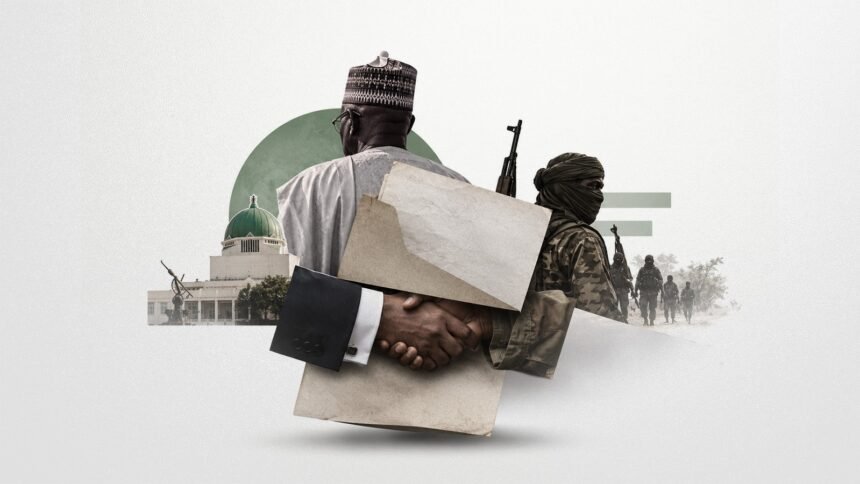
The Pan-African Paradigm of Security Sovereignty and Selective Truth
A presidential spokesperson’s instruction to “contact the military” says more about Abuja’s long war against Boko Haram than any official communique has in years. That single deflection, offered when reporters asked about a reported secret truce with factions of the insurgency, sits at the center of a paradigm playing out across the continent: governments quietly negotiating with the armed actors they publicly vow never to negotiate with, while maintaining a hardline posture for domestic and international audiences. This is less hypocrisy than the blunt arithmetic of asymmetric conflict, where state capacity, moral clarity, and battlefield reality rarely align. For Nigeria, and for the wider Sahel-facing security architecture of West Africa, the question is not whether quiet dialogue with insurgents happens- it plainly does- but who gets to author the resulting narrative of peace, and on whose terms accountability is eventually demanded. Structural sovereignty over a security crisis means more than winning or losing battles; it means owning the story of how the war ends, rather than letting foreign reporting break it. As Nigeria’s undeclared truce becomes public knowledge, the continent’s institutions must recalibrate: reclaim the narrative of self-determined security, even when the underlying compromises are uncomfortable.
A Truce Without a Signature
According to reporting by The New Humanitarian, corroborated by Nigerian outlet Premium Times, the Nigerian government has entered into an unacknowledged ceasefire arrangement with elements of Jama’atu Ahlis-Sunna Lidda’awati wal-Jihad (JAS), the formal name for the Boko Haram faction distinct from its rival, the Islamic State West Africa Province. Three people with direct contacts among senior JAS commanders described the arrangement to journalists, situating it within a landscape of roughly three active factions spread across Nigeria’s North-east and North-central regions. Two of these factions are described as based in the North-east under commanders identified as Ali Ngulde and Alhaji Kale. In contrast, a third, led by a commander known as Mr Doro, operates from islands in Lake Chad, exploiting the weak security presence across that porous, multi-national basin. The geography itself is instructive: state authority in the Lake Chad region has always been asymmetric, a patchwork of national claims over a shared, ungoverned water frontier, and durable insurgent sanctuary has persisted longest there.
The Ransom Behind the Silence
The truce’s origins trace to a specific, previously contested episode: the release of hostages after roughly 95 days in captivity, freed in June under circumstances the Nigerian government described vaguely, while The New Humanitarian’s sourcing points to negotiated terms involving payment. A youth leader from Borno State, Samaila Kaigama, was the first to publicly allege that government-linked actors paid ransom for the release of captives taken near Ngoshe. This claim reportedly named a figure of roughly N5 billion. Nigeria’s State Security Service has since arrested Kaigama and arraigned him in court, with the SSS asserting it has evidence contradicting his allegation. The layering here is structurally significant: a state that maintains, as official doctrine, that it does not pay ransom to terrorist organizations is simultaneously prosecuting the citizen who alleged that it did, while independent reporting suggests a truce, plausibly financed in part by exactly such payments, has taken hold regardless of the official record.
The Local Peace Economy Beneath the National Denial
Nigeria’s undeclared federal truce does not exist in isolation; it sits atop a broader, increasingly normalized architecture of subnational peace-making that has quietly reshaped counterinsurgency practice across the north. In Katsina State, more than eighteen local government areas have entered into their own truces with local banditry networks, deals brokered by council chairpersons and conducted in the presence of military officials, a tacit, if unofficial, state endorsement. Similar arrangements have taken root in Kaduna and Zamfara states. What emerges is a matrix of overlapping, decentralized security bargains, each negotiated locally, each carrying its own risk of empowering the very actors they are meant to neutralize, and each testing the limits of a “whole-of-society, whole-of-nation” framing that military officials have begun using publicly to describe an approach that, until recently, would have been politically unspeakable. The proliferation of these local deals suggests the federal truce with JAS factions is less an aberration than the logical extension of a strategy already normalized at the grassroots.
Denial as Doctrine, Dialogue as Practice
Confronted with the reporting, presidential spokesperson Bayo Onanuga declined to engage substantively, telling Premium Times by text message to direct questions to the military; the spokesperson for Defense Headquarters, Samaila Uba, did not respond to calls. This institutional silence is its own kind of policy statement, an unwillingness to either confirm the humanitarian logic of dialogue or defend the doctrinal purity of refusal. At a security briefing, when pressed to explain the framework governing local truces, a military official offered a formulation that captured the contradiction precisely: “We do not also support the payment of any ransom,” he said, before pivoting to describe “this whole-of-society, whole-of-nation approach to resolving security issues.” Analysts quoted in the underlying reporting were skeptical that any of this amounts to durable peace. One security researcher, identified only as Mr Samuel, cautioned that the arrangement “could be just a temporary, tactical ceasefire that benefits both sides, but doesn’t really affect” the war’s structural drivers, expressing doubt that dialogue alone could produce a “sustainable peace settlement.”
The Islamic State Exception
Crucially, reporting indicates the truce does not extend to the Islamic State West Africa Province. This rival faction has increasingly eclipsed JAS in territorial reach and battlefield sophistication across the Lake Chad basin. That carve-out means that even a successful, durable de-escalation with JAS factions would leave Nigeria’s most capable and ideologically rigid insurgent adversary entirely outside any negotiated framework, a reminder that fragmentation within Boko Haram’s broader movement, long treated as a security weakness to be exploited, now complicates the very diplomacy meant to end the conflict. A truce with one faction while war continues against another is not peace; it is triage, a redistribution of state attention and resources toward the fight the government judges more winnable, while a parallel insurgency continues to entrench itself in the same ungoverned spaces that produced JAS in the first place.
Sovereignty Measured in Reckoning, Not Silence
The trajectory of Nigeria’s undeclared truce ultimately tests a proposition central to the continent’s evolving security architecture: that sovereignty is not merely the capacity to fight, or even the capacity to negotiate, but the capacity to be honest with one’s own citizens about which of the two is happening and why. A government that prosecutes a whistleblower for alleging a ransom payment while quietly normalizing the local peace deals that make such payments almost inevitable is not exercising sovereignty so much as deferring an eventual reckoning with it. For Nigeria’s north, still recovering from a fifteen-year insurgency that has displaced millions and hollowed out entire local economies, durable peace will ultimately have to be built on candor rather than carefully worded denials. The path toward reclaiming structural accountability over the war’s endgame runs not through more secrecy, but through a state willing to narrate its own compromises and let its citizens judge them on the record, rather than through the columns of a foreign newsroom.