




A Mid-Year Budget Review Built on Weaker Mining Income
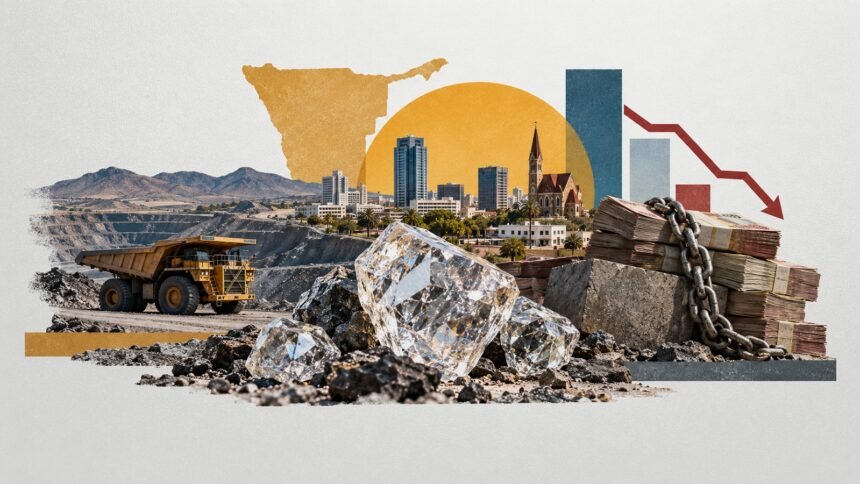
A resource can be a country’s strongest asset right up until the year it stops paying. Namibia’s diamond taxes and royalties brought the state N$5.8 billion in 2023/24. For 2026/27, the Treasury now projects N$414 million. That collapse sits at the center of the mid-year budget review that Finance Minister Ericah Shafudah has tabled in parliament, and it is compounded by a second, quieter risk: N$11.8 billion in debt owed by state-owned enterprises that the government has guaranteed.
Together, the two pressures show how a mineral-rich economy can find its fiscal room squeezed from both ends, with less coming in from the ground and more potential liabilities sitting on the state’s balance sheet.
Less From the Ground
Mining remained the main source of weakness in the review. Shafudah said mining company taxes and royalties were expected to fall to N$5.2 billion from N$6.1 billion. “Diamond taxes and royalties have fallen from N$5.8 billion in 2023/24 to a projected N$414 million in 2026/27, an estimated shortfall of N$5.3 billion over the medium-term expenditure framework,” she said.
A fall of that size is not a rounding error. It turns diamonds from one of the state’s dependable earners into a minor line in the budget within three financial years, and it removes billions of Namibian dollars that could have paid for schools, clinics or debt service. The review does not suggest that the loss will be reversed quickly, which is why the Treasury has had to cut its forecasts now rather than hope for a rebound.
The knock-on effect reaches the whole revenue picture. The government has reduced its total revenue forecast to N$88.1 billion. “Non-tax revenue has been revised down to N$5 billion from N$6.1 billion, mainly due to lower mineral royalties and public enterprise dividends,” Shafudah said, meaning the state expects N$1.1 billion less in non-tax revenue than it originally budgeted.
Dividends That Did Not Arrive
Public enterprises are supposed to help carry the budget. When they make profits, they pay dividends and other contributions to the state, money that can fund public services and ease the pressure to raise taxes or borrow. This year those dividends are falling at the same time as mining revenue, leaving the Treasury with less room to meet its spending commitments without leaning harder on other taxes or on borrowing.
The record of some enterprises adds to the concern. Budget figures show that the government has previously had to absorb N$1.358 billion in legacy tax liabilities owed by public enterprises. When an enterprise does not pay taxes such as value-added tax or pay-as-you-earn, the state loses revenue it should have collected; if the same enterprise then struggles to repay a state-backed loan, the burden on the public purse grows again.
Guarantees as Hidden Debt
The N$11.8 billion in guaranteed debt is equivalent to about 4% of Namibia’s gross domestic product. It does not appear as ordinary government borrowing, but if public enterprises cannot repay their lenders, the state is on the hook. The Ministry of Finance has itself warned that the financial position of public enterprises and the possibility of defaults remain important risks to the national budget.
“Sovereign debt dynamics and balance sheet exposures continue to require rigorous management due to elevated borrowing costs, public debt levels, and looming rollover risks,” the ministry said in its fiscal risk statement. Rollover risk, the danger that maturing debts must be refinanced at worse terms or cannot be refinanced at all, makes contingent liabilities more dangerous when interest rates are high.
Tighter Checks and a Governance Bill
The Treasury says it will tighten the gate. “The government will strengthen credit-risk assessment and closely monitor beneficiaries’ solvency, cash flow adequacy and debt-servicing capacity to contain fiscal exposure and mitigate the risk of contingent liabilities crystallizing into direct sovereign obligations,” the ministry said.
Parliament is also considering the public enterprises governance amendment bill, intended to improve oversight, financial reporting and accountability among public enterprises. Shafudah said the proposed legislation was expected to improve the way these entities are managed. Whether it does will depend less on the text than on enforcement: on boards being held to account for unpaid taxes and on guarantees being refused to enterprises that cannot show how they will repay.
The Lesson Beyond Windhoek
Namibia’s position will be familiar to other African commodity exporters. Guarantees for state companies are an easy way to keep investment going without adding to headline debt, and a narrow commodity base is an easy way to fund a budget in good years. Namibia’s review shows how quickly those two habits can combine when a commodity turns: falling diamond income reduces the cushion just as the guarantees become harder to ignore.
Keeping Control of the Public Purse
Economic self-determination for a resource-rich country rests on two disciplines: saving and diversifying when minerals pay well, and refusing to let state companies turn into open-ended claims on taxpayers. Namibia’s mid-year numbers are a warning that neither discipline can be postponed. Stronger checks on guarantees, enterprises that pay their taxes and their dividends, and a revenue base less tied to the diamond market would leave Windhoek, not commodity buyers or creditors, deciding the country’s spending priorities.