



A Battle Counted Twice in Lower Shabelle
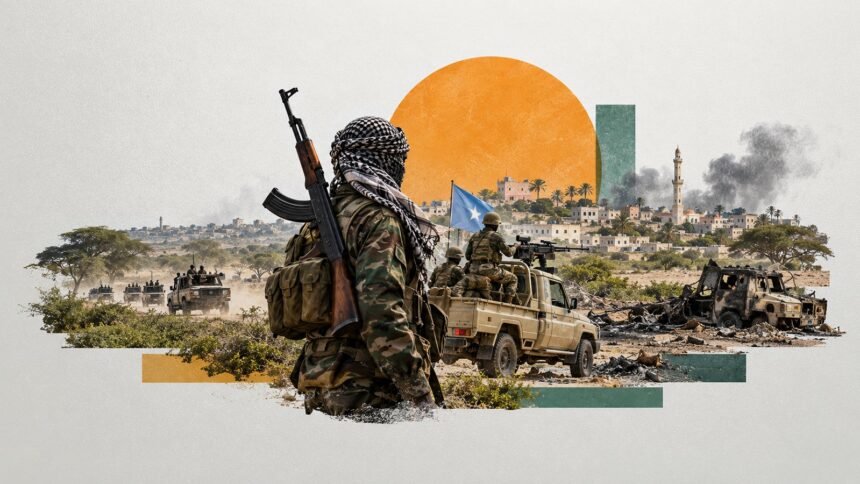
How many people died in Lower Shabelle on Monday? A day later, nobody outside the two warring camps can say. Somalia’s defense ministry said on Tuesday that federal troops had killed 75 Al-Shabaab fighters and wounded 56 more in several hours of fighting near the southern city of Leego on 26 October. The al-Qaeda-linked insurgents, for their part, claimed to have killed 321 government soldiers in an attack on Turkish-trained troops and an allied militia. Neither figure has been independently verified, and the gap between them is far too wide to split down the middle.
The battle matters beyond its uncertain toll. It was fought in a region where the federal government has been battling an insurgency for two decades despite a major international effort to defeat it, and at a moment when the outside money and logistics behind that effort are thinning. For a continent that has spent its own soldiers and political capital on Somalia’s stabilization, the fight near Leego is a test of whether Somali forces can hold ground. At the same time, foreign backers recalculate whether the Somali state can tell its own citizens what happened to its own soldiers.
Two Versions of One Afternoon
The insurgents’ version is of an ambush. Al-Shabaab said it launched its attack on Monday afternoon and described a three-hour assault in which its fighters, it claimed, also captured prisoners, weapons and vehicles. The group framed the target as Turkish-trained government troops fighting alongside an allied militia, a detail chosen to signal that it can strike the units on which the government’s new strategy depends.
The government’s version is of an offensive. “The Somali National Army, conducting Operation Banooda, launched a major assault lasting several hours on 26 October against Al-Shabaab positions in Jameeca,” the defense ministry said in a statement. In that account, the army was the side that moved first, and the militants were the ones caught in their positions.
The two accounts do overlap on some points. The ministry confirmed that the militants used vehicles packed with explosives during the fighting and acknowledged that equipment had been hit. “The attack damaged some military vehicles,” the ministry said. Its statement did not, however, give any toll for government forces, and it neither confirmed nor denied the insurgents’ claims to have taken prisoners and seized equipment.
What the Gaps Suggest
Silence on one’s own losses is a familiar feature of war communications, but it carries a cost. When a statement concedes damaged vehicles and car bombs yet offers no number for dead or wounded soldiers, the only casualty figure for the government side in public circulation becomes the one supplied by the enemy. That hands the insurgents a propaganda advantage they did not have to earn on the battlefield.
There are signs that the confrontation was serious. One local report, which the government has not confirmed, said the cabinet had been called into emergency session to discuss what it described as “heavy casualties and substantial military equipment losses” near Leego. That report adds weight to the sense of a significant clash, but it does not settle which side suffered more, how the fighting unfolded, or whether either headline figure is close to the truth. Until independent observers, local elders or the families of the dead can speak, the scale of Monday’s losses remains a matter of competing claims.
A Long War Close to the Capital
Lower Shabelle is not a remote frontier. It lies close enough to Mogadishu that every setback there is felt politically in the capital, and it has been fought over repeatedly in an insurgency that has survived two decades of military pressure and successive foreign deployments. Al-Shabaab still controls large areas of central Somalia, which means that ground taken in one district can be lost in another, and that the group retains the capacity to mount major attacks when it chooses.
That durability is the real story behind the competing tolls. Whether 75 fighters died or 321 soldiers did, the insurgency has shown again that it can bring explosive-laden vehicles and organized units to bear against government positions. The government has shown again that it can mount multi-hour operations. Neither side is close to a decisive result.
Turkey Steps Forward as Washington Steps Back
The battle comes as the international scaffolding around Somalia’s counter-insurgency shifts. Turkey has emerged as a key supporter of the federal government, including through the training of Somali troops, and its role has grown as the United States and other major donors pull back from supporting the campaign.
Washington has stopped funding the United Nations logistics mission that supplies combat operations in Somalia, a vital part of the support underpinning the war effort. The United States has cited the government’s failure to make progress in uniting the country and confronting the insurgency as its reason. The withdrawal leaves Somali forces and their partners under more pressure at exactly the moment the insurgents are testing them.
Replacing one patron with another is not the same as building self-sustaining capacity. Turkish training can produce disciplined units, but fuel, rations, medical evacuation and ammunition resupply are what keep those units in the field after a three-hour firefight, and that is the part of the system now losing its funding.
An Election Season Under Fire
The fighting also lands in a political calendar. Somalia has set a date for a presidential election in May, and the campaign against Al-Shabaab is one of the main measures by which voters, clan leaders and federal member states will judge the government. A battle whose cost the government will not state publicly is unlikely to strengthen trust in its account of the war’s progress.
For the insurgents, inflated or not, a claim of 321 dead soldiers is designed to reach exactly those audiences: recruits, wavering local militias and families wondering whether the state can protect their sons in uniform.
Owning the Count
There is a quieter lesson here about self-reliance. A state that cannot or will not publish its own casualty figures leaves its war story to be written by its enemies and its foreign funders. Somalia’s partners on the continent, from troop-contributing neighbors to the African Union, have an interest in helping build credible, independent casualty reporting, because legitimacy is as much a front line as Lower Shabelle. Honest numbers would not end the insurgency, but they would let Somalis judge for themselves how the war is going, and decide on their own terms what it is worth.