





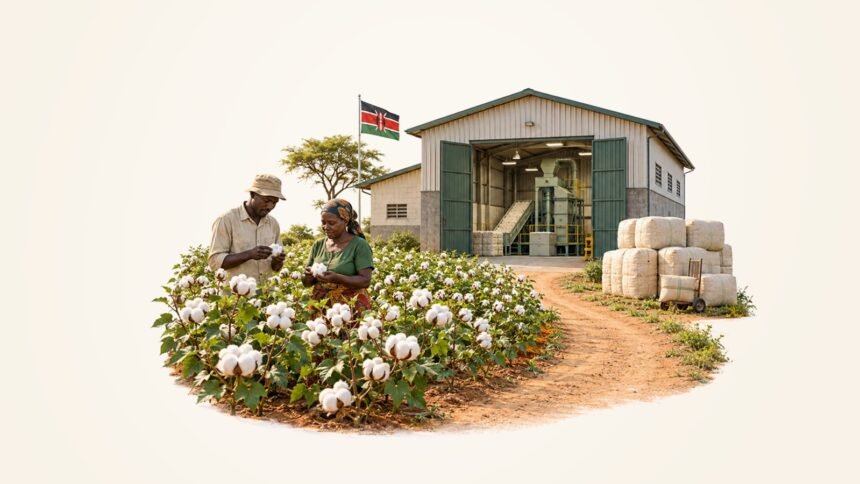
The Pan-African Paradigm of Agrarian Sovereignty and Value Retention
What does it mean for a ginnery to fall silent for four months, its belts and rollers motionless, while the fields two kilometers away are already turning green with the next harvest? At Luanda Ginnery in Kenya’s Busia County, that silence is not a sign of industrial failure so much as a symptom of a structural mismatch that has trailed African cotton production for decades: the machinery to process raw fiber into an exportable, value-added commodity has consistently outpaced the reliable supply of farmers willing to grow it. Kenya is growing cotton again, its fields around Busia now roughly two months into a new planting cycle, farmers scanning the skies for rains that will determine whether the crop justifies the risk. But the deeper question facing Kenya, and much of cotton-growing Africa, is not whether the plant can be coaxed back into the soil; it is whether the value generated by that plant can be captured domestically, in ginneries and textile mills, rather than exported as raw fiber for someone else’s factory to finish. Busia’s farmers and its idle machines are, together, attempting to answer that question, and reclaiming the industrial half of an equation Africa has too often ceded to others.
The Ginnery That Waits for Farmers
Inside Luanda Ginnery, the absence of noise is itself the story. For roughly four months there has been no cotton to process, the belts and rollers that ordinarily separate fiber from seed sitting idle while the surrounding roads, rough enough that farmers and visitors rely on motorcycle taxis to reach fields off the main routes, lead out to plants still two months from harvest. The facility’s manager, identified in reporting only by his surname, Barasa, frames the dependency bluntly: “If they don’t grow cotton, then we don’t have raw materials. That means we won’t move on.” It is a simple statement that captures an industrial system built around a single, fragile input: a ginnery, however upgraded its equipment, generates no value at all without a predictable flow of cotton arriving from smallholder fields, and Busia’s flow has been anything but predictable in recent years.
The Central Contradiction of Revival
That fragility runs in both directions, which is precisely what makes Busia’s revival attempt structurally difficult rather than simply a matter of encouragement. Kenya needs more cotton under cultivation to make its ginneries commercially viable. Still, farmers need functioning ginneries, reliable buyers, and predictable prices before cotton becomes worth the risk of planting over maize or other staples. Breaking that circularity is why the local farming cooperative has become the critical connective institution, the bridge between individual smallholders and an industrial system that cannot function through either party acting alone. Without an intermediary capable of guaranteeing farmers a market and guaranteeing the ginnery a supply, the two sides of Busia’s cotton economy risk remaining permanently out of sync, each waiting on the other to move first.
A Farmer’s Arithmetic
Vincent Akumu’s ambitions illustrate the scale of what stands in the way. He currently farms one and a half acres of cotton and wants to expand to five, a fivefold increase that depends on land preparation machinery he cannot reliably access. Farmers in the area depend on county-owned equipment, hired machines when available, or labor-intensive manual preparation when neither option materializes, and seed access presents its own separate constraint. Bernard Ojiambo, chairman of the local farming union, situates the current moment against a longer history: cotton has been grown in the region for decades, but years of delayed payments and weak markets steadily pushed farmers toward maize instead. “Cotton is more of a value than maize,” Ojiambo argues. Still, he is equally clear that farmers need structured support in financing, inputs, and guaranteed offtake to make that value proposition credible again after years of disappointment.
Waiting for the Rains, Waiting for the Machines
Weather, Busia’s farmers ultimately dictate the revival’s timeline cannot control, and infrastructure they do not yet fully possess. With the cotton still roughly two months from maturity, both the fields and the upgraded Luanda Ginnery remain in a holding pattern, each side of the value chain suspended until the other is ready to move. Beyond the ginnery itself, textile factories further down the chain represent the next tier of dependency: their future output depends entirely on what happens in fields like Vincent’s, meaning that a shortfall at the smallholder level would ripple through every subsequent stage of Kenya’s attempted cotton-to-cloth industrialization, regardless of how modern the processing equipment further along the chain has become.
Reclaiming the Value Chain From Field to Factory
Busia’s stalled ginnery and its waiting fields are, in miniature, the story of African agro-industrial ambition more broadly: raw production capacity that consistently outstrips the institutional scaffolding, financing, cooperative structures and guaranteed markets needed to convert that capacity into durable industrial value retained on the continent. Kenya’s cotton comeback will only become a genuine industrial revival if the cooperative bridge between Vincent Akumu’s fields and Barasa’s silent machines proves sturdy enough to survive a full season, and if the textile factories waiting further downstream find the fiber arriving reliably enough to plan around. The rains have not yet come. The machines have not yet restarted. But the intent to keep more of cotton’s value inside Busia, rather than exporting the raw crop for finishing elsewhere, is itself a modest act of reclaiming an agrarian sovereignty Kenya’s farmers have spent a generation ceding by default.