





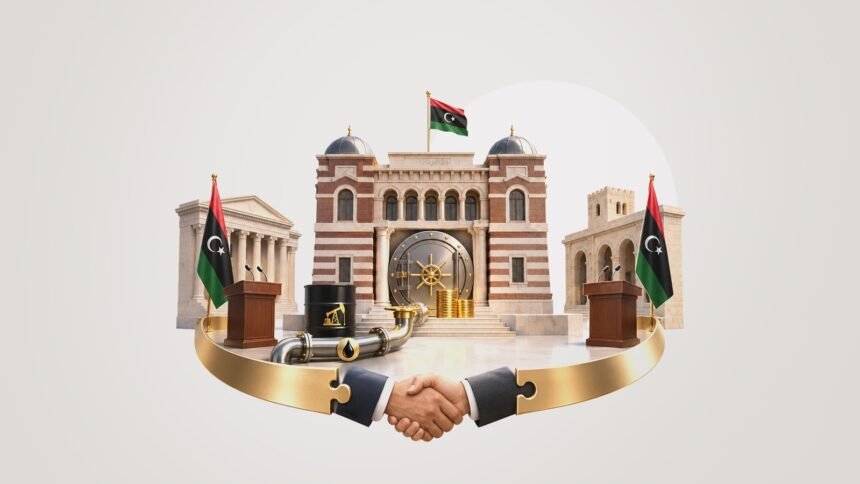
Who Holds the Keys to Libya’s Oil Money
Who gets to run the institution that receives Libya’s oil revenue? This week, the eastern-based House of Representatives answered, voting to appoint Fawzi Abu Khazam as governor of the Central Bank of Libya after accepting Naji Issa’s resignation. According to the parliament’s spokesperson, 78 of the 90 members present voted in favor. The Tripoli-based High Council of State, the rival chamber in the west that has long claimed a say over senior appointments, had not commented on the vote.
The appointment comes in a week that also saw the eastern authorities sign a cooperation agreement with neighboring Niger and Turkey to describe talks aimed at reunifying Libya’s divided institutions. Taken together, these moves show Benghazi acting with growing confidence as a center of power, at the very moment when outside mediators speak of bringing east and west back under one roof.
A Resignation, a Raid and a Vote
Libya has been split since 2014 between a UN-recognised government in Tripoli, led by Prime Minister Abdulhamid Dbeibah, and a rival administration and parliament in the east backed by military commander Khalifa Haftar. The parliament sits in Benghazi, under Haftar’s control. The central bank is one of the few bodies that serves the whole country, which is why every change at its head is fought over.
Issa took over the bank in 2024, during a political standoff that halted oil production and caused a deep financial crisis. In August, he submitted his resignation to both legislative chambers, saying he could not continue, but he gave no public explanation. In October, on the same day parliament accepted his resignation, the central bank said unidentified individuals had raided its headquarters in Tripoli. The parliament, which got a new speaker only weeks before the vote, has now moved to fill the post itself.
Details on Abu Khazam’s background and on whether Tripoli will recognize his appointment were not available when this brief was prepared. The silence of the High Council of State matters: an appointment backed by only one side could leave the bank with contested leadership at a time when it needs the trust of both halves of the country.
A Pact With Niamey
On Sunday, Niger’s Prime Minister Ali Mahaman Lamine Zeine visited Benghazi with political and military officials and approved a memorandum of understanding with Haftar to expand cooperation “in various fields”. Niger shares a border of more than 340 kilometers with Libya and maintains relations with both Libyan authorities, but the visit marks a clear shift toward Benghazi.
For Niger’s military government, the eastern authorities control territory and routes that matter for its own security and trade across the Sahara. For Haftar, a formal agreement with a neighboring government adds diplomatic weight to an administration that lacks UN recognition. The text of the memorandum and its specific areas of cooperation have not been made public.
Ankara’s Unification Track
At the same time, Turkey says it is working to bring the two sides together. A senior Turkish official said that Ankara hosted talks last week between military officials from Libya’s eastern and western administrations, together with diplomats, aimed at reunification. The discussions have so far focused on unifying the armed forces, with political unity expected to be addressed later. No agreement has been reached, but the parties have apparently agreed to keep talking.
Turkish Foreign Minister Hakan Fidan said on Friday that the time had come to reunify the two administrations and hinted that an announcement could come soon. “One of the most important pillars of national unification is how the military units currently controlled separately by both sides will be brought together under a single umbrella,” he said. Turkey strongly backed the Tripoli government during years of fighting, but its ties with the eastern authorities have warmed significantly, making it one of the few countries that talks to both.
Parallel Moves, Uncertain Direction
There is an obvious tension between the two tracks. Reunification talks imply shared institutions; a central bank governor chosen by one chamber, and foreign agreements signed by one side, imply the opposite. It is possible that both can coexist, with the east strengthening its hand before any deal. It is also possible that unilateral appointments will make a deal harder to reach. Much will depend on whether the High Council of State and the Tripoli government accept or reject Abu Khazam.
Since the overthrow of Muammar Gaddafi in a NATO-backed uprising in 2011, Libya has repeatedly seen its institutions pulled between rival authorities and their foreign backers. The central bank, the national oil company and the security forces have each been at the center of that struggle.
Libyans First at the Table
Libya’s self-determination depends on Libyans controlling the institutions that manage their common wealth, not on which foreign capital hosts the next round of talks. A single, accountable central bank governed by rules that both halves of the country accept would do more for ordinary Libyans than any number of memoranda. This week’s vote in Benghazi will be judged by whether it brings that closer or pushes it further away.