



Pan-African Destiny: A Continent Bound by Shared Struggle and Shared Hope
Africa today is not fifty-four separate nations but a single civilisational organism wounded in the same place. From the dunes of the Ogaden to the townships of Khayelitsha, from the fishing villages of Lake Chad to the refugee camps of Dadaab, the same spectre stalks: extreme poverty that now afflicts 489 million people—more than the entire population of the European Union and North America combined. This is no longer a development challenge; it is an existential emergency that threatens the very possibility of an African future.
The youth bulge is the most visible manifestation of this crisis. By 2035, one in every two children born on Earth will be African. Yet the majority of these children are entering a world where their parents already survive on less than $2.15 a day, where one in three children is stunted, where secondary school completion rates hover below 40 per cent in half the continent, and where formal jobs are so scarce that 70 per cent of young workers are trapped in vulnerable, low-productivity employment. The “millennium babies” who were supposed to inherit the dividends of the MDGs are now twenty-five-year-olds selling phone credit on dusty roadsides, nursing dreams that statistics have already declared impossible.
This is the Pan-African tragedy: a continent whose peoples once dreamed together of Uhuru, of Harambee, of Ujamaa, now finds itself collectively imprisoned inside the same economic cage built during centuries of extraction and reinforced by decades of predatory globalisation. The dream of continental unity—Nkrumah’s “Africa Must Unite,” Senghor’s civilisation de l’universel, the Lagos Plan of Action, the Abuja Treaty, Agenda 2063—remains the only scale large enough to confront a threat that is itself continental in scope.
The Anatomy of African Poverty: Depth, Breadth, and Historical Roots
In 2025, sub-Saharan Africa will remain the only region on Earth where the absolute number of impoverished people continues to rise. The World Bank’s latest estimates show that 44 per cent of the region’s population—nearly one in every two human beings—lives below the $2.15 extreme poverty line, and 67 per cent below the $6.85 lower-middle-income threshold. Multidimensional poverty, which includes deprivations in health, education, and living standards, affects 55–60 per cent of Africans, the highest rate in the world.
The geography of destitution is brutally clear. Ten of the twelve poorest countries on earth (measured by GDP per capita, PPP) are African: South Sudan ($251), Burundi ($469), Central African Republic ($532), Malawi ($611), Madagascar ($618), Somalia ($645), Niger ($647), Democratic Republic of Congo ($779), Mozambique ($811), and Sierra Leone ($867). In each of these states, more than two-thirds of the population lives in extreme poverty. Fragility and conflict explain much of this concentration: the bottom ten include five countries classified by the World Bank as being in active conflict or in a post-conflict transition.
Yet poverty is not only a problem of the poorest states. Nigeria, Africa’s largest economy and most populous nation, has overtaken India as the country with the world’s most significant number of impoverished citizens—over 100 million. South Africa, the continent’s most industrialised economy, has an official unemployment rate above 34 per cent and a youth unemployment rate approaching 65 per cent; its Gini coefficient of 0.63 is among the highest ever recorded. Even relatively successful middle-income countries like Gabon, Botswana, and Equatorial Guinea exhibit extreme inequality, with oil and mineral rents captured by tiny elites while the majority remain in poverty.
The historical roots run deep. The trans-Atlantic and Indian Ocean slave trades removed tens of millions of the most productive members of society over four centuries. Colonialism deliberately underdeveloped the continent, creating export monocultures, suppressing industrialisation, and drawing borders that ignored ethnic and ecological realities. After independence, the Cold War turned many African states into proxy battlegrounds. At the same time, structural adjustment programmes in the 1980s and 1990s forced the dismantling of social services, the privatisation of public assets, and the liberalisation of trade, precisely when infant industries needed protection. The result: a continent that produces what it does not consume and consumes what it does not grow, locked into commodity dependence in an age of collapsing terms of trade.
Development Interrupted: From African Lions to a Lost Quarter-Century
Between 2000 and 2014, Africa experienced its most extended sustained period of growth since independence. Six of the world’s ten fastest-growing economies were African. Extreme poverty fell from 57 per cent to 35 per cent. A narrative of “Africa Rising” took hold. Then came the triple shock of the 2014 commodity price collapse, the COVID-19 pandemic, and the 2022–2025 global inflation and debt crisis. Growth slowed to 3.5–4 per cent—below population growth—and poverty rates began rising again for the first time in a generation.
The IMF and World Bank now project that sub-Saharan Africa will need average annual growth of at least 7–8 per cent for the next twenty-five years to return to the pre-pandemic poverty trajectory. Yet in 2025–2030, growth is expected to average only 4.1 per cent. The continent faces a “lost quarter-century” in which hundreds of millions of young people will enter adulthood in conditions worse than those their parents knew.
The structural obstacles are formidable: a manufacturing sector that has actually declined as a share of GDP since 1980; an informal economy that employs 85 per cent of the workforce yet generates only subsistence incomes; an infrastructure deficit estimated at $100–170 billion per year; a tax-to-GDP ratio stuck at 15–17 per cent, half the level needed to finance development; and a debt crisis that has seen external debt service absorb 20–40 per cent of export revenues in many countries.
Human Dignity Under Siege: When Poverty Becomes a Human Rights Catastrophe
Poverty in Africa is not only economic; it is an assault on the very idea of shared humanity. One in three African children suffers physical stunting; one in twelve dies before the age of five. Thirty million children are out of primary school. In the Sahel, life expectancy has fallen in some countries since 2015. Gender-based violence, early marriage, and female genital mutilation persist at horrific levels in the poorest regions, driven by economic desperation.
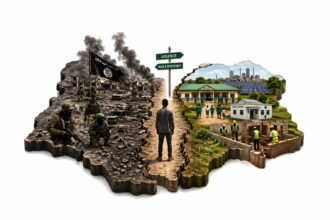
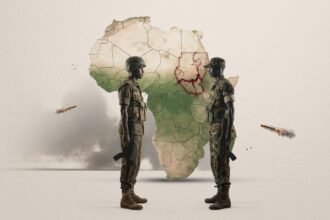
In fragile states, poverty and rights violations form a vicious circle. When young men have no jobs, no prospects, and no dignity, the recruitment pitch of armed groups becomes compelling. Boko Haram, Al-Shabaab, ISWAP, and the plethora of militias in the eastern DRC all feed on the same reservoir of hopelessness. The African Union’s own reports acknowledge that socioeconomic marginalisation is the most critical driver of violent extremism on the continent.
The Rentier Trap: When Resources Become a Curse
Across much of Africa, the economy remains organised around the extraction and export of unprocessed natural resources—oil, gas, gold, diamonds, cobalt, coltan, and lithium. This rentier model creates three fatal distortions:
- It concentrates wealth in the hands of a tiny elite connected to political power and foreign corporations.
- It makes national budgets hostage to volatile global commodity prices.
- It crowds out productive investment in agriculture, manufacturing, and human capital.
Nigeria, Africa’s largest oil producer, has earned over $1 trillion from oil since 1960, yet has a poverty rate of 46 per cent and 13 million out-of-school children. The Democratic Republic of Congo sits on $24 trillion worth of mineral resources, yet has the world’s third-highest number of impoverished people. Angola, the continent’s second-largest oil exporter, has a child mortality rate worse than that of Afghanistan.
Even non-oil rentierism—dependence on foreign aid, remittances, or mineral royalties—produces similar pathologies: weak domestic revenue mobilisation, lack of accountability to citizens, and the perpetual postponement of structural transformation.
The Climate-Poverty Doom Loop
Africa is the continent least responsible for climate change and most vulnerable to its effects. By 2030, up to 118 million additional Africans could be pushed into extreme poverty by climate impacts—droughts, floods, heatwaves, and crop failures. The Horn of Africa is already experiencing its worst drought in forty years; the Sahel is losing 12 million hectares of productive land to desertification annually; Lake Chad has shrunk to 10 per cent of its 1960s size.
Smallholder farmers, who produce 80 per cent of Africa’s food, are on the front line. A single failed rainy season can wipe out an entire year’s income. Without massive investment in climate-resilient agriculture, irrigation, and early-warning systems—estimated at $15–30 billion per year—the continent faces recurring famines on a scale not seen since the 1980s.
Lessons from Elsewhere: US and Chinese Anti-Poverty Models in the African Context
The United States reduced its poverty rate from 22 per cent in 1959 to 11 per cent today through a combination of sustained economic growth, massive public investment (the New Deal, the GI Bill, the Great Society), progressive taxation, and social protection floors. China lifted 800 million people out of poverty in 40 years through state-led industrialisation, rural infrastructure, land reform, universal basic education and health, and deliberate urbanisation, supported by labour-intensive manufacturing.
Africa needs elements of both models, adapted to its realities:
- The Chinese emphasis on infrastructure, industrial policy, and agricultural productivity.
- The American emphasis on democratic accountability, social safety nets, and human capital investment.
Yet neither superpower is offering Africa the complete package. U.S. engagement remains heavily securitised and conditional; Chinese engagement prioritises resource access and elite partnerships over governance reform. A genuine African path must be synthesised from both, while rejecting the extractive elements of each.
Accountability or Collapse: The Governance Imperative
At root, Africa’s poverty crisis is a crisis of governance and political will. Corruption costs the continent an estimated $148 billion per year—more than the combined total of aid and foreign direct investment. Illicit financial flows, generated mainly by multinational corporations with the complicity of local elites, exceed $89 billion annually.
The solutions are known:
- Transparent resource contracts and beneficial ownership registries.
- Independent anti-corruption agencies with real prosecutorial power.
- Digital public financial management systems that allow citizens to track every tax dollar.
- Debt workouts that prioritise human development over creditor rights.
- A Pan-African financial architecture—stronger African Development Bank, African Monetary Fund, continental payment system—that reduces dependence on external actors.
The Horizon: From Existential Threat to Historic Opportunity
By 2050, Africa will have the world’s largest workforce and a population of 2.5 billion. If current trends continue, most of those workers will be poor, undereducated, and underemployed—an existential catastrophe of unprecedented scale.
But trends are not destiny. The same demographic youth bulge that threatens chaos can become the most significant demographic dividend in human history if Africa achieves:
- 7–8 per cent sustained growth through industrialisation and agro-processing.
- 20 million new formal jobs created every year for the next twenty-five years.
- Universal secondary education and dramatic reductions in stunting.
- A green re-industrialisation built on the continent’s critical minerals and renewable energy potential.
The African Continental Free Trade Area, if fully implemented, could increase intra-African trade by 50 per cent and lift 30–50 million people out of poverty by 2035. The global transition to clean energy requires minerals that Africa possesses in abundance—if the continent can move up the value chain from raw exports to refining and manufacturing, it can capture trillions in value.
Poverty in Africa is not an African problem. It is a global problem that happens to be located in Africa. If the continent fails, the shock waves—migration crises, pandemics, terrorism, climate refugees—will overwhelm every border on earth.
The choice is stark: collective Pan-African action at scale, supported by a new global bargain that finally treats Africa as an equal partner, or a 21st century defined by the slow-motion collapse of an entire continent and the moral bankruptcy of humanity.
The hour is late, but the possibility of a renaissance remains. The question is whether Africa—and the world—still possess the vision and courage to seize it.