




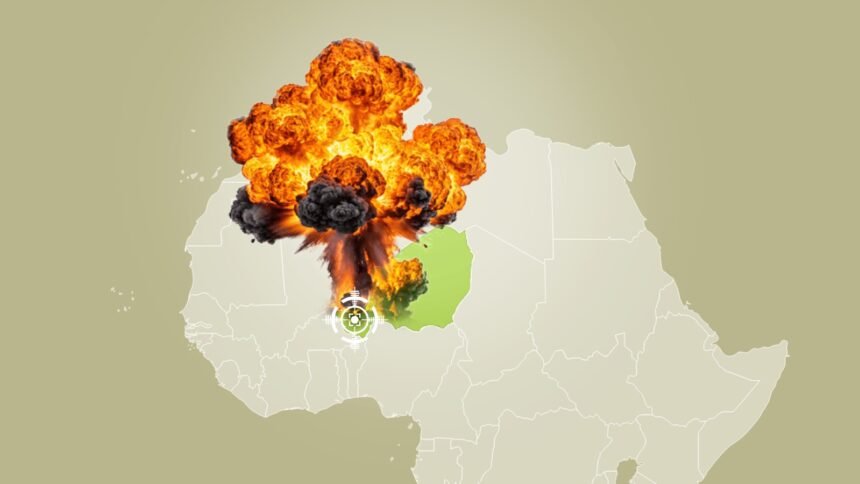
Niger’s security apparatus grapples with intensified jihadist aggression, exemplified by the Islamic State’s claimed January 29, 2026, assault on Niamey’s international airport and adjacent airbase, where motorcycle-borne militants deployed drones and heavy weaponry to damage aircraft and ignite chaos. As the Sahel’s militant mosaic evolves, this analysis dissects counterterrorism efforts against Islamic State and al-Qaeda affiliates, highlighting junta-led tactics amid shifts in foreign power and multilateral hurdles, while forecasting pathways to bolster regional resilience.
Pan African Perils: Jihad’s Sahelian Spread
The Sahel’s jihadist perils engulf Pan African security, with Niger’s Niamey assault underscoring Islamic State’s audacious expansion amid governance voids and resource rivalries. The predawn raid, claimed by IS via Amaq propaganda, deployed drones for reconnaissance and heavy arms to perforate aircraft from Asky and Air Côte d’Ivoire, igniting fires that scorched tarmac without reported casualties. Calm was restored swiftly through heavy deployments, yet the strike’s proximity to the presidential palace highlights vulnerabilities in a region where 2025 violence displaced over 500,000 across Niger, Mali, and Burkina Faso.
Pan-African implications loom large: jihad’s spread southward pressures coastal states like the Ivory Coast, where U.S. drone overtures aim to curb incursions, while Mozambique’s ISIS raids mirror Sahelian tactics, displacing 300,000. Perils stem from intertwined threats: Islamic State’s Sahel Province (ISSP) and al-Qaeda’s JNIM hybridize operations, taxing gold mines for millions to fund escalations. Continental responses falter amid ECOWAS sanctions and AU suspensions, demanding unified vigilance: cross-border intelligence pacts to dismantle supply chains, lest Sahelian jihad erodes Africa’s economic corridors.
Niger’s Nocturnal Vulnerabilities: Niamey Assault Dynamics
Niger’s nocturnal vulnerabilities exposed in the Niamey assault reveal jihadist infiltration amid junta consolidation, where militants on motorcycles struck Base Aérienne 101, formerly hosting U.S. and Russian forces, damaging planes and scattering evidence like seized motorcycles. The attack, lasting an hour before repulse, aligns with ISSP’s recent Tillabéri raids killing 120 in September 2025, exploiting western frontiers for drone-enabled strikes.
Dynamics complicate Niger’s post-2023 coup landscape: junta leader Abdourahamane Tchiani’s regime, facing internal dissent and external isolation, blames neighboring states such as Benin and Côte d’Ivoire without evidence, thereby diverting attention from domestic failings, including 60 percent poverty, that fuel recruitment. Vulnerabilities persist in urban targets: the airport’s dual civilian-military role makes it particularly susceptible to disruption, echoing 2025’s refugee influxes that strained camps. Niger’s counterstrike must address these: enhanced urban patrols and community sentinels to mitigate nocturnal threats, fostering internal cohesion against jihad’s opportunistic advances.
Islamic State & AQ in Sahel: Militant Hybrid Horizons
Islamic State and al-Qaeda’s Sahelian horizons hybridize threats, with ISSP’s Niamey claim signaling tactical evolution amid JNIM’s complementary sieges. ISSP, an IS offshoot since 2015, deploys drones for precision in Niger’s west, abducting foreigners like an American pilot in October 2025, while JNIM, al-Qaeda’s 6,000-strong arm, coordinates blockades starving Mali’s Bamako and Burkina’s Djibo.
Hybrid horizons exploit fractures: ISSP’s Fulani alliances blend herder grievances with jihad, taxing uranium for $200 million to fund arms, mirroring JNIM’s gold extortions yielding $300 million. In Niger, this mosaic enables urban strikes like Niamey, spilling from rural Tillabéri massacres. Horizons demand dismantling: targeted ops disrupting drone supply chains from Libyan markets, while addressing ethnic marginalization to erode militant appeals across the Sahel’s volatile expanse.
Counter-Terrorism Efforts: Sahel’s Tactical Twists
Counter-terrorism efforts in the Sahel are intertwined with Niger’s post-Niamey reinforcements, where junta-led operations, bolstered by Russian Wagner since 2023, prioritize perimeters but struggle against hybrid tactics. Niamey’s swift cordon restored order, yet ISSP’s drone use marks escalation, echoing JNIM’s 2025 advances claiming 7,800 lives across the AES bloc.
Twists comparative: Mali’s Wagner-guarded mines yield reprisals alienating populations, while Burkina’s VDP recruits surge but commit excesses fueling recruitment. Niger’s efforts, 5,000 troops in western patrols, repel raids but lag in tech, with French Barkhane’s 2022 exit ceding drones to militants. Sahel’s counter-twists require innovation: hybrid forces fusing kinetics with community dialogues, enhancing radar nets against aerial threats to untangle tactical knots.
US & France vs. Russia: Sahel’s Foreign Force Flux
US and France versus Russia’s Sahelian force flux pivots with Niger’s Niamey vulnerabilities highlighting post-colonial realignments. France’s Barkhane withdrawal (2022) from Mali ceded influence, with juntas expelling UN MINUSMA and embracing Russia’s Africa Corps for training and arms, as in Niger’s Base 101 shift from US to Russian occupancy.
Flux’s impacts: Russian mercenaries commit atrocities like Mali’s Moura (300 dead, 2022), alienating Fulani and boosting ISSP, while US sanctions and travel bans from January 2026 strain Niger’s economy. Comparatively, France’s legacy failures, failing to stem jihad amid elite corruption, paved Russian inroads, yet Moscow’s mine priorities neglect counter-terror. Sahel’s flux demands balance: Pan-African protocols regulating foreign actors, leveraging U.S. technology with Russian arms under local command to stabilize force dynamics.
AU vs. UN Efforts: Multilateral Maneuvers in Sahel
AU versus UN efforts maneuver through Sahel’s multilateral maze, where Niger’s assault exposes gaps in international support amid junta isolation. AU suspensions post-coups pressure returns to order, while UN’s MINUSMA exit (2023) from Mali leaves monitoring voids, with 2025’s 1.2 million IDPs underscoring humanitarian shortfalls.
Maneuvers comparative: AU’s G5 Sahel dissolution yields to AES’s 5,000-strong force, yet lacks operational teeth against JNIM’s advances. UN’s sanctions backfire, fueling anti-Western sentiment, while AU dialogues in Addis urge inclusive transitions. Sahel’s maneuvers require synergy: joint AU-UN task forces for border monitoring, bridging multilateral divides to enhance counter-terror efficacy.
Security Outlook: Sahel’s Stability Spectrum
Sahel’s security spectrum forecasts turbulent horizons, with Niger’s Niamey assault portending urban jihad escalations amid junta entrenchment and foreign fluxes. Stability wavers: 2026 projections see violence surging 40 percent if junta repressions alienate peripheries, fueling ISSP’s drone campaigns.
Spectrum’s brighter edges: Pan-African pacts could be recalibrated, with AU-mediated dialogues fostering equitable reforms. Outlook hinges on addressing roots, poverty, ethnic marginalization, to spectrum shift from siege to sovereignty, forging Sahel’s resilient dawn.