





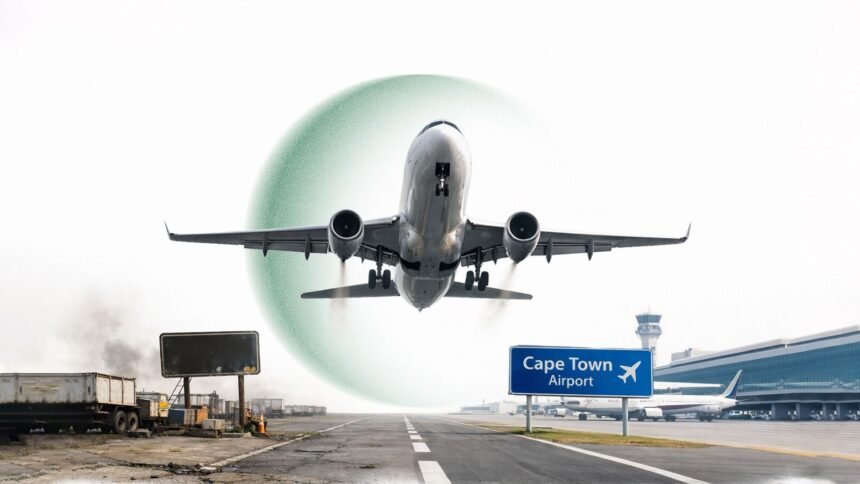
On a recent autumn morning in Cape Town, arriving passengers stepped into a terminal of polished floors, orderly immigration lines, and departure boards that, unusually in much of Africa, mostly read “on time.”
Days earlier and nearly 10,000 kilometers away, that experience had been turned into trophies at a ceremony in London: Cape Town International Airport was again named the Best Airport in Africa at the 2026 Skytrax World Airport Awards, extending a winning streak that now stretches 11 consecutive years.
The South African Hub Did More Than Defend A Title
Skytrax, the British‑based rating agency that organizes what it calls the world’s largest airport customer‑satisfaction survey, also recognized Cape Town as Africa’s cleanest airport and the continent’s leader for airport staff service in 2026.
The latest survey drew responses from travelers of more than 100 nationalities between August 2025 and February 2026, covering every stage of the journey from check‑in to final boarding.
For South African officials, the sweep confirms a narrative they have been advancing for years: that their airports now set the benchmark for the continent.
For many travelers elsewhere in Africa, the news can land differently, highlighting a divide between a handful of well‑resourced hubs and airports where delays, outages and overcrowding still define the experience.
The awards raise a question with implications for tourism, trade, and regional integration: Does Cape Town’s rise signal an aviation renaissance for Africa, or the entrenchment of a two‑tier system in which only a few cities deliver world‑class service?
Background and Stakes
Skytrax’s World Airport Awards have been running since 1999 and now evaluate more than 575 airports worldwide, using what the company describes as an independent, survey‑based methodology.
In the 2026 Africa rankings, South Africa dominated:
Cape Town placed first, Johannesburg’s O. R. Tambo International Airport second, and Durban’s King Shaka International Airport fourth, with several smaller South African airports also appearing in regional top‑ten lists.
Cape Town’s continued success reflects years of investment by Airports Company South Africa, the state‑controlled operator that manages nine major airports.
According to travel and business outlets, the company has invested in terminal refurbishments, expanded security lanes, digital way‑finding, and staff training that emphasize visible customer support and efficient problem‑solving.
“These prestigious recognitions from the Skytrax World Airport Awards are a powerful affirmation of the dedication, resilience, and professionalism of our employees, partners, and stakeholders,” Fani Mphaphuli, acting group executive for operations management at Airports Company South Africa, said after the 2026 results.
The company and local tourism officials have pointed to the awards as evidence that a focus on day‑to‑day reliability, rather than only showpiece architecture, can shape how travelers perceive an entire destination.
The Stakes Are Significant
African governments and development banks have long argued that better air connectivity is essential to unlocking intra‑African trade and tourism. Yet, the continent still accounts for a small share of global passenger traffic and faces relatively high average ticket prices.
In that context, a well‑rated entry point that reassures international visitors can influence decisions about where to hold conferences, launch new routes, or locate regional headquarters.
Human Stories and Real-World Examples
The contrast across Africa is evident in published accounts by travelers and in regional media.
South African broadcasters and local newspapers have highlighted that Cape Town’s queues, signage, and cleanliness often compare favorably with those at airports elsewhere on the continent, where passengers report long waits, intermittent power, and limited information when flights are disrupted.
Those disparities are echoed in online forums and social media posts reacting to the latest awards, where commenters frequently describe Cape Town as an exception rather than the rule.
Tourism and travel‑trade outlets have seized on the Skytrax results as a marketing tool.
TravelNews Africa, for example, framed Cape Town’s 11th straight win, and companion awards for cleanliness and staff quality, as a “valuable selling point” for tour operators packaging trips to the Western Cape.
Adventure and business travel blogs have likewise argued that consistently high scores on reliability and passenger experience make the city a more attractive gateway for visitors wary of complicated transfers.
In The Air, Ethiopian Airlines Has Built A Parallel Story of Consistency
The carrier, which describes itself as Africa’s largest aviation group, was named Best Airline in Africa at the 2025 Skytrax World Airline Awards, marking its eighth consecutive year holding that title.
In a statement, Mesfin Tasew, the airline’s chief executive, said the recognition was “a testament to the hard work, dedication and passion of the entire Ethiopian Airlines family” and to the “trust and loyalty” of its customers.
Taken together, the Cape Town and Ethiopian results suggest that parts of the continent now routinely meet global benchmarks for airport and airline services, even as many passengers continue to encounter fragile systems elsewhere.
Policy, Debate, and What’s Next
Officials in South Africa and Ethiopia argue that these successes demonstrate what is possible when governments give airport and airline operators clear mandates, stable funding, and the freedom to operate commercially.
They also point to multilateral initiatives such as the African Union’s Single African Air Transport Market, designed to liberalize routes and encourage competition, as a way to spread those gains beyond a handful of hubs.
Critics and some analysts caution that liberalization without parallel infrastructure investment could instead concentrate traffic in a few better‑run airports.
In countries where facilities struggle with underfunding, governance problems, or the aftereffects of conflict, they warn, open skies may deepen disparities between passengers using high‑performing hubs and those reliant on crowded, aging terminals.
Development lenders and aviation experts have called for a focus on basic, high‑impact upgrades, reliable power, runway maintenance, and modern security, rather than only on prestige terminal projects, arguing that such investments can improve safety and punctuality across the board.
Climate advocates, meanwhile, note that African countries are acutely vulnerable to climate change even as they seek to expand aviation.
This sector adds to global emissions, and argues that improving efficiency at existing airports, reducing delays, and reducing fuel‑wasting ground time should be part of any expansion strategy.
For now, Cape Town’s glass‑fronted terminal stands as both model and mirror.
It shows what sustained investment and management can deliver and reflects how far many other airports still have to go.
As this year’s trophies make their way into display cases, the more urgent test may not be whether South Africa can keep winning them, but whether the rest of the continent can close the gap that those awards quietly illuminate.