





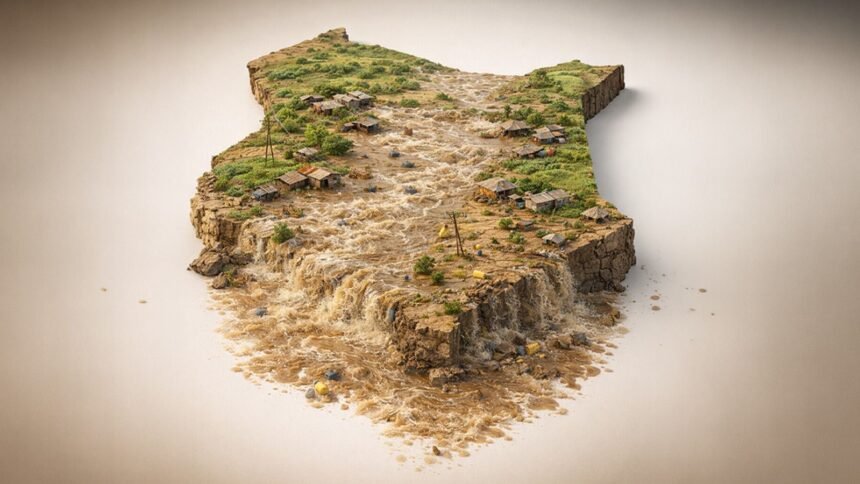
On the outskirts of Nairobi, where paved roads give way to muddy tracks, the water came in the night. Residents woke to the sound of metal sheets rattling and children shouting as brown floodwater pushed through doorways, swallowing mattresses, schoolbooks, and sacks of maize. By dawn, neighbors were wading chest‑deep, trying to salvage what they could.
Scenes like this have played out across Kenya for weeks, as unusually heavy seasonal rains turned rivers into torrents and low‑lying neighborhoods into lakes. Police say at least 108 people have been killed since the deluge began, swept away in flash floods or buried in landslides, while thousands of families have been forced from their homes.
Officials warn that even if the rains ease, saturated soils and clogged drainage systems mean the risk of further flooding remains high.
The disaster has become another entry in a grim tally of climate‑linked shocks battering East Africa: historic drought followed by destructive floods, all in a country that has spent years developing plans to adapt to a warming world.
For diplomats watching from New York and Geneva, Kenya’s ordeal is a stark illustration of a global adaptation gap that is no longer measured only in spreadsheets and summit declarations, but in lives lost and communities repeatedly rebuilt.
Structural Vulnerabilities and Stakes
Kenya is no stranger to erratic weather. What has changed, scientists say, is the intensity and frequency of extremes. A warmer atmosphere can hold more moisture, making heavy downpours more likely even as higher temperatures increase evaporation and prolong dry spells.
In recent years, the country has lurched from a multi‑year drought that withered crops and decimated livestock to floods that wash away topsoil and infrastructure in a matter of days.
At the same time, the stakes have grown. More than three‑quarters of Kenyans depend directly or indirectly on rain‑fed agriculture or climate‑sensitive sectors. Roads, bridges, and power lines built for past rainfall patterns struggle under new loads. When a bridge collapses or a road is cut, truck drivers cannot reach markets, health workers cannot reach clinics, and children cannot reach school.
The damage ripples through an economy already strained by debt and inflation.
In policy circles, Kenya is often cited as a leader on climate adaptation. The government adopted one of Africa’s earliest National Adaptation Plans, a 2015–2030 blueprint that identifies priority actions in sectors from water and agriculture to health and infrastructure.
It has integrated climate risk into national climate law and strategies, and submitted an adaptation communication under the Paris Agreement outlining how it intends to build resilience.
Yet the latest floods reveal a stark reality: having a plan is not the same as being protected. Analysts estimate that Kenya will need tens of billions of dollars in adaptation investments by 2030 to meet its own priorities, far more than current domestic and international financing flows.
County‑level climate funds designed to channel money to local projects are lauded as a model, but they remain undercapitalized.
Human Stories and Real-World Examples
Nowhere are these gaps more visible than in the country’s informal settlements and rapidly growing secondary towns. In low‑income neighborhoods along Nairobi’s rivers, residents often build homes on marginal land because safer plots are unaffordable.
Drainage is poor or nonexistent; when rivers swell, there is nowhere for the water to go except into people’s homes. Families who lost everything in floods a few years ago say they are now reliving the same nightmare, only worse.
In western counties around Lake Victoria, fishing communities have watched the shoreline creep into their villages. Repeated floods have contaminated wells, damaged schools, and forced temporary closures of health centers. During the recent deluge, local officials reported struggling to maintain even basic services, improvising evacuation shelters in churches and schools while waiting for emergency supplies to arrive.
Rural areas tell a similar story in a different language. In drought‑stricken counties in the north and east, herders who spent years rebuilding their herds after prolonged dry spells have seen animals drown or fall ill in the sudden rains. Dirt roads become impassable, cutting off markets and veterinary services.
For these communities, climate change is not debated in parts per million of carbon dioxide; it is measured in the number of cattle lost, the days children miss school, and the months it takes to repair washed‑out boreholes.
Each new disaster also takes a psychological toll. Aid workers describe a sense of exhaustion among people who have been moved from drought relief to flood relief and back again. “It’s like never being able to stand up straight before the next blow comes,” one Kenyan humanitarian worker said in a recent interview.
Policy, Debate, and What’s Next
Behind these human stories lies a series of policy and political debates that stretch far beyond Kenya’s borders. Kenyan officials argue that they have done their part by drafting plans, passing climate laws, and setting up institutions, but that without far greater support from wealthy nations, adaptation efforts will remain piecemeal.
They point to repeated promises at global climate conferences to double adaptation finance and provide scaled‑up, predictable support that has yet to materialize at the levels needed.
International donors and development banks highlight dozens of ongoing projects, including climate‑resilient roads, upgraded drainage systems in selected cities, early‑warning systems, and climate‑smart agriculture programs.
These initiatives, they say, show that money is flowing and that progress is possible. But critics note that the funding is often short‑term, spread thinly across many projects, and burdened with complex reporting requirements that strain local capacity.
There are disagreements, too, over what counts as adaptation. Governments and lenders may classify large dams or roads as climate‑resilient infrastructure. At the same time, community groups argue that the real test is whether local people can access safe housing, clean water, and reliable livelihoods when the next storm hits.
Kenyan civil society organizations have warned that without stronger participation by counties and communities in deciding priorities, adaptation risks will become a technocratic exercise divorced from lived experience.
For countries like Kenya, the next few years will be crucial. The government is updating its climate strategies and seeking greater access to global funds set up under United Nations climate talks and multilateral development banks.
It is also under pressure to balance investment in long‑term resilience with mounting debt obligations and pressing social needs.
The choices made in Nairobi and in international financial centers will determine whether future rainy seasons look different from this one.
If significant, sustained investments in early‑warning systems, drainage, riverbank restoration, and safer housing are made, the next round of heavy rains may still disrupt lives but claim fewer of them. If not, Kenya’s floods may become less an alarm and more a preview of a new normal in a warming world.
As the waters slowly recede, families will return to rebuild homes on the same vulnerable plots, often with little choice. Their decisions, and the limited options behind them, will say as much about the global politics of climate adaptation as any communiqués agreed in conference halls thousands of miles away.