





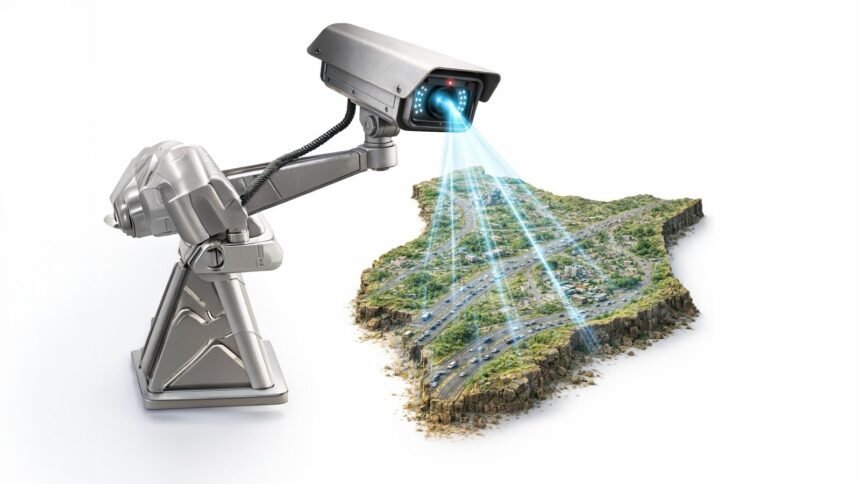
On a muggy evening in Lagos, commuters stream past a row of new CCTV poles, each crowned with clusters of cameras and a small white box humming quietly above the traffic. Few people look up. Attention stays locked on the gridlock below, not on the lenses now fixed on their faces and license plates.
These cameras are part of a sweeping surveillance buildout that researchers say has turned Nigeria into Africa’s biggest buyer of “smart city” monitoring technology, an AI‑enabled infrastructure that is reshaping public space in ways many citizens barely see, and even fewer are asked to approve.
Surveillance Boom: Background and Stakes
In March 2026, a study coordinated by the U.K.-based Institute of Development Studies (IDS) with the African Digital Rights Network mapped the spread of AI‑enabled surveillance systems in 11 African countries, drawing on government contracts, corporate records, and expert interviews.
The researchers estimate that these states have together spent more than 2 billion dollars on Chinese‑supplied ‘smart city’ products, including AI‑enabled CCTV networks and centralized control centers.
Nigeria stands out at the top of that list. According to the IDS‑linked research and coverage by outlets such as Semafor and Yahoo News, it has spent over 470 million dollars on AI‑enabled facial recognition and automatic license plate recognition systems, making it the largest buyer of smart city surveillance technologies among the 11 countries studied.
One summary of the findings notes that Nigeria’s investments include around 10,000 “smart” cameras connected to centralized control centers. However, the exact number of devices and the full value of contracts are hard to verify because many deals are not fully public.
Officials present these systems as a response to genuine security threats. Nigeria has struggled with Islamist insurgencies, armed banditry, kidnappings, and rising urban crime over the past decade.
Supporters argue that extensive camera networks and real‑time command centers can help deter attacks, support investigations, and manage traffic in cities whose populations are growing far faster than their police forces.
The IDS team and its partners do not deny those pressures. Still, they warn that AI‑driven monitoring is being rolled out “rapidly and opaquely,” often in environments where legal safeguards and oversight lag far behind the technology.
In a public summary of the research, IDS says AI‑enabled mass surveillance systems supplied and funded by China are already “violating citizens’ freedoms and the fundamental human right to privacy” in parts of Africa.
Human Stories and Real‑world Examples
On the streets, Nigeria’s surveillance turn appears in small, cumulative ways: another cluster of cameras at a busy junction, new hardware overlooking a bus stop, an expanded wall of screens inside a police control room. These installations rarely come with signage explaining who is watching, what is being recorded, or how long footage is stored.
Rights advocates say the gaze is not evenly distributed. Drawing on interviews across multiple countries, the IDS‑linked study reports that surveillance infrastructure tends to concentrate in areas already subject to heavy policing, informal settlements, districts associated with opposition politics or youth protests, and places security forces consider “sensitive.”
Once facial recognition and automatic tracking are layered onto those patterns, researchers argue, there is a risk that existing biases in policing are reinforced rather than challenged.
To illustrate the stakes, the report and follow‑up coverage look beyond Nigeria as well. In Uganda, activists have warned that “safe city” camera networks can be used to identify and monitor protest organizers.
In Kenya, civil society groups and human rights organizations have documented the rollout of new surveillance technologies in and around areas that later hosted Gen Z‑led demonstrations, fuelling fears that protesters could be identified and targeted after the fact.
In Algeria, one contributor to the IDS study says that smart city tools marketed for traffic management and crime prevention have, in practice, become tools of the security forces primarily, reinforcing protesters’ sense that the space for public assembly is shrinking.
For Nigerian lawyers, journalists, and activists tracking these developments, the concern is that similar technologies could be quietly repurposed at home, with limited transparency and few practical avenues for redress if abuses occur.
Policy, Debate, and Expert Views
Behind Nigeria’s surveillance surge is a distinctive political and commercial model. The IDS study and independent analyses describe how Chinese state‑linked firms market turnkey “safe city” packages that bundle AI‑enabled CCTV, data centers, and software platforms, often financed through soft loans from policy banks such as China Eximbank.
A typical deal, researchers note, might involve a loan of about 250 million dollars tied to the purchase of cameras from companies like Hikvision, with a command‑and‑control center built and serviced by Huawei or ZTE.
China already supplies much of Africa’s connectivity infrastructure: Huawei and ZTE have built an estimated 70 percent of the continent’s 4G networks, according to one analysis cited in coverage of the IDS work. That footprint makes it easier to layer smart surveillance systems onto existing telecoms, deepening both technical and political ties.
Critics question whether this approach is either effective or accountable. The researchers say there is limited public evidence that smart city systems have significantly reduced crime, even as they greatly expand governments’ ability to collect and analyze data on residents’ movements. The report warns that such tools are already being used to monitor human rights defenders, journalists, and political opponents, contributing to a “chilling effect” on civic life as people become more cautious about what they say and where they go.
Legal protections have not kept pace. While Nigeria and several of its peers have adopted data‑protection laws, enforcement bodies are often under‑resourced and lack the technical capacity to scrutinize complex AI deployments, the study notes. Contracts for surveillance systems are rarely fully disclosed, making it difficult for citizens or lawmakers to know where data is stored, who has access to it, and how long it is retained.
Bulelani Jili, a Georgetown University scholar of Chinese technology in Africa, cited in reporting on the study, has argued that surveillance and cybersecurity laws themselves can be double‑edged. In some countries, he notes, regulations introduced in the name of security have expanded states’ ability to monitor online activity and criminalize dissent.
The deeper challenge, he suggests, is negotiating a sustainable balance between security, accountability, and civil liberties once powerful tools are already embedded in state institutions.
Where We Go from Here
Nigeria’s choices now resonate well beyond its borders. As the largest spender on AI‑enabled surveillance among the 11 African countries studied, it is helping to define how “smart city” technologies are adopted and governed, or left largely ungoverned, across the continent.
The same research that raises alarms also points to possible guardrails. Digital rights groups are pushing for dedicated laws on smart surveillance that align with African Union data‑protection principles, and some courts in the region have begun to push back against abusive data practices. A few local governments are experimenting with transparency measures such as public registries of camera locations and clearer limits on data retention.
For now, though, in Lagos, Abuja, and other Nigerian cities, the most visible signs of this shift remain physical and understated. Another pole going up, another set of lenses pointed down at the street. The question facing Nigeria, and neighbors watching closely, is whether technologies introduced in the name of safety can be brought under democratic control before the feeling of being watched becomes an unquestioned feature of urban life.