





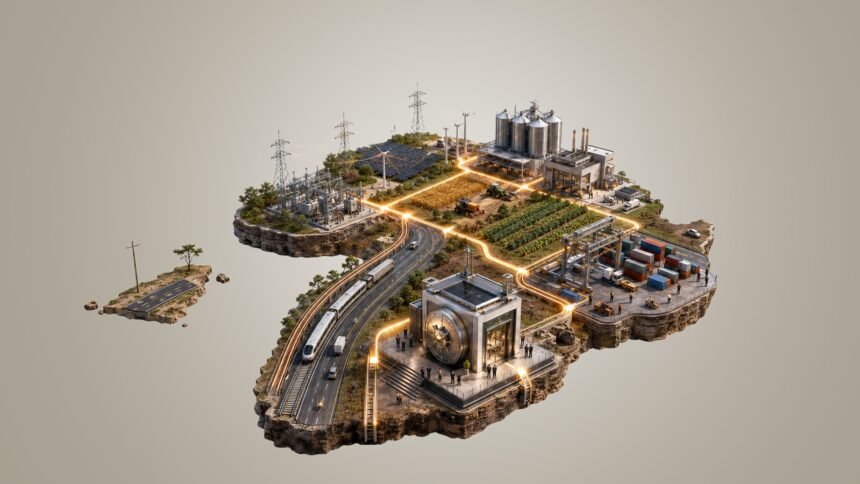
Africa is recording thousands of successful development projects every year. Yet, many of the continent’s biggest economic problems remain unresolved, according to the African Development Bank’s (AfDB) latest development review released during its Annual Meetings in Brazzaville on May 28.
In the 2026 Annual Development Effectiveness Review, the Bank warns that, despite strong project-level results across sectors such as energy, agriculture, and infrastructure, these gains have not yet translated into broad economic transformation across the continent.
In 2025, AfDB-supported projects helped connect more than 1.5 million people to electricity, supported nearly 7 million farmers with climate-resilient agricultural technologies, improved food security for 18.4 million people, and expanded access to financing for thousands of businesses.
Infrastructure investments also supported nearly 2,000 kilometers of roads, while trade finance operations facilitated more than $1.29 billion in trade. At the project level, many of the Bank’s operations either met or exceeded targets, according to the report.
Yet despite these achievements, broader continental indicators continue to paint a worrying picture. Food insecurity across Africa has worsened in recent years, with the share of people facing moderate or severe food insecurity rising from 54 percent in 2020 to 58 percent in 2023.
Agricultural productivity remains weak, with cereal yields stagnating at around 1.68 tonnes per hectare, far below the global average of approximately 4.2 tonnes.
Electricity access has improved modestly, rising from 56 percent to 60 percent between 2020 and 2023, while more than 565 million Africans still lack access to electricity. Making Africa accounts for 85 percent of the world’s unelectrified population.
Meanwhile, industrialization remains slow despite growth in manufacturing output, as many African economies continue to depend heavily on low-value production and commodity exports.
The report argues that these persistent gaps reflect a broader structural problem: isolated project successes that are not automatically translating into economy-wide transformation.
According to AfDB, several interconnected barriers continue to slow progress across the continent, including fragmented regional markets, weak transport and energy infrastructure, climate shocks, conflict, limited industrial value addition, high borrowing costs, and inadequate long-term financing.
These structural constraints often dilute the wider impact of otherwise successful projects.
According to the report, while irrigation schemes may increase production in one region, conflict, poor road networks, rising fertilizer prices, and weak storage systems will continue to disrupt broader food systems elsewhere.
Similarly, new electricity transmission projects may connect thousands of households, but underdeveloped regional grids and financing gaps still leave millions without reliable power.
The Bank says addressing these challenges will require a shift from isolated interventions toward larger, integrated, and more transformative investments capable of generating system-wide impact.
Increasingly, the institution is prioritizing regional infrastructure, continental electricity markets, agro-industrial processing zones, transport corridors, and financial reforms to unlock private-sector investment at scale.
The report also highlights growing concern over the changing global economic environment.
Africa is facing mounting debt vulnerabilities, declining development aid, geopolitical tensions, climate-related disasters, and rising protectionism, even as financing needs are increasing.
According to the AfDB, the continent now faces an estimated annual development financing gap of about $400 billion.
This pressure is pushing African institutions to rethink traditional development models and place greater emphasis on what the Bank describes as “financial sovereignty,” reducing dependence on external aid while strengthening domestic and regional economic systems.
Among the key recommendations emerging from the report are the need to scale up regional integration, strengthen private-sector participation, improve coordination between national and regional planning, invest more heavily in resilient infrastructure, and mobilize larger pools of long-term capital.
The Bank also stresses the importance of moving beyond measuring project outputs alone and placing greater focus on long-term development outcomes, including structural transformation, productivity growth, resilience, and job creation.
While development investments are improving lives across the continent, the AfDB cautions that Africa risks continuing to record successful projects without achieving the broad-based economic transformation needed to improve living standards significantly.
The report calls policymakers and development institutions alike to move from isolated development gains to genuine structural transformation before global economic pressures deepen even further.