





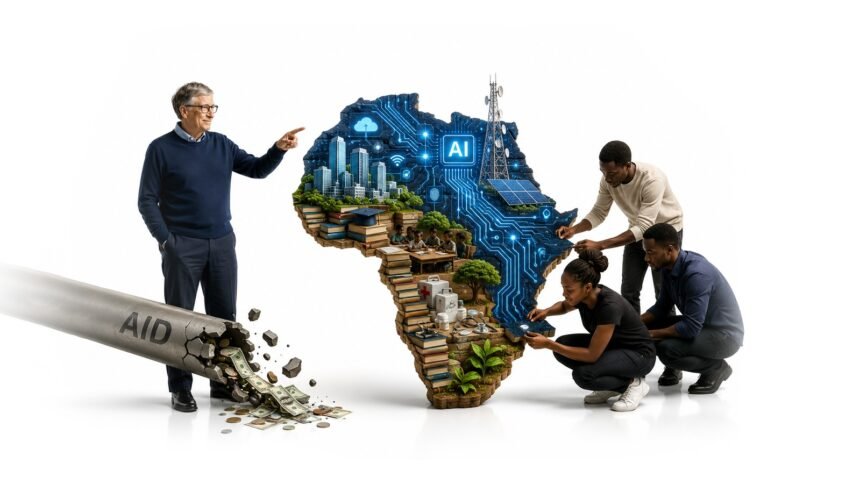
Microsoft co-founder and philanthropist Bill Gates has urged African governments to make urgent investments in healthcare, education, and digital technology, warning that the continent cannot rely on foreign aid to drive development.
Speaking in a recent interview with CNBC Africa, Gates said declining international assistance is creating a difficult moment for many African countries, which are now under increasing pressure to finance development priorities from domestic resources.
“There’s no doubt this is a difficult moment,” Gates said, referring to the reduction in development assistance budgets across the continent.
He argued that Africa’s long-term economic prospects will depend less on external funding and more on the strength of its own institutions, workforce, and innovation systems.
Gates described Africa’s young population as the continent’s greatest strategic advantage. By 2040, Africa is expected to have the world’s largest working-age population. This shift could either become a major economic engine or a missed opportunity, depending on how governments respond.
“Africa’s greatest asset is its young people,” he said. “If countries continue investing in health, education, and innovation, that demographic shift can become one of the greatest economic opportunities of this century.”
Economists have increasingly pointed to primary healthcare, quality education, and digital infrastructure as the foundations for turning population growth into higher productivity, employment, and household incomes.
Gates placed particular emphasis on digital public infrastructure (DPI) and artificial intelligence, describing them as critical tools for accelerating economic growth.
He said systems such as digital payment networks, identity platforms, and secure data infrastructure can make it easier for citizens to access government services, participate in the formal economy, and connect to financial systems.
“AI is the biggest technological advancement of our lifetime,” Gates said, adding that digital public infrastructure is becoming “essential for economic growth.”
Across Africa, governments are expanding investments in digital identity systems, interoperable payment platforms and AI-enabled public services as they seek to improve efficiency and widen access to finance and healthcare.
While the Gates Foundation and other philanthropic organizations continue to fund health, agriculture, and innovation programs across Africa, Gates stressed that external financing cannot substitute for effective national leadership.
He said sustained progress will require governments to make deliberate choices about how public resources are allocated and to strengthen domestic institutions capable of delivering services at scale.
Analysts say the warning comes at a time when several donor countries are reducing aid commitments, forcing African governments to rethink development models that have historically relied heavily on external support.
The shift, Gates suggested, should be seen not only as a challenge but also as an opportunity for African countries to build more self-reliant economies powered by skilled people, modern technology, and stronger local institutions.