




The Pan-African Paradigm of Historical Restitution and Collective Sovereignty
Across the African landscape, the contemporary implementation of post-colonial development stands at a highly critical intersection with the unresolved structural damage of the past. The Pan-African vision for complete economic self-determination and cultural re-engineering relies on a unified assertion of resource sovereignty and historical restitution. For generations, the continent’s socio-economic progression has been restricted by systemic wealth extraction, institutional fractures, and unequal global trade frameworks. Reclaiming Africa’s shared future requires moving past symbolic diplomacy toward a structured, cross-border framework for reparatory justice. By coordinating a unified global front with diaspora communities across the Caribbean and the Americas, African nations are transforming traditional human rights advocacy into a concrete mechanism for structural repair, financial sovereignty, and global institutional accountability.
Systemic Depopulation and the Roots of Underdevelopment
The historical footprint of commercial human trafficking across sub-Saharan Africa represents one of the most destructive factors in the structural underdevelopment of the continent. For centuries, targeted slave raiding networks systematically drained African societies of millions of young, productive individuals, causing massive demographic shocks and destroying local agricultural and manufacturing systems. This systematic depopulation disrupted internal state-building processes, fragmented long-standing ethnic governance structures, and replaced diverse local trade routes with a volatile economy based entirely on human extraction. The generational loss of human capital stalled internal technological development, trapping coastal and interior communities alike in a state of institutional instability that laid the groundwork for subsequent colonial subjugation.
Commercial Triangular Networks and Global Capital Accumulation
The transatlantic slave trade relied on a highly organized, commercial triangular network designed to maximize capital accumulation for Western European empires. Manufactured industrial commodities, weapons, and textiles were shipped from European ports to West African coastal gateways, where they were exchanged for enslaved African individuals. These victims were then transported across the Atlantic through the lethal Middle Passage to supply forced labor to vast plantation economies in the Americas and the Caribbean. The raw materials produced by this forced labor, including sugar, cotton, tobacco, and gold, were shipped back to Europe, providing the vast, non-reciprocal capital inflows that funded the Western Industrial Revolution and established contemporary global wealth inequalities.
Transforming International Jurisprudence
The global movement for reparatory justice achieved a major milestone following a decisive shift within international legal frameworks. Initiated by a proposal drafted by Ghana on behalf of African Union member states, the United Nations General Assembly voted to adopt a landmark resolution formally declaring the trafficking of enslaved Africans and the resulting centuries-old enslavement of people from the continent as a crime against humanity.
Classifying the transatlantic trade as one of the gravest crimes in human history provides a major boost for Africa’s long-term quest for global restitution. The UN resolution formally instructs member states to engage in inclusive, good-faith dialogues on reparatory justice, while demanding the prompt and unhindered restitution of stolen cultural properties, historical archives, and ancestral human remains to their true countries of origin.
The Structural Logic of Holistic Repair
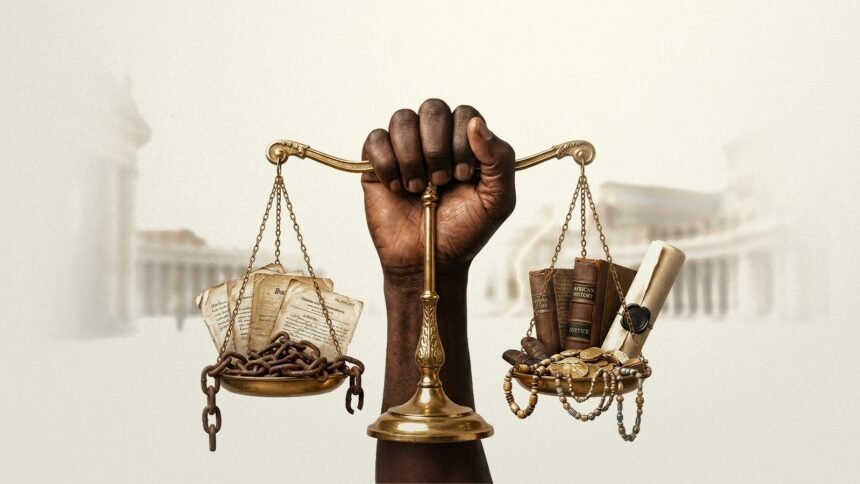
Within contemporary academic and legal discourse, reparations are defined as a comprehensive, multi-layered framework of restorative justice that extends far beyond direct financial compensation. The structural logic of reparatory justice establishes that because the historical crimes of enslavement and colonialism caused long-term systemic damage, the process of repair must be equally multi-dimensional.
Holistic repair requires both state and non-state institutions that benefited from historical exploitation to offer full, formal, and unconditional apologies to facilitate trust-building and reconciliation. Furthermore, the framework mandates fair and adequate compensation to address the contemporary legacies of apartheid, genocide, and structural racism, combined with systemic interventions such as debt relief and technology transfers to reverse the historical economic imbalances affecting people of African descent globally.
The Accra Roadmaps and Institutional Mobilization
The practical transition from recognizing historical wrongs to implementing reparatory justice was advanced during a high-profile, three-day international conference held in Accra, Ghana. Titled “Next Steps,” the landmark gathering attracted heads of state, government ministers, civil society representatives, historians, and legal experts representing over 80 nations. The final day of the summit resulted in the formal adoption of a comprehensive, 19-point global framework for reparatory justice and restitution.
To lead the implementation phase, Ghana’s President John Mahama announced the establishment of three specialized institutional pillars: an advisory panel on reparatory justice, an expert panel on cultural artifacts, and a dedicated legal panel. Supported by the African Lawyers Union to ensure broad-scale inclusion, the Accra summit concluded with a symbolic wreath-laying ceremony at Osu Castle. This 17th-century Danish fortress historically served as a primary slave-trading hub, coinciding with international Juneteenth celebrations to honor the victims of the transatlantic trade.
Executive Reluctance and the End-Point Standoff
The diplomatic push for global reparatory frameworks faces complex resistance and structural standoffs from major economies within the Global North. While several Western governments have begun to acknowledge the severe moral failures of the transatlantic trade, their executive leadership remains highly reluctant to accept formal legal liability or sign binding financial restitution agreements.
Illustrating this institutional tension, French President Emmanuel Macron addressed the Accra conference virtually from the Élysée Palace, acknowledging that enslaved Africans were torn from their homes, dehumanized, and treated as simple commercial goods. However, the French executive pushed back against standard compensation models, stating that reparations should not be viewed as an absolute endpoint or a simple cheque to bring the story to a close, highlighting an ongoing ideological divide over the financial and structural implementation of historical repair.
Building Multilateral Guarantees and Policy Frameworks
The long-term enforcement of the 19-point Accra framework requires translating international declarations into binding multilateral policy guarantees. The newly established expert and legal panels are structured to provide the necessary technical, intellectual, and policy support to strengthen state capacities during bilateral negotiations. Rather than replacing the localized initiatives of individual states, these centralized panels look to harmonize legal claims across regional blocs.
Enforcement mechanisms focus on integrating reparatory demands directly into international trade negotiations, demanding structural debt relief from global financial institutions to offset historical exploitation, and using international courts to mandate the unconditional return of stolen cultural heritage and national archives currently held by Western museums and non-state institutions.
Comprehensive Audits and Gender-Responsive Revisions
The technical methodology used to calculate global reparatory obligations relies on rigorous, data-driven econometric audits that evaluate both historical capital extraction and contemporary socio-economic deficits. Legal and economic experts use the Caribbean Community’s (Caricom) established 10-point reparations plan as a primary structural framework to measure systemic damage.
These calculations factor in centuries of unpaid labor, the systemic destruction of local industries, and the long-term public health disparities caused by slavery and colonial governance. Crucially, during the Accra proceedings, Prime Minister Mia Mottley of Barbados announced a major gender-responsive revision of the Caricom calculating model, explicitly integrating the disproportionate, multi-generational impact of enslavement and physical exploitation on girls and women, thereby ensuring that the global demand for financial and structural repair reflects the full complexity of historical trauma.
The Advisory Executive Coalition for Transcontinental Ambition
The latest development in the global campaign for reparatory justice is the formation of a powerful executive alliance within the newly launched Advisory Panel on Reparatory Justice. This elite leadership body brings together heads of state with deep historical ties to the transatlantic trade across Africa and the Caribbean, including President John Mahama of Ghana, Prime Minister Mia Mottley of Barbados, President Joseph Boakai Sr of Liberia, President Netumbo Nandi-Ndaitwah of Namibia, and President Bassirou Diomaye Faye of Senegal.
Liberia’s President Boakai Sr emphasized that the UN resolution has opened an unprecedented diplomatic door, noting that the collective commitment of this transcontinental coalition will determine whether the framework leads to meaningful systemic reconciliation or remains another forgotten summit. By presenting a unified, international executive front, this coalition is working to ensure that the historical exploitation of the continent is met with a coordinated, sustained global effort to restore human dignity and build a future founded on absolute structural equality.