




For centuries, military power was measured by the number of soldiers and weapons, and by the ability to produce ammunition at scale. But that equation is changing.
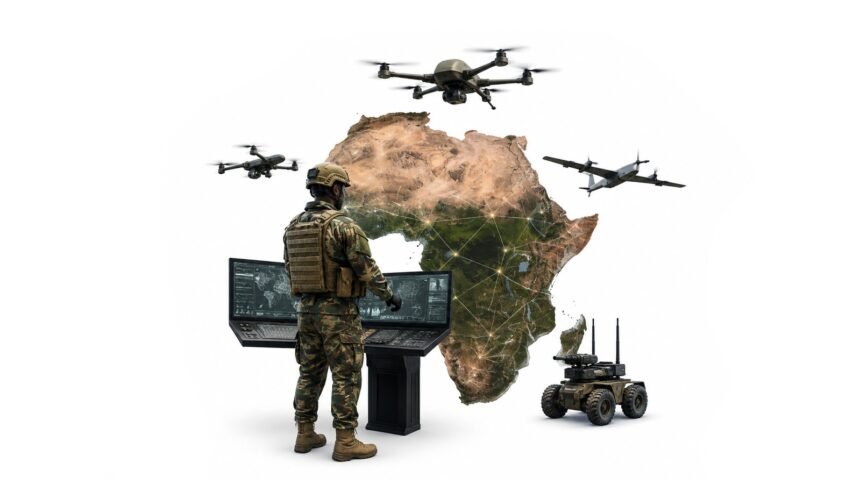
Machines can now perceive their surroundings, process information, make decisions and act with diminishing human intervention, transforming the way military operations are conducted.
For Africa, the question is no longer whether autonomous systems will arrive—they are already being used on the continent and in conflicts around the world.
The bigger question is whether African countries will help shape this technological revolution or remain consumers of systems developed elsewhere.
The issue was at the center of discussions during the High-Level Discussion at the International Security Conference on Africa (ISCA) in Kigali on August 12.
What Exactly Is An Autonomous System?
According to Col Patrick Nyirishema, Head of Defense Research and Development at the Rwanda Defense Force (RDF), autonomy exists on a spectrum, ranging from systems that follow pre-programmed instructions to those capable of perceiving their surroundings, making decisions and acting with limited human intervention.
He stressed that AI, automation and autonomy are not the same thing. A remotely controlled drone, for example, may use sophisticated AI but remain under the direct control of a human operator.
At the highest level of autonomy, a system can independently assess its environment, consider possible actions, make decisions and act on them.
The technology therefore involves more than simply putting AI into a drone. It combines sensors, computing, navigation, communications and decision-making capabilities that are expanding what military systems can do.
How Autonomous Systems Are Changing Militaries
Nyirishema said the emergence of autonomous systems could fundamentally change how militaries recruit, train and organize themselves.
“The number of personnel becomes less and less important. However, the kind of people that you have, although less in number, now matters much more because you need people who are going to be conducting operations jointly with autonomous systems. You need people who will operate these systems. You need people who are going to build these systems,” he said.
He said military institutions must also adapt to rapidly evolving technology that requires new ways of thinking.
“The starting point is to build talent. Because this is a new field, for us to be able to bring this technology into our own context, we need to build it to be responsive to a specific environment.”
Nyirishema said talent should not be developed exclusively within defense and security institutions because many of the technologies involved also have civilian applications.
He cited the Russia-Ukraine war as a “laboratory” for military innovation and a glimpse into the future of warfare.
He pointed to the increasing use of relatively low-cost systems against much more expensive military assets as one of the lessons emerging from the conflict.
However, Nyirishema noted that the same technological shift is creating new challenges for African countries, as non-state actors are increasingly able to access technologies once associated primarily with national militaries.
Africa’s Security Dilemma
Mali’s Minister of Foreign Affairs and International Cooperation, Abdoulaye Diop, said the issue should be viewed not only through a technological or military lens but also through the lens of sovereignty, politics, and geopolitics.
Mali covers more than 1.2 million square kilometers and shares borders with seven countries. Diop said the country’s size makes it difficult to rely solely on human personnel to secure its territory.
“This is why in recent years Mali has invested heavily in autonomous systems, in technology to ensure security, especially drone technology.”
“Today we have dozens, almost hundreds of these tools that are managed by the defense and security forces, but which are also managed by Malians,” he added.
However, the minister said the spread of autonomous systems among terrorist groups could extend beyond Mali, creating wider security challenges for neighboring and other African countries.
At the same time, he said the changing global technology landscape presents an opportunity for African countries to diversify their partnerships and build their own capabilities rather than remain dependent on foreign suppliers.
“So we cannot enter the automated systems just through the window. It also requires investments, it requires training, it also requires a long-term commitment.”
He said the ultimate objective should not simply be to acquire autonomous systems, but to build African technological autonomy.